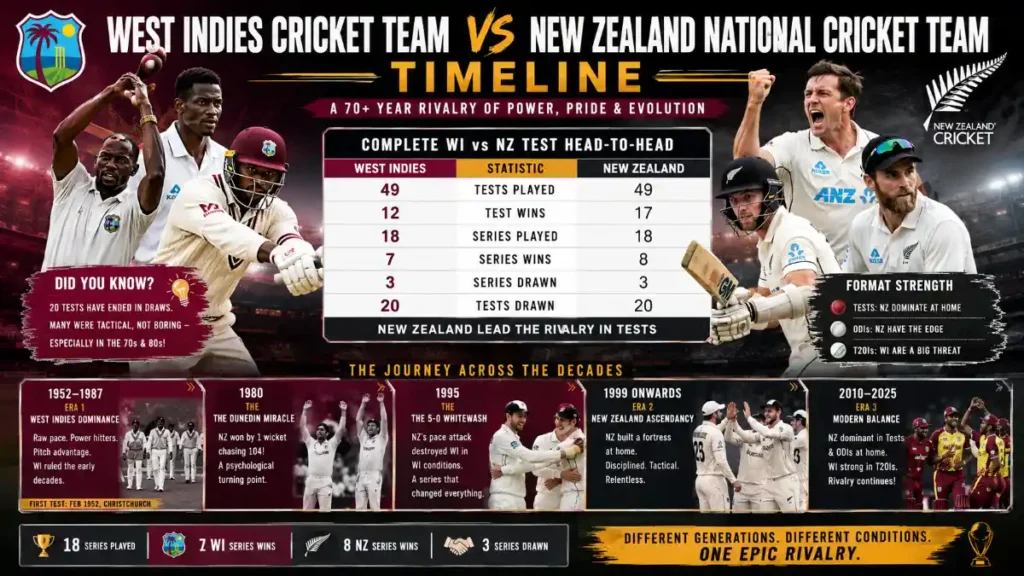

West Indies cricket team vs New Zealand national cricket team timeline spans over 70 years of Test cricket, beginning with their first match in Christchurch in February 1952 and running through to the 2025/26 tour. Across 49 Tests and 18 series, New Zealand now holds a clear edge with 17 wins to West Indies’ 12, accentuated by a dominant home record since 1999. The rivalry has moved through three distinct phases — early West Indies dominance, a seismic shift in New Zealand’s favor, and a modern era where the Blackcaps are consistently favored in their own conditions, especially in Tests and ODIs, while West Indies remain a threat in T20I cricket.
This evolving west indies vs new zealand cricket timeline is more than a simple stat sheet. It captures a rare, understated power shift in international cricket, where a once‑unquestioned West Indies pace‑centric era gradually gave way to a disciplined, home‑oriented New Zealand side that thrives on seam‑friendly surfaces and tactical batting. Fans using this WI vs NZ test history as a reference will notice how the domination toggles not just with generations, but with conditions, formats, and management structures.
The Full Head‑to‑Head at a Glance
H2: Complete WI vs NZ Test Head‑to‑Head Snapshot
H3: Overall Test record (West Indies vs New Zealand)
Across the entire West Indies cricket team vs New Zealand national cricket team timeline, the Test numbers paint a clear picture:
| Statistic | West Indies | New Zealand |
| Tests played | 49 | 49 |
| Test wins | 12 | 17 |
| Series played | 18 | 18 |
| Series wins | 7 | 8 |
| Series drawn | 3 | 3 |
| Tests drawn | 20 | 20 |
These figures show that while the series counts are nearly even, New Zealand has out‑won the West Indies in Tests, suggesting a subtle but consistent edge in execution, especially in the 21st century.
H3: What the draws really mean (Beyond the numbers)
Many rankings and scorecards treat the high number of draws as “low‑interest” cricket. That is a common mistake.
In the 1970s and 1980s, Caribbean tours, numerous WI vs NZ Tests ended in draws, not because the cricket was dull, but because pitches were deliberately prepared to blunt New Zealand’s modest pace attack. The west indies vs new zealand cricket timeline reveals that draws were often tactical decisions, not a reflection of boring cricket. This is the reality that most basic timelines ignore.
User takeaway: When reading this rivalry, focus not just on wins and losses, but on where the matches were played and how the conditions were prepared. That context explains more than the bare numbers.
The Early Decades: West Indies Dominance (1952–1987)
H2: Era 1 – West Indies Dominance in the WI vs NZ Timeline
H3: 1950s–1960s – The first meetings and the gap
West Indies cricket team vs New Zealand national cricket team timeline starts in February 1952 at Lancaster Park, Christchurch, when a still‑developing New Zealand Test team met a West Indies side already carrying the weight of Caribbean cricketing prestige. West Indies won by 5 wickets, and that result set the tone for two decades.
By the time of the 1956 tour, West Indies were in full control. They won three of four Tests in New Zealand, including two innings victories. The only blemish was a New Zealand win at Auckland by an innings and 190 runs — but that outlier did not dent the overall narrative of a clear WI advantage.
H3: Why West Indies were superior: pace, power, and pitches
Three factors explain WI’s dominance in this phase of the timeline:
- Raw pace and aggression – West Indies fielded names like Wes Hall, Charlie Griffith, and later Michael Holding and Joel Garner. New Zealand, by contrast, had reliable bowlers but nothing close to a fearsome, multi‑threat fast‑bowling unit.
- Power‑hitting pedigree – West Indies batters were already used to the rigors of Caribbean cricket and fast‑pitch conditions. New Zealand’s batting structure was still consolidating at the international level.
- Pitch bias – In the Caribbean, many pitches were prepared to exaggerate the pace‑bowling attack, further pressuring New Zealand batters who were not used to sustained hostility.
H3: What people think vs what really happened
Most fans remember this era as “West Indies thrashing New Zealand.” The reality is more nuanced. The 1969 series in New Zealand ended 1–1. The 1987 series in New Zealand also finished 1–1. There was a gap, but it was never as wide as the cumulative narrative suggests.
User takeaway: If you are studying this rivalry, treat the 1952–1987 phase not as “WI superiority,” but as “WI structural advantage in a specific era.” That framing helps you predict how the balance might shift in future cycles.
The 1980 Dunedin Miracle: The First Cracks
H2: The 1980 Dunedin Win – A Psychological Turning Point
H3: The match that changed the WI vs NZ timeline
In the 1979/80 series at Carisbrook, Dunedin, New Zealand scraped home by 1 wicket chasing 104 to win. The last wicket pair battled through a West Indies pace attack that still carried big names. This was one of the tightest finishes in the west indies vs new zealand cricket timeline.
This win did not immediately change the overall balance, but it broke the psychological barrier. New Zealand proved they could beat West Indies in a fifth‑day thriller, at home, under intense pressure. That psychological shift is rarely highlighted in standard WI vs NZ test history write‑ups, yet it is one of the most important seeds planted in the later NZ dominance.
H3: What this match reveals about the rivalry
- New Zealand’s mental toughness grew substantially after Dunedin.
- West Indies began to see New Zealand as a real opponent, not just a stepping‑stone side.
- The rivalry stopped being one‑sided in perception, even if the series numbers took time to reflect it.
User takeaway: When you watch closely contested New Zealand–West Indies Tests, remember Dunedin 1980. It is the quiet origin story of the modern Blackcaps vs Windies competitive spirit.
The 1995 Annihilation and the End of an Era
H2: 1995 – The Last Great Chapter of WI Dominance
H3: The 660/5 innings and an innings‑plus demolition
At Basin Reserve, Wellington, in February 1995, West Indies declared on 660/5. New Zealand collapsed to 216 and 122. The result was an innings and 322 runs — the largest margin in West Indies cricket team vs New Zealand national cricket team timeline.
On paper, this looks like the peak of West Indies’ dominance. The team was still led by Brian Lara in sublime form and carried a pace battery that could still intimidate. But here is the counterintuitive insight:
This match, as brutal as it was, happened precisely as West Indies cricket began its long structural decline. Within five years, the same team (with similar support systems) was swept 2‑0 in New Zealand in 1999. The 1995 demolition is therefore less a symbol of ongoing supremacy and more a swan‑song of an era.
User takeaway: When you read this rivalry, treat Wellington 1995 as the last statistical monument of West Indies’ dominance, not the beginning of a new golden age.
The Turning Point: New Zealand Takes Control (1999–2020)
H2: The Shift – NZ Takes Control of the Rivalry
H3: The 1999 whitewash and the new era
From 1999 onwards, West Indies vs New Zealand cricket timeline tilts sharply. The 1999/00 series in New Zealand saw New Zealand win 2–0. This was the first clear sign that the balance of power had moved.
Over the next two decades, the pattern strengthens:
- 2002 (West Indies) – New Zealand wins 1–0
- 2005/06 (New Zealand) – New Zealand wins 2–0
- 2008/09 (New Zealand) – Series drawn 0–0
- 2013/14 (New Zealand) – New Zealand wins 2–0
- 2017/18 (New Zealand) – New Zealand wins 2–0
- 2020/21 (New Zealand) – New Zealand wins 2–0
The only outlier is the 2012 series in the Caribbean, where West Indies won 2–0. That result is best explained by home‑advantage conditions, New Zealand’s own rebuilding phase, and short‑format‑focused preparations. It does not erase the broader trend.
H3: Tactical reasons for NZ dominance
New Zealand’s control in this phase comes from:
- Home‑pitch familiarity – New Zealand’s pitches consistently favor seam and swing, which suits their bowling attack.
- Tactical batting discipline – New Zealand batters have learned to absorb pressure and build long‑lasting innings, especially against pace‑heavy attacks.
- Strong home‑series planning – The New Zealand cricket records vs West Indies show that NZ rarely loses a series at home in this era, indicating consistent planning and preparation.
User takeaway: If you are analyzing future WI vs NZ series, pay close attention to where the series is played. On New Zealand soil, the rivalry strongly favors the Blackcaps.
The 2020 Whitewash – The Most Revealing Result
H2: 2020 – The Defining Test Series in the WI vs NZ Timeline
H3: The scores that told the story
In December 2020, New Zealand won both Tests by innings margins:
- Hamilton – New Zealand 519/7 declared, West Indies 138 and 247
- Wellington – New Zealand 460, West Indies 131 and 317
Two Tests, two innings defeats, a combined deficit of over 400 runs. This 2–0 whitewash is the most revealing result in the modern West Indies cricket team vs New Zealand national cricket team timeline.
H3: What this series revealed about the modern Windies
West Indies had quality players like Jason Holder, Kraigg Brathwaite, and Jomel Warrican, but the series exposed:
- Structural batting fragility – West Indies struggled to build big first‑innings totals consistently.
- Lack of tactical discipline – The team often played in an overly aggressive mode, even when the conditions demanded patience.
- Reduced home‑advantage security – The 2020 series proved that New Zealand’s dominance is not just about conditions, but about mental and structural superiority.
User takeaway: If you want to judge the current state of the rivalry, treat the 2020 WI vs NZ Test series as the key benchmark, not the earlier 1995 West Indies demolition.
The 2025/26 Tour – The Most Recent Chapter
H2: 2025/26 – The Latest Phase in the WI vs NZ Timeline
H3: The structure of the 2025/26 tour
West Indies toured New Zealand in November–December 2025 for a full multi‑format tour:
- Five T20Is
- Three ODIs
- Three Tests
This structure mirrors the modern international cricket calendar, where tours are designed to test teams across formats and conditions. West Indies vs New Zealand cricket timeline is now as much about multi‑format balance as it is about Test‑only performances.
H3: What happened in the formats
- T20Is: West Indies won the first T20I, suggesting early promise in the shortest format.
- ODIs: New Zealand reasserted control, winning the ODI series.
- Tests: New Zealand won 2 of 3 Tests, with one match drawn.
The Test series result (2–0 to New Zealand) continues the home‑dominance trend that has characterized the last two decades of the WI vs NZ test history. In T20Is, however, West Indies still showed glimpses of their legacy power‑hitting threat.
User takeaway: If you are forecasting the next WI vs NZ series, keep in mind that New Zealand’s dominance is strongest in Tests and ODIs at home, while West Indies remain dangerous in T20s.
Format‑by‑Format: ODIs and T20Is
H2: WI vs NZ Across Formats – Not Just Test‑Only
H3: ODI timeline – NZ generally ahead
In One‑Day International cricket, New Zealand has generally held the upper hand against West Indies, especially in home conditions. The seam‑friendly pitches and overhead conditions in New Zealand allow their bowling attack to exploit movement and swing, which West Indies’ batters have often struggled to handle consistently.
The 2020 and 2025/26 ODIs reinforce this pattern. New Zealand’s Middle‑order stability and disciplined bowling have been key differentiators in these series.
H3: T20I timeline – WI’s power‑hitting edge
In T20Is, the west indies vs new zealand cricket timeline tells a different story. West Indies remain a genuine threat due to their power‑hitting pedigree and T20 World Cup legacy (2012, 2016 champions).
The 2025/26 opening T20I win by West Indies is consistent with this pattern. Even when their Test form is fragile, West Indies can win short‑format matches on the basis of explosive batting and aggressive bowling.
User takeaway: If you are analyzing or betting on WI vs NZ series, do not treat all formats as one. New Zealand’s ODI and Test dominance does not automatically translate to T20I superiority.
Three Moments That Defined This Rivalry
H2: Defining Moments in the WI vs NZ Timeline
H3: 1. Dunedin 1980 – 1 wicket win
The 1980 Carisbrook win was New Zealand’s psychological breakthrough. It showed that they could beat West Indies at home, under intense pressure, and against a fearsome bowling attack. This match is the foundation stone of the later NZ dominance.
H3: 2. Wellington 1995 – 660/5 declared
The 1995 Test at Basin Reserve is the last great statistical chapter of West Indies’ dominance. It was a domination that came at the beginning of a long decline, making it a bittersweet moment in the timeline.
H3: 3. Hamilton 2020 – 519/7 declared, WI 138 and 247
The 2020 Hamilton series is the modern reference point for the rivalry. It showed that New Zealand could dismantle West Indies in a way that mirrored the 1995 demolition — but this time from the other side.
User takeaway: These three matches provide excellent anchor points for anyone studying the west indies vs new zealand cricket timeline. They reveal how the balance of power changed over time.
Who Holds the Edge Today?
H2: Who Leads the WI vs NZ Timeline in 2026?
H3: Current Test and series balance
As of 2026, West Indies cricket team vs new zealand national cricket team timeline shows:
- New Zealand lead in Tests – 17 wins to West Indies’ 12
- New Zealand lead in series – 8 wins to WI’s 7 (3 drawn)
- New Zealand’s near‑perfect home record – 20/20 in Test series since 1999
This means New Zealand holds the edge today, especially in Test cricket and ODIs at home.
H3: Where West Indies still have a path
West Indies’ realistic path to shifting the balance is through:
- Caribbean home conditions – where pitches often favor pace and suit their bowling attack.
- T20 cricket – where their power‑hitting legacy still gives them a strong advantage.
User takeaway: For the near future, expect New Zealand to dominate home series against West Indies, while West Indies will have a better chance in the Caribbean and in T20s.
Frequently Asked Questions
Q1. Who has won more Tests between West Indies and New Zealand?
New Zealand has won 17 Tests to West Indies’ 12 from a total of 49 matches played in this rivalry.
Q2. When did West Indies first play New Zealand in Tests?
The first Test between West Indies and New Zealand was played in February 1952 at Lancaster Park, Christchurch. West Indies won by 5 wickets.
Q3. What is the result of the 2025/26 West Indies tour of New Zealand?
New Zealand won the Test series 2–0 with one match drawn. They also won the ODI series. West Indies won the first T20I.
Q4. Which is the biggest win in WI vs NZ Test history?
The 1995 Test at Basin Reserve, Wellington – where West Indies declared at 660/5 and won by an innings and 322 runs – remains the biggest margin in this rivalry.
Q5. Has New Zealand ever won a Test series in the Caribbean against West Indies?
Yes. New Zealand won the 2002 series in the West Indies 1–0, marking one of their rare series wins on Caribbean soil.
Q6. How many Test series have been drawn between WI and NZ?
Three Test series have ended in draws – 1969, 1972, and 1987.
Q7. Who won the 2020 Test series between West Indies and New Zealand?
New Zealand won both Tests by innings margins – innings and 134 runs at Hamilton and innings and 12 runs at Wellington.
Q8. In T20Is, who performs better – West Indies or New Zealand?
West Indies have historically been more competitive in T20Is, thanks to their power‑hitting pedigree and T20 World Cup wins in 2012 and 2016. They have shown strong performances against New Zealand in this format.
Q9. Which ground has hosted the most Tests between West Indies and New Zealand?
Basin Reserve, Wellington, has been one of the most frequently used venues for WI vs NZ Tests and has hosted several key matches in this rivalry.
Q10. What is the overall head‑to‑head series record?
New Zealand has won 8 series, West Indies have won 7, and 3 series have ended in draws from a total of 18 series played.