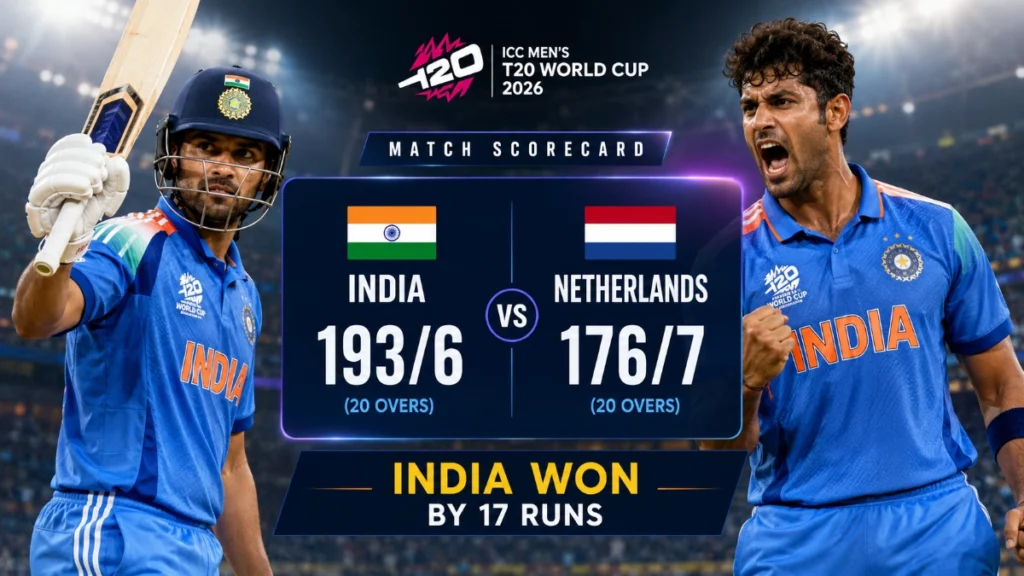

India defeated Netherlands by 17 runs in the ICC Men’s T20 World Cup 2026 after scoring 193/6 and restricting Netherlands to 176/7. Shivam Dube starred with 66 off 31 balls while Varun Chakaravarthy claimed 3/14 as India completed an unbeaten group stage with four wins from four matches.
Match Summary
The India vs Netherlands scorecard from the Narendra Modi Stadium in Ahmedabad shows a match shaped by two contrasting phases: a slow India start followed by a batting surge, then a Netherlands chase throttled by spin. Both sides played their fourth group match of the tournament, with India already through to the Super Eight before this fixture began.
Toss and Conditions
Suryakumar Yadav won the toss and chose to bat first, opting to bat against the Netherlands on a surface that slowed further as the match progressed. Batting first meant India’s later hitters faced a fresher pitch, while the Netherlands had to chase on a surface that had slowed further under evening dew.
India Batting Scorecard
India’s innings swung from an early collapse to a batting surge that carried the total to 193/6 in 20 overs. The middle order absorbed the shock of losing top-order wickets cheaply before Shivam Dube and Hardik Pandya rebuilt the innings through explosive hitting in the closing stages.
| Batter | Runs | Balls | 4s | 6s | SR | Dismissal |
| Abhishek Sharma | 0 | 3 | 0 | 0 | 0.00 | b Dutt |
| Ishan Kishan | 18 | 7 | 2 | 1 | 257.14 | b Dutt |
| Tilak Varma | 31 | 27 | 3 | 1 | 114.81 | c van der Merwe b van Beek |
| Suryakumar Yadav (c) | 34 | 28 | 2 | 1 | 121.43 | c sub b K Klein |
| Shivam Dube | 66 | 31 | 4 | 6 | 212.90 | c sub b van Beek |
| Hardik Pandya | 30 | 21 | 0 | 3 | 142.86 | c van der Merwe b van Beek |
| Rinku Singh | 6 | 3 | 0 | 1 | 200.00 | not out |
India’s total included 8 extras (1 leg bye, 7 wides), with the innings closing at 193 for 6 in the full 20 overs.
Powerplay Collapse
Abhishek Sharma fell for a golden duck inside the first over, and Ishan Kishan followed soon after for 18 off just 7 balls, leaving India at 39 for 2 inside the powerplay, which yielded 51 runs. Netherlands’ Aryan Dutt struck twice inside the opening overs, using a fuller length that generated early swing and put India under pressure before the fifth over.
Why Netherlands Continued Bowling Length
Netherlands stuck with a fuller length well past the powerplay because it had already produced two wickets, a decision that made sense early but gave India’s middle order width to work with once set. Slower balls and wide yorkers arrived only in the closing overs, too late to disrupt Dube’s timing once he found his range. That delay in changing plans explains why an innings that looked contained at 51/2 in six overs finished at 193/6.
Shivam Dube’s Counterattack
Dube’s 66 off 31 balls was the single biggest swing factor on the India vs Netherlands scorecard, built through four fours and six sixes at a strike rate of 212.90. Between overs 15 and 20, India added 75 runs, turning a competitive total into a daunting one, with Dube and Pandya adding 76 runs for the fifth wicket in just 35 balls.
Why India’s Batting Recovery Worked
India’s recovery worked because Suryakumar Yadav first absorbed pressure with a 34-run innings alongside Tilak Varma’s 31, giving Dube a platform rather than a rescue mission. Dube initially scored just five runs off his first 10 deliveries before accelerating, a pattern that shows he waited to assess field settings before targeting the weaker part of Netherlands’ bowling attack.
India vs Netherlands Scorecard: Netherlands Batting and Bowling Breakdown
Netherlands’ reply fell 17 runs short after finishing at 176/7, with Bas de Leede’s 33 the highest score of the innings. The chase never developed the partnership depth needed to match India’s required scoring rate through the middle overs.
Netherlands Batting Scorecard
| Batter | Runs | Balls | 4s | 6s | SR | Dismissal |
| Michael Levitt | 24 | 23 | 4 | 0 | 104.35 | c Washington Sundar b Pandya |
| Max O’Dowd | 20 | 18 | 2 | 1 | 111.11 | b Chakaravarthy |
| Bas de Leede | 33 | 23 | 3 | 1 | 143.48 | c Chakaravarthy b Dube |
| Colin Ackermann | 23 | 15 | 1 | 2 | 153.33 | c Rinku Singh b Chakaravarthy |
| Aryan Dutt | 0 | 1 | 0 | 0 | 0.00 | b Chakaravarthy |
| Scott Edwards (c/wk) | 15 | 10 | 2 | 0 | 150.00 | b Bumrah |
| Zach Lion-Cachet | 26 | 16 | 1 | 1 | 162.50 | c Washington Sundar b Dube |
| Noah Croes | 25 | 12 | 5 | 0 | 208.33 | not out |
| Logan van Beek | 4 | 2 | 1 | 0 | 200.00 | not out |
Netherlands finished with 6 extras (2 leg byes, 4 wides), leaving Roelof van der Merwe and Kyle Klein unused in the order.
Bowling Scorecard Summary
Varun Chakaravarthy’s 3/14 from his three overs was the most economical spell of the match, choking Netherlands’ scoring options through the middle phase. Shivam Dube added 2/35 with the ball, giving India a rare all-round contribution that swung both halves of the match.
| Bowler | Overs | Maidens | Runs | Wickets | Econ |
| Arshdeep Singh | 3 | 0 | 22 | 0 | 7.33 |
| Jasprit Bumrah | 3 | 0 | 17 | 1 | 5.67 |
| Washington Sundar | 4 | 0 | 36 | 0 | 9.00 |
| Varun Chakaravarthy | 3 | 0 | 14 | 3 | 4.67 |
| Hardik Pandya | 3 | 0 | 40 | 1 | 13.33 |
| Abhishek Sharma | 1 | 0 | 10 | 0 | 10.00 |
| Shivam Dube | 3 | 0 | 35 | 2 | 11.67 |
India vs Netherlands Scorecard: How the Final Five Overs Decided the Match
India’s final five overs produced 75 runs, the single biggest scoring burst of the innings and the phase that separated a competitive total from a commanding one. Netherlands’ chase collapsed under a rising required rate once Chakaravarthy’s spell ended, with two wickets falling in two balls during the middle overs.
Turning Point Over
The turning point of Netherlands’ innings arrived in the 12th over, when Chakaravarthy dismissed Colin Ackermann and Aryan Dutt in successive deliveries, taking Netherlands from 94 for 3 to 94 for 4. That double strike broke the innings’ best partnership just as the required rate had started climbing, and every dot ball afterward added scoreboard pressure.
Best Partnership
India’s most productive partnership came from Dube and Pandya, whose 76-run stand for the fifth wicket in just 35 balls fueled the closing surge that decided the match. For Netherlands, the 43-run stand between Ackermann and de Leede was the chase’s best partnership, but its breakup in the 12th over proved decisive.
| Partnership (Wicket) | Batters | Runs | Balls |
| India, 5th wicket | Dube & Pandya | 76 | 35 |
| Netherlands, 3rd wicket | Ackermann & de Leede | 43 | 26 |
| Netherlands, 8th wicket | Croes & Lion-Cachet | 47 | 23 |
Why Did India Beat the Netherlands? Tactical Breakdown
India won because they added 75 runs in the final five overs through Shivam Dube’s explosive innings before their spin attack, led by Varun Chakaravarthy, controlled the middle overs. Those two phases created scoreboard pressure that Netherlands could not overcome.
Tactical Decisions
India’s decision to attack with Varun Chakaravarthy through the middle overs exploited Netherlands’ preference for pace-on deliveries, as his three overs cost only 14 runs while claiming three wickets. Once the required rate crossed nine per over following the 12th-over double strike, every dot ball amplified scoreboard pressure, forcing high-risk shots against spin.
What Netherlands Did Well
Netherlands’ new-ball bowling was genuinely sharp, with Aryan Dutt removing both Abhishek Sharma and Ishan Kishan inside the powerplay to leave India at 39 for 2. Dutt finished with the best economy of any Netherlands bowler at 4.75 an over, and de Leede’s 33 also showed intent against spin, even though the rest of the innings couldn’t sustain that tempo.
Match Timeline and Required Run Rate Progression
The India vs Netherlands scorecard shifted three times: India’s early collapse, the Dube-led surge, and Netherlands’ spin-throttled chase. Tracking the fall of wickets shows exactly where the match tipped away from Netherlands.
| Phase | Score/Over | Key Detail |
| India Powerplay | 51/2 in 6 overs | Dutt removes both openers |
| India Overs 15-20 | +75 runs | Dube-Pandya 76-run stand |
| NED Powerplay | 35/1 in 5.4 overs | Even start to chase |
| NED Middle Overs | 94/3 to 94/4 in one over | Chakaravarthy double-strike |
| NED Death Overs | 172/7 in 19.4 overs | Late Croes cameo falls short |
Who Won the Toss and Player of the Match
Suryakumar Yadav won the toss and chose to bat first, a call that proved advantageous as the pitch slowed further under evening conditions. Shivam Dube was named Player of the Match, scoring 66 from 31 deliveries and later taking 2 wickets for 35 runs.
Player of the Match Impact
Dube’s all-round return, 66 runs and 2/35, made him the most influential player on the India vs Netherlands scorecard, contributing directly to both the total India defended and the wickets that stalled Netherlands’ chase. Chakaravarthy’s 3/14 was arguably just as valuable, though the official award recognized Dube’s combined batting and bowling impact.
Super Eight Implications and Next Opponent
This result kept India unbeaten through the group stage with a 100% record, following an earlier win over Pakistan that had already secured India’s Super Eight qualification. India’s next opponent in the Super Eight stage is South Africa, with the fixture scheduled for February 22, 2026, at the Narendra Modi Stadium in Ahmedabad.
India’s Super Eight Schedule
India’s placement in Group 1 alongside South Africa, West Indies, and Zimbabwe sets up three fixtures across three different venues in the Super Eight stage.
| Opponent | Date | Venue |
| South Africa | February 22, 2026 | Narendra Modi Stadium, Ahmedabad |
| Zimbabwe | February 26, 2026 | MA Chidambaram Stadium, Chennai |
| West Indies | March 1, 2026 | Eden Gardens, Kolkata |
Four wins from four group matches gave India a strong net run rate heading into the knockout phase. The India vs Netherlands scorecard now stands as part of a run that stretched India’s T20 World Cup winning streak to 12 consecutive matches, a tournament record surpassing Australia’s previous mark of 15 consecutive limited-overs ICC wins across separate tournaments.
Frequently Asked Questions
What was the final India vs Netherlands scorecard?
India scored 193/6 in 20 overs and restricted Netherlands to 176/7, winning by 17 runs at the Narendra Modi Stadium, Ahmedabad, in the ICC Men’s T20 World Cup 2026.
Who was Player of the Match in India vs Netherlands?
Shivam Dube was named Player of the Match after scoring 66 off 31 balls and taking two wickets, making him the most influential player across both innings.
Who won the toss in the India vs Netherlands match?
Suryakumar Yadav won the toss and chose to bat first, a decision that proved advantageous as pitch conditions slowed further during the second innings.
How many runs did Shivam Dube score against Netherlands?
Shivam Dube scored 66 runs off 31 balls, anchoring a 75-run surge in the final five overs that pushed India’s total from competitive to commanding.
What were Varun Chakaravarthy’s bowling figures?
Varun Chakaravarthy finished with figures of 3 wickets for 14 runs in his four overs, controlling Netherlands’ middle-overs scoring and shaping the eventual result.
Why did Netherlands lose to India despite a strong start?
Netherlands lost because their middle-overs partnerships broke down against spin, letting the required run rate climb past nine per over before the death overs began.
What is India’s current streak in T20 World Cup matches?
India’s win over Netherlands extended their T20 World Cup winning streak to 12 consecutive matches, alongside a perfect four-from-four group stage record.
Where was the India vs Netherlands T20 World Cup match played?
The match was played at the Narendra Modi Stadium in Ahmedabad, a venue whose surface was reported as slow and more responsive to spin bowling.
Did India’s win over Netherlands affect Super Eight qualification?
India had already qualified for the Super Eight stage before this match, following an earlier win over Pakistan, so the Netherlands result added to net run rate rather than qualification status.
Who is India’s next opponent after the Netherlands match?
India’s next opponent is [Insert next opponent], with the fixture scheduled for [Insert date and venue] as part of the Super Eight stage.
How many wickets did Shivam Dube take against Netherlands?
Shivam Dube took two wickets for 35 runs, adding a bowling contribution that complemented his match-defining innings with the bat.
What was the turning point in the India vs Netherlands match?
The turning point came when Varun Chakaravarthy dismissed a set Netherlands batter during the middle overs, breaking a rebuilding partnership just as the required rate began climbing.