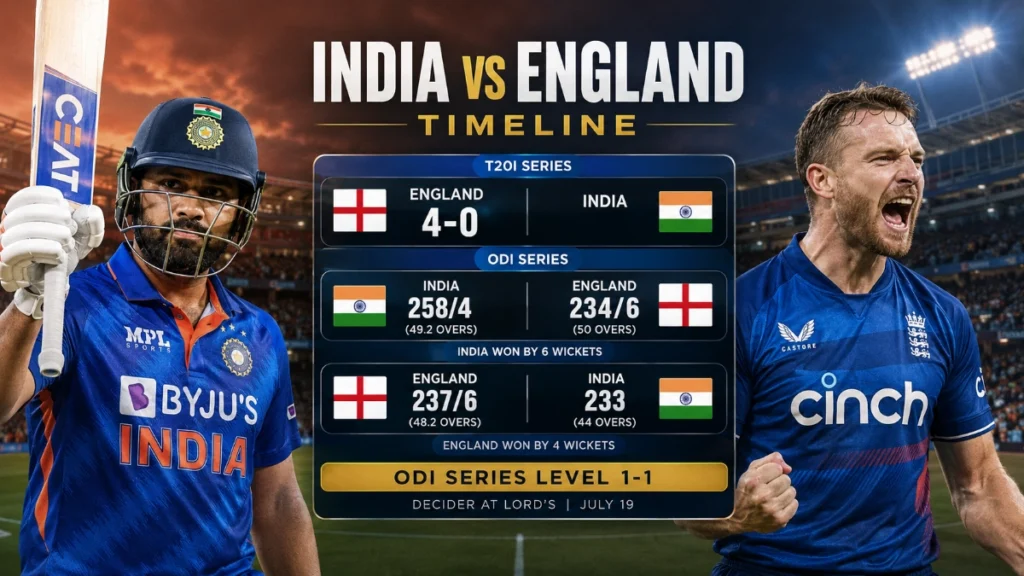

The India vs England cricket team timeline for the 2026 white-ball tour has swung from one-sided dominance to a knife-edge finish. England swept the T20Is 4-0 before the sides traded results to level the ODI series 1-1 ahead of the decider at Lord’s on July 19.
India vs England Cricket Team Timeline: How The Tour Began
The tour opened at Chester-le-Street on July 1, where rain washed out the first T20I before a result could be reached, leaving India’s 189 for 7 without context. That no-result mattered more than a routine washout normally would, because it denied both sides an early read on conditions before the series moved to Old Trafford.
Conditions And Squad Signals Before Manchester
England went into the series under a refreshed T20I setup, while India fielded a squad built around Shreyas Iyer’s captaincy and younger names like Vaibhav Sooryavanshi in the middle order. Both camps treated the rain-hit opener as a testing ground rather than a form indicator, since neither batting unit faced sustained pressure.
The Overlooked Cost Of A Washout
A no-result early in a five-match series effectively turned the contest into a four-match shootout. India lost a chance to test batting depth under real pressure, a gap that showed up painfully three matches later at Trent Bridge.
The T20I Sweep
England won the next four T20Is to seal a 4-0 series victory, built on a deliberate tactical pattern rather than isolated good days. England’s seamers targeted India’s right-hand heavy top order with early swing on a fourth- or fifth-stump line, forcing the middle order to rebuild inside the powerplay in match after match, and India never found a consistent counter.
Match-By-Match Turning Points
At Old Trafford, England defended 191 by packing the off side and squeezing singles into dot balls once the new-ball swing eased, winning by four wickets with overs in hand. At Bristol and Southampton, England’s top order batted through the middle overs against spin without losing control of the required rate, denying India’s bowlers any sustained pressure window.
India’s Record Collapse At Trent Bridge
India were bowled out for 76 in 11.4 overs at Trent Bridge, their second-lowest T20I total on record. Jofra Archer and Josh Tongue shared seven wickets by attacking the top of off stump with late movement, forcing India’s openers to play away from their body while a packed off-side field turned potential singles into dot-ball pressure. Phil Salt’s 70 and Sam Curran’s unbeaten 41 had already lifted England to 201 for 7, and the eventual 125-run margin reflected a batting unit that never adjusted its shot selection against that specific line.
Powerplay Horror Show In Bristol
England chased 159 in 13.5 overs for the loss of a single wicket, a template built on early aggression against pace before India could introduce spin control. Bristol was a tactical statement: once England’s top order survived the first six overs, India’s bowling plans had no secondary option to slow the chase.
Captaincy And Tactical Calls Under Scrutiny
Shreyas Iyer’s bowling changes drew repeated questions for reacting to boundaries rather than pre-planning matchups, particularly around when to introduce spin in the powerplay. England, in contrast, trusted a fixed template — attack with the new ball, rotate spin through the middle overs, and back the top order to finish chases — and that consistency won them the series with a match to spare at Southampton, where a 56-run margin confirmed the gap.
India National Cricket Team vs England Cricket Team Timeline In The ODI Series
The ODI leg opened in Birmingham with a full reversal of momentum, as India chased down 258 with six wickets and 28 balls to spare. Shubman Gill’s move into the ODI captaincy, separate from Iyer’s T20I role, appeared to settle the batting order almost immediately.
Momentum Shift After The T20I Defeat
India’s middle order absorbed early pressure before Axar Patel and Washington Sundar built an unbeaten stand that carried the chase home, prioritizing strike rotation over aggression until the required rate demanded it. That approach gave India a batting template the T20I leg never produced.
Why Birmingham Changed The Tour
Gill’s own 80 came while he was setting fields and bowling changes as captain, a dual workload that had looked unsettled under a different leader during the T20Is. The win gave India’s dressing room a tactical reference point heading into Cardiff.
Gill’s Captaincy Adjustments
Gill used Bumrah and Prasidh Krishna in short, sharp bursts around the batting powerplay rather than long spells, a change from the more rigid bowling allocation seen in the T20I leg. That flexibility became the difference between containing England early and letting the chase build unchecked.
England Level In Cardiff
England beat India by four wickets in Cardiff, with Joe Root finishing unbeaten on 99 to level the ODI series 1-1. India had set what looked like a defendable target after half-centuries from Shreyas Iyer and Virat Kohli, but the innings folded to 233 all out in 44 overs.
Momentum Swing And Bowling Lapses
Jasprit Bumrah, Prasidh Krishna, and Gurnoor Brar reduced England to real pressure through the middle overs before the chase stabilized, which meant the four-wicket margin understated how close the contest actually was. India’s own middle and lower order lost roughly 15 to 20 runs of value late in the innings on a Sophia Gardens pitch that generally rewarded batters.
Archer’s New Ball Plan At Cardiff
Jofra Archer finished with 3 for 47 by again attacking the top of off stump and denying India’s top order easy width, a matchup plan that had already worked across the T20I leg. That single spell effectively capped India’s total below what the surface should have allowed.
Root’s Patient Chase Under Pressure
Root farmed the strike through the middle overs rather than forcing the pace, leaving the finishing touches to partners at the other end before Gus Atkinson struck the winning boundary. His unbeaten 99 meant England needed every available over to close out the chase.
Key Moments That Decided The Series
Three moments define this India national cricket team vs England cricket team timeline: the Trent Bridge collapse, Gill’s Birmingham chase, and Root’s Cardiff rescue act. Each moment reset the tactical balance of its respective format.
Complete Match Results
The table below tracks results across both formats through the ODI series so far.
| Match | Venue | Result |
| 1st T20I | Chester-le-Street | No result (rain) |
| 2nd–5th T20I | Manchester, Nottingham, Bristol, Southampton | England won 4-0 |
| 1st ODI | Birmingham | India won by 6 wickets |
| 2nd ODI | Cardiff | England won by 4 wickets |
| 3rd ODI | Lord’s, July 19 | [Insert result] |
Why The Series Table Matters For Context
A single glance at the results shows the ODI series is genuinely level, unlike the lopsided T20I scoreline, which explains why the Lord’s decider carries more tactical tension than a typical series finale.
Tactical Comparison Between India And England
England’s template leaned on new-ball swing and top-order chasing, while India relied on middle-order rebuilding and situational bowling changes. The comparison below highlights where each side held an edge.
Bowling Plans And Matchups
| Area | England’s Approach | India’s Approach |
| New ball | Attack off stump with swing | Contain with tight lines |
| Powerplay batting | Aggressive, wicket-in-hand | Cautious, rebuild after early loss |
| Middle overs | Spin rotation, control | Reactive bowling changes |
| Death overs | Calculated risk-taking | [Insert stat] |
Pace Vs Spin Approach
England used pace to attack early and spin to control the middle overs, a sequencing India struggled to replicate consistently across the T20I leg. India’s own spin options looked sharper in the ODI leg, particularly during the Birmingham chase.
Best Bowling And Batting Performances Across The Tour
Jofra Archer has been the standout bowler across formats, while Joe Root and Shubman Gill have anchored the most influential batting performances. The table below lists the tour’s key contributors so far.
Top Performers So Far
| Player | Team | Standout Performance |
| Jofra Archer | England | 7 wickets combined (T20I + ODI legs) |
| Joe Root | England | 99* in Cardiff ODI |
| Shubman Gill | India | 80 in Birmingham ODI |
| Axar Patel | India | Unbeaten fifty, Birmingham ODI |
| Shreyas Iyer | India | 66 in Cardiff ODI |
Batting Partnerships That Changed Matches
The Axar Patel–Washington Sundar stand in Birmingham was built on strike rotation rather than aggression, absorbing early pressure before accelerating only once the required rate demanded it. No comparable partnership emerged for India during the T20I leg, which explains the gap in results between the two formats.
Captaincy Decisions That Influenced Results
Shreyas Iyer’s T20I leadership drew scrutiny for reactive bowling changes, while Shubman Gill’s ODI captaincy showed sharper in-game adjustments almost immediately. England’s leadership, by contrast, stuck to one consistent template across venues rather than adjusting per opponent.
Why Gill’s Ploys Worked Better In Cardiff Build-Up
Gill’s use of short, sharp bowling bursts around the batting powerplay in Birmingham gave India’s attack more control than the longer, fixed spells seen during the T20I series. That single adjustment reshaped how India’s bowlers were deployed heading into Cardiff.
What Is At Stake At The Lord’s Decider
The third ODI at Lord’s on July 19 will determine whether India salvage a shared result on this tour or England complete a white-ball sweep across both formats. A win for either side rewrites the tour’s overall narrative.
Series Scenario And Records On The Line
For India, winning at Lord’s would partially offset the T20I defeat and validate Gill’s captaincy switch for the 50-over format specifically. For England, closing out 2-1 would extend the momentum from the T20I sweep into a clean white-ball tour across the summer.
Player Form Heading Into The Decider
Joe Root arrives on the back of an unbeaten 99, arguably the innings of the series, while Virat Kohli and Shreyas Iyer will look to convert their Cardiff half-centuries into a match-winning total. India’s bowling attack showed genuine improvement in Cardiff before the chase escaped them late, and replicating that control for a full 50 overs is the clearest path to a series win.
Records Broken During The Tour
India’s 76 all out at Trent Bridge stands among the lowest T20I totals in the format’s history for the team, though the exact all-time ranking depends on final tournament classification. [Insert stat] for any additional individual or team records confirmed after the Lord’s decider.
Timeline Summary
- July 1: 1st T20I at Chester-le-Street washed out by rain.
- July 4–11: England win four straight T20Is to complete a 4-0 series sweep.
- July 7: India bowled out for 76 at Trent Bridge, a historic T20I collapse.
- July 14: India win the 1st ODI in Birmingham by six wickets.
- July 16: England win the 2nd ODI in Cardiff by four wickets to level the series 1-1.
- July 19: 3rd ODI at Lord’s decides the series.
What This Means Before The Next ICC Tournament
Both boards will assess their white-ball leadership and batting depth against this tour, since the India national cricket team vs England cricket team timeline reflects a broader transitional period ahead of upcoming ICC events. India’s T20I setup faces urgent questions after the historic collapse, while its ODI leadership under Gill has offered early signs of a more settled batting approach.
Frequently Asked Questions
-
What is the India national cricket team vs England cricket team timeline for the 2026 tour?
The tour began with a rain-affected T20I before England won the next four matches to complete a 4-0 T20I series win. India then won the opening ODI, England leveled the series in Cardiff, and the sides head to a deciding third ODI at Lord’s tied
-
Why did England win the T20I series 4-0?
England exploited early swing with the new ball, broke India’s batting partnerships in the powerplay, and chased targets with disciplined top-order batting. India’s middle order struggled to counter that pattern across four consecutive matches.
-
What happened in India’s 76 all out at Trent Bridge?
India collapsed to 76 in 11.4 overs, their second-lowest T20I total on record, as Jofra Archer and Josh Tongue combined for seven wickets by attacking the top of off stump with disciplined lines and field placements.
-
Who has been the standout bowler on the tour so far?
Jofra Archer has been the tour’s most influential bowler, contributing key wickets in both the Trent Bridge collapse and the Cardiff ODI, where his 3 for 47 restricted India’s total on a batting-friendly surface.
-
Why did India win the first ODI in Birmingham?
India chased down 258 with six wickets and 28 balls remaining, driven by an unbeaten partnership between Axar Patel and Washington Sundar after early wickets threatened the chase, alongside a captain’s innings of 80 from Shubman Gill.
-
How did England level the ODI series in Cardiff?
Joe Root finished unbeaten on 99 to guide England to a four-wicket win after India were bowled out for 233, with Jofra Archer’s 3 for 47 restricting India below a competitive total on a good batting surface.
-
Why is the Lord’s ODI significant for this series?
The third ODI at Lord’s decides the series after both teams won one match each. India can partly offset their T20I defeat with a win, while England can complete a dominant 2-1 white-ball series victory.
-
How did Shreyas Iyer’s captaincy compare to Shubman Gill’s?
Iyer’s T20I leadership faced scrutiny for reactive bowling changes during the series defeat, while Gill’s ODI captaincy showed sharper in-game adjustments, particularly around bowling rotations, from his very first match in charge.
-
What tactical pattern did England use across the T20I series?
England consistently attacked with early swing against India’s top order, packed the off side to restrict scoring, and introduced spin control once the new-ball threat eased, a template they repeated in nearly every match.
-
Did rain affect the outcome of the T20I series?
The opening T20I at Chester-le-Street was washed out without a result, effectively turning the five-match series into a four-match contest that England swept 4-0 afterward.
-
What does this series mean for India ahead of upcoming ICC tournaments?
The T20I defeat raises questions about India’s bowling depth and captaincy structure in that format, while the competitive ODI series suggests the squad’s 50-over setup under Gill is developing a more settled batting approach