
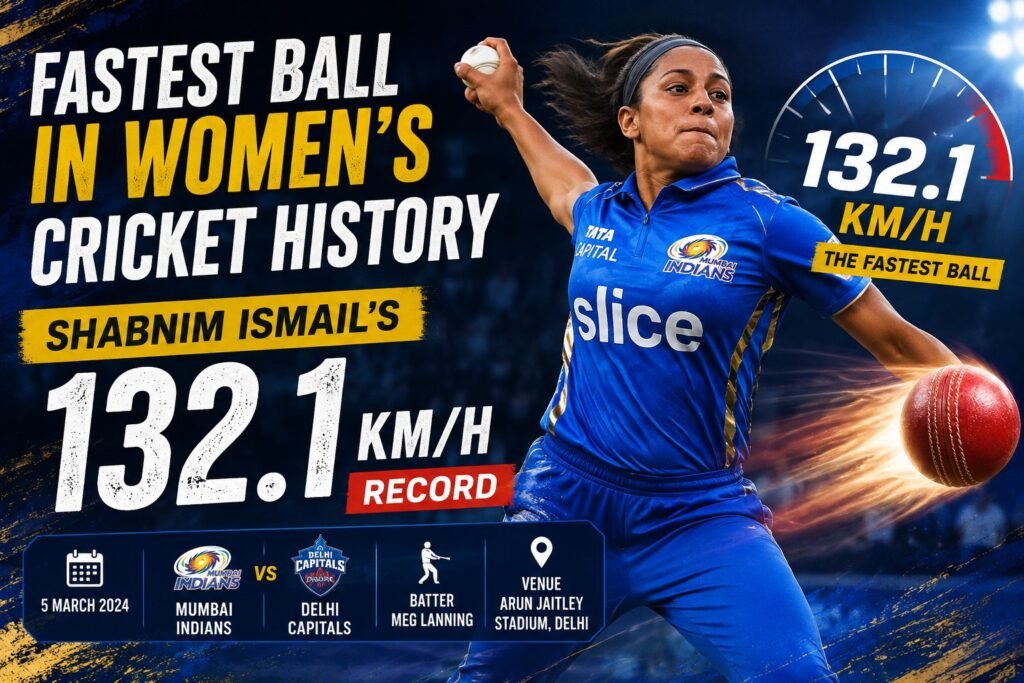

Fast bowling has become one of the most exciting parts of women’s cricket, but one delivery stands above the rest. Former South African fast bowler Shabnim Ismail holds the record for the fastest recorded ball in women’s cricket history, clocking 132.1 km/h (82.08 mph) during the Women’s Premier League in 2024.
The delivery did more than set a new speed record. It made Ismail the first woman recorded bowling faster than 130 km/h, establishing a landmark for women’s fast bowling.
What Is the Fastest Ball in Women’s Cricket History?
The fastest recorded ball in women’s cricket history is 132.1 km/h (82.08 mph), bowled by South Africa’s Shabnim Ismail.
She delivered the record-breaking ball while representing Mumbai Indians against Delhi Capitals in the 2024 Women’s Premier League at Arun Jaitley Stadium in Delhi. The ball was delivered to former Australian captain Meg Lanning and struck her pad.
| Record | Details |
| Fastest bowler | Shabnim Ismail |
| Speed | 132.1 km/h |
| Speed in mph | 82.08 mph |
| Team | Mumbai Indians |
| Opponent | Delhi Capitals |
| Batter | Meg Lanning |
| Tournament | Women’s Premier League |
| Date | 5 March 2024 |
| Venue | Arun Jaitley Stadium, Delhi |
Shabnim Ismail’s Record-Breaking 132.1 km/h Delivery
The historic moment came on 5 March 2024 during a WPL match between Mumbai Indians and Delhi Capitals.
Ismail was bowling the third over of the Delhi Capitals’ innings. On the second delivery of the over, the speed gun registered 132.1 km/h as her delivery crashed into Meg Lanning’s pad.
The significance was immediate. According to the ICC, it was the first recorded delivery in women’s cricket to exceed the 130 km/h barrier.
Interestingly, Ismail did not make much of the achievement afterward. The ICC reported that when asked about the record after the match, she explained that she did not normally look at the big screen while bowling.
The record therefore looked less like an isolated attempt to chase a number and more like the natural result of a career built around genuine pace.
Who Is Shabnim Ismail?
Shabnim Ismail is a former South African international fast bowler and one of the most accomplished pacers in women’s cricket.
Her international career lasted 16 years. She represented South Africa in 127 ODIs, 113 T20Is,s and one Test before announcing her international retirement in 2023. She finished with 317 international wickets.
Pace was central to her reputation throughout her career. She combined speed with aggression and an ability to attack batters with the new ball.
Even after retiring from international cricket, Ismail continued playing franchise cricket—and it was during that phase of her career that she produced the fastest recorded delivery in the women’s game.
How Fast Has Shabnim Ismail Bowled?
The 132.1 km/h delivery was not an isolated example of Ismail’s pace.
ICC records note several major speed milestones during her career:
| Year | Recorded Speed | Context |
| 2016 | 128 km/h | Against West Indies |
| 2022 | 127 km/h | Women’s Cricket World Cup |
| 2022 | 127 km/h | Women’s Cricket World Cup |
| 2024 | 132.1 km/h | Mumbai Indians vs Delhi Capitals |
Read More: Fastest Ball in Women’s Cricket History
The progression is important.
Years before breaking 130 km/h, Ismail was already operating around the upper end of recorded pace in women’s cricket. The ICC specifically noted her previous 128 km/h delivery against the West Indies and two 127 km/h deliveries at the 2022 Women’s Cricket World Cup when reporting her new record.
Who Bowled the First 130 km/h Ball in Women’s Cricket?
Shabnim Ismail was the first woman recorded to bowl a delivery faster than 130 km/h.
Her 132.1 km/h delivery in the 2024 WPL broke that significant speed barrier.
This matters because 130 km/h has long represented a major benchmark for elite pace in women’s cricket.
Ismail didn’t just cross it narrowly. She reached 132.1 km/h, pushing the recorded ceiling of women’s fast bowling into new territory.
Fastest Ball in Women’s International Cricket
There is an important distinction between the fastest recorded ball in women’s cricket overall and Ismail’s international achievements.
Her 132.1 km/h record came in the Women’s Premier League, not an international match.
Before that, Ismail had been recorded at 128 km/h against the West Indies in 2016. She also reached 127 km/h twice at the 2022 ICC Women’s Cricket World Cup.
Therefore, articles discussing this record should not incorrectly describe the 132.1 km/h delivery as an international cricket record. It is the fastest recorded delivery in women’s cricket overall, achieved in franchise cricket.
Why Shabnim Ismail Was So Fast
Raw speed in cricket is not simply about physical strength. Fast bowlers generate pace through a combination of their run-up, momentum, bowling action, body mechanics, and release.
Ismail became particularly known for an aggressive approach to fast bowling. Her relatively compact frame did not prevent her from generating serious pace.
Three characteristics stood out throughout her career: an energetic approach to the crease, an aggressive bowling mentality, and the ability to sustain high intensity across spells.
Her effectiveness was not limited to the speed gun either. During the 2022 Women’s Cricket World Cup, she collected 14 wickets at an average of 17.50, demonstrating that her pace translated into meaningful results at the highest level.
Why 132.1 km/h Is Such an Important Record
Records matter most when they change perceptions.
The significance of Ismail’s delivery was not simply that it was faster than the previous recorded mark. It demonstrated that the 130 km/h barrier could be broken in elite women’s cricket.
That creates a new reference point for the next generation of fast bowlers.
As women’s cricket becomes increasingly professional, players have greater access to specialist pace coaching, strength and conditioning, sports science, workload monitoring, and high-level franchise competition.
Ismail’s 132.1 km/h delivery now gives emerging pacers a measurable benchmark to chase.
Who Are Some of the Fastest Bowlers in Women’s Cricket?
Ismail is the record holder, but women’s cricket has produced several bowlers renowned for genuine pace, including Cathryn Fitzpatrick, Lea Tahuhu, Tayla Vlaeminck, Darcie Brown,n and Issy Wong.
However, historical rankings of the “10 fastest female bowlers ever” need to be treated carefully.
Reliable ball-by-ball speed data has not been available consistently throughout the history of women’s cricket. Comparing a modern player whose every delivery can be measured with a bowler from an earlier era can therefore create misleading rankings.
For that reason, the fastest recorded delivery is more precise than claiming an unquestionable all-time ranking based on incomplete historical measurements.
Can a woman bowl at 140 km/h?
No woman has yet been officially recorded bowling 140 km/h in top-level cricket, based on the established record discussed here.
However, Ismail’s 132.1 km/h delivery shows how far women’s pace bowling has progressed.
Whether 140 km/h will eventually be reached cannot be predicted with certainty. Improvements in athletic development, biomechanics, coaching, and the expanding professional structure of women’s cricket could continue pushing bowling speeds upward.
For now, 132.1 km/h remains the benchmark to beat.
Fastest Women’s Ball vs Fastest Men’s Ball
The fastest widely recognized recorded delivery in men’s international cricket is associated with Pakistan’s Shoaib Akhtar, who reached 161.3 km/h (100.23 mph) against England during the 2003 Cricket World Cup.
That is considerably faster than Ismail’s 132.1 km/h record, but comparing the two should mainly provide historical context rather than determine sporting quality.
Men’s and women’s cricket have different physical profiles, and bowling effectiveness involves far more than maximum speed. Accuracy, movement, variation, control, and tactical execution can be equally important.
What connects the two records is their significance: both Akhtar and Ismail pushed the recorded pace ceiling of their respective games.
How Women’s Fast Bowling Is Getting Quicker
Women’s cricket has changed significantly over the past decade.
Professional domestic competitions and franchise leagues provide players with more opportunities to train and compete at a high level. Fast bowlers increasingly have access to specialist coaches, strength programs, physiotherapists, nutrition support, and performance analysis.
Competitions such as the WPL have also created environments where the world’s leading players regularly compete against one another.
The result is not automatically faster bowling, but the conditions for developing elite pace are stronger than they were in previous generations.
Ismail’s record may therefore represent both an individual achievement and a sign of the broader evolution of women’s cricket.
Why Speed Alone Doesn’t Make a Great Fast Bowler
A 130 km/h delivery looks spectacular on a speed gun, but successful fast bowling requires much more.
Elite pacers need to combine pace with:
- Line and length
- Swing or seam movement
- Variations
- Accuracy
- Match awareness
- Control under pressure
Ismail’s career illustrates this distinction well. Her reputation was built not simply on bowling quickly but on taking wickets consistently against international-quality batters.
Her 317 international wickets provide a much better picture of her career than speed alone.
Shabnim Ismail’s Legacy in Women’s Cricket
Ismail retired from international cricket as one of South Africa’s most important players.
She competed across a 16-year international career and represented South Africa at multiple major ICC tournaments. Her combination of pace, aggression and wicket-taking ability made her one of the defining fast bowlers of her generation.
Then, after international retirement, she added another extraordinary achievement to her career.
132.1 km/h.
It is a simple number, but one that changed the recorded history of women’s fast bowling.
Until another bowler surpasses it, Shabnim Ismail remains the woman who set the pace benchmark.
Final Thoughts
The fastest recorded ball in women’s cricket history is 132.1 km/h (82.08 mph), bowled by Shabnim Ismail for Mumbai Indians against Delhi Capitals in the 2024 Women’s Premier League.
But the importance of the delivery goes beyond a number on a speed gun.
Ismail became the first woman recorded to break the 130 km/h barrier, establishing a new benchmark for fast bowling. Her record is also the culmination of a career in which pace was consistently backed by performance: 317 international wickets across 16 years for South Africa.
As women’s cricket continues to professionalize, the next question is no longer whether 130 km/h is possible.
It is who will be the first to go faster.
Frequently Asked Questions
Who bowled the fastest ball in women’s cricket history?
Shabnim Ismail bowled the fastest recorded delivery in women’s cricket at 132.1 km/h (82.08 mph) during the 2024 Women’s Premier League.
When did Shabnim Ismail bowl at 132.1 km/h?
She achieved the record on 5 March 2024 while playing for the Mumbai Indians against the Delhi Capitals at Arun Jaitley Stadium.
Who faced the fastest ball in women’s cricket?
Former Australian captain Meg Lanning faced the record-breaking 132.1 km/h delivery. It struck her pad on the second ball of the third over.
Has any female bowler crossed 130 km/h?
Yes. Shabnim Ismail became the first woman recorded to cross 130 km/h when she bowled at 132.1 km/h in the WPL.
What was Shabnim Ismail’s previous fastest ball?
Before the 132.1 km/h record, the ICC notes that Ismail had reached 128 km/h against the West Indies in 2016 and 127 km/h twice during the 2022 Women’s Cricket World Cup.
Is Shabnim Ismail still playing international cricket?
No. She announced her international retirement in 2023 after a 16-year South African career, although she continued playing franchise cricket afterward.
Has a female bowler bowled 140 km/h?
There is no established official record of a woman reaching 140 km/h in top-level cricket. The recognized benchmark discussed by the ICC remains Ismail’s 132.1 km/h delivery.
What is the fastest ball in WPL history?
Shabnim Ismail’s 132.1 km/h delivery for Mumbai Indians against Delhi Capitals in 2024 set the record for the fastest recorded delivery in women’s cricket, and it occurred in the WPL.