
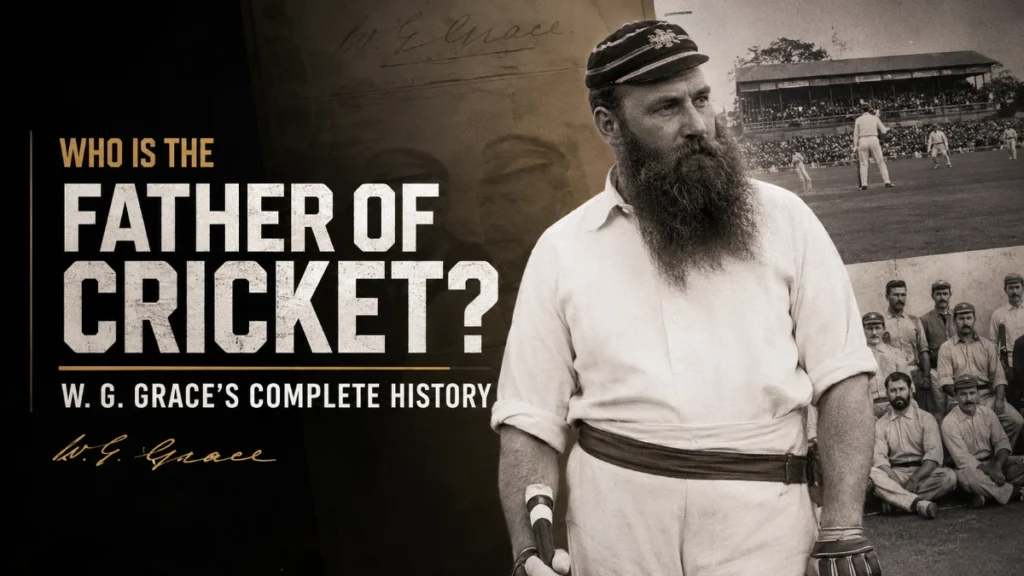

If you have ever wondered who is the father of cricket?, the answer points to one legendary figure: Dr. William Gilbert Grace (W. G. Grace). Although cricket existed long before his time, Grace revolutionized batting, popularized the sport across England, attracted record crowds, and inspired generations of players.
At a Glance
| Detail | Information |
| Full Name | William Gilbert Grace |
| Popular Name | W. G. Grace |
| Born | 18 July 1848 |
| Birthplace | Downend, Gloucestershire, England |
| Died | 23 October 1915 |
| Nationality | English |
| Profession | Cricketer & Medical Doctor |
| Role | All-rounder |
| Batting Style | Right-handed |
| Bowling Style | Right-arm Medium Pace |
| Known As | Father of Cricket |
What Does “Father of Cricket” Mean?
The title “Father of Cricket” is an honorary recognition rather than an official award. It is used to describe the individual whose contribution had the greatest impact on the growth, popularity, and development of cricket.
Many legendary players have changed the game, but very few have transformed it completely. W. G. Grace is remembered not because he invented cricket, but because he revolutionized the way it was played, watched, and understood. His remarkable influence on batting, professionalism, and public interest earned him a unique place in cricket history.
History of Cricket Before W. G. Grace
To understand why W. G. Grace is known as the Father of Cricket, it is important to understand what cricket looked like before his arrival.
Cricket originated in England during the 16th century as a simple rural pastime. For several centuries, it remained a recreational game played mainly in villages and schools. During the eighteenth century, organizations such as the Marylebone Cricket Club (MCC) helped standardize the Laws of Cricket, but the sport was still limited in popularity compared to what it would later become.
By the middle of the nineteenth century, county cricket had started gaining attention, yet matches attracted relatively small crowds, media coverage was limited, and professional training was uncommon. Players relied more on natural ability than structured techniques, while batting methods were still developing.
Everything changed when W. G. Grace entered first-class cricket.
His extraordinary performances, innovative batting style, and larger-than-life personality drew thousands of spectators to grounds across England. Newspapers began covering cricket extensively, crowds grew larger than ever before, and the sport evolved from a gentleman’s pastime into a national obsession.
Many historians believe this period marked the beginning of modern cricket.
Who Was W. G. Grace?
William Gilbert Grace, popularly known as W. G. Grace, was one of the greatest all-round cricketers in history and one of the most influential sporting figures of the Victorian era.
Born on 18 July 1848 in Downend, Gloucestershire, Grace displayed exceptional cricketing talent from an early age. He quickly established himself as a dominant batter, reliable bowler, and inspirational leader. Over a career spanning more than four decades, he broke numerous first-class records and became the first true superstar of cricket.
What made Grace unique was not just his ability to score runs. He introduced disciplined preparation, modern batting techniques, strategic thinking, and a professional approach to the game at a time when cricket was still largely amateur.
Away from cricket, Grace was also a qualified physician. Balancing medicine with an extraordinary sporting career, he became one of the most respected public figures in England.
Even today, more than a century after his retirement, W. G. Grace remains one of the most celebrated names in cricket history. His lasting impact on the sport is the reason he continues to be remembered as the Father of Cricket.
W. G. Grace Biography
| Category | Details |
| Full Name | William Gilbert Grace |
| Popular Name | W. G. Grace |
| Date of Birth | 18 July 1848 |
| Birthplace | Downend, Gloucestershire, England |
| Nationality | English |
| Profession | Cricketer and Medical Doctor |
| Batting Style | Right-handed |
| Bowling Style | Right-arm Medium Pace |
| Playing Role | All-rounder |
| Test Debut | 1880 |
| First-Class Career | More than 40 years |
| First-Class Runs | 54,000+ |
| First-Class Centuries | 120+ |
| First-Class Wickets | 2,800+ |
| Highest First-Class Score | 344 |
| Legacy | Widely known as the Father of Cricket |
Why Is W. G. Grace Called the Father of Cricket?
W. G. Grace is widely known as the Father of Cricket because he transformed the game during the late nineteenth century. Although cricket had already existed for hundreds of years, Grace elevated it from a traditional English pastime into a structured, professional, and widely celebrated sport.
His influence extended far beyond scoring runs or winning matches. He revolutionized batting techniques, inspired a professional mindset among players, attracted thousands of spectators to cricket grounds, and became the first true superstar of the game. Historians and cricket writers regard him as one of the most influential figures in cricket history because his contributions shaped the sport in ways that continue to influence modern cricket.
Below are the key reasons why W. G. Grace earned this remarkable title.
1. He Popularized Cricket Like Never Before
Before W. G. Grace became famous, cricket was primarily followed within England and had limited public attention. Matches were popular among enthusiasts, but the sport had not yet reached the level of national excitement it enjoys today.
Grace changed that completely.
Whenever he played, thousands of spectators gathered to watch him bat. Newspapers dedicated extensive coverage to his performances, making him one of the most recognized athletes of the Victorian era. His popularity helped cricket reach new audiences and inspired many young people to take up the sport.
Many historians believe Grace was cricket’s first genuine sporting celebrity.
2. He Revolutionized Batting Techniques
One of Grace’s greatest contributions was changing how batting was played.
During the early years of cricket, batting was largely defensive. Players focused mainly on surviving at the crease rather than dominating bowlers.
Grace introduced a far more complete approach that included:
- Better footwork
- Improved shot selection
- Strong defensive technique
- Controlled attacking strokes
- Greater patience and concentration
His batting style became the foundation for many of the techniques still taught in cricket coaching today.
Modern legends such as Sir Donald Bradman, Sachin Tendulkar, Ricky Ponting, Virat Kohli, and Joe Root all benefited from batting principles that evolved from the methods pioneered during Grace’s era.
3. He Made Cricket More Professional
During the nineteenth century, cricket was often viewed as a gentleman’s hobby rather than a professional career.
W. G. Grace helped change that mindset.
He emphasized:
- Consistent practice
- Physical fitness
- Tactical awareness
- Mental discipline
- Match preparation
His dedication encouraged future generations to treat cricket as a serious profession rather than simply a recreational activity.
Today, these principles remain central to elite cricket around the world.
4. He Became Cricket’s First Global Superstar
Long before television, social media, or live streaming existed, W. G. Grace achieved extraordinary fame.
His iconic beard, dominant performances, and charismatic personality made him instantly recognizable across Britain. Crowds often travelled long distances simply to watch him play.
His popularity helped transform cricket into one of England’s biggest sporting attractions and demonstrated the commercial potential of the game.
In many ways, Grace laid the foundation for the global popularity that cricket enjoys today.
5. His Records Were Decades Ahead of Their Time
Grace’s statistics were astonishing for his era.
Career Highlights
| Achievement | Record |
| First-Class Runs | 54,000+ |
| First-Class Hundreds | 120+ |
| First-Class Wickets | 2,800+ |
| First-Class Matches | 870+ |
| Highest First-Class Score | 344 |
| Career Span | More than 40 Years |
These achievements remained benchmarks for generations and demonstrated an exceptional level of consistency and longevity.
6. He Inspired Generations of Cricketers
W. G. Grace’s influence did not end with his retirement.
His approach to batting, leadership, and professionalism inspired many of the greatest players who followed him. Cricket historians often describe him as the bridge between early cricket and the modern game.
His legacy can still be seen in:
- Technical batting coaching
- Professional player development
- County cricket structure
- International cricket culture
- Fan engagement with the sport
Very few athletes have influenced an entire sport for more than a century.
7. He Helped Shape Modern Cricket
W. G. Grace’s impact extended beyond his personal achievements.
He played an important role in changing how cricket was organized, promoted, and appreciated.
His contributions helped:
- Increase attendance at cricket matches
- Expand newspaper coverage of the sport
- Raise the popularity of county cricket
- Inspire the growth of international cricket
- Encourage higher playing standards
These developments laid the foundation for the professional cricket ecosystem that exists today.
Did W. G. Grace Invent Cricket?
No.
This is one of the most common misconceptions.
Cricket originated in England several centuries before W. G. Grace was born.
He did not invent the game.
Instead, he transformed it through his performances, innovations, leadership, and influence. That is why he is remembered as the Father of Cricket, rather than the inventor of cricket.
Is “Father of Cricket” an Official Title?
No official governing body, including the International Cricket Council (ICC) or the Marylebone Cricket Club (MCC), formally awards the title “Father of Cricket.”
Instead, it is an honorary title widely used by cricket historians, sports writers, commentators, and fans to recognize W. G. Grace’s extraordinary contribution to the game’s development.
Although unofficial, the title has become universally associated with Grace because of his unmatched impact on cricket’s evolution and popularity.
Early Life and Education
William Gilbert Grace was born on 18 July 1848 in the village of Downend, Gloucestershire, England, into a family deeply passionate about cricket. His father, Dr. Henry Mills Grace, was a physician who also played cricket at a high standard, while several of his brothers were talented cricketers. Growing up in such an environment allowed Grace to develop his skills from a very young age.
Unlike many modern players who receive formal coaching through academies, Grace learned the game by playing with family members and local clubs. These early matches helped him build exceptional hand-eye coordination, patience, and confidence at the crease.
Outside cricket, Grace was equally dedicated to academics. He studied medicine and later qualified as a medical doctor, earning respect both on and off the cricket field. Throughout much of his career, he balanced his responsibilities as a physician while continuing to dominate English cricket—an achievement that remains remarkable even by today’s standards.
His childhood shaped not only his cricketing ability but also the discipline and work ethic that defined his extraordinary career.
How W. G. Grace Started Playing Cricket
Grace’s journey into cricket began almost as soon as he could hold a bat. Encouraged by his father and older brothers, he spent countless hours practicing in local fields around Gloucestershire.
By the age of 15, he had already become one of the most promising young cricketers in England. His natural talent, combined with relentless practice, quickly caught the attention of county selectors.
Unlike many players of his era, Grace possessed an unusual combination of patience, aggressive stroke play, and tactical intelligence. Even as a teenager, he demonstrated a maturity beyond his years, regularly outperforming experienced cricketers.
These early performances laid the foundation for what would become one of the greatest careers in cricket history.
First-Class Cricket Debut
W. G. Grace made his first-class debut in 1865, marking the beginning of a career that would span more than four decades.
From his very first appearances, Grace displayed remarkable consistency with both bat and ball. His ability to score heavily under pressure quickly established him as one of the brightest talents in English cricket.
Within a few seasons, he had become the leading figure in county cricket. Opposing teams often built their entire bowling strategy around dismissing Grace because his wicket was considered the key to winning matches.
His performances also attracted unprecedented media attention, helping increase public interest in county cricket across England.
Rise to National Stardom
During the 1870s, W. G. Grace transformed from an outstanding county cricketer into England’s biggest sporting icon.
His performances regularly dominated newspaper headlines, and thousands of spectators travelled long distances simply to watch him bat. Cricket grounds that had once attracted modest crowds began filling with passionate supporters whenever Grace appeared.
His popularity extended far beyond cricket enthusiasts. Even people who rarely followed the sport recognized his distinctive beard and commanding presence.
This level of fame was almost unheard of during the Victorian era, making Grace one of the world’s first true sports celebrities.
Test Cricket Career
When international Test cricket was still in its infancy, W. G. Grace represented England against some of the strongest teams of his time.
He played in England’s early Test matches and helped establish the country’s reputation as a dominant cricketing nation. Although the international calendar was far less crowded than it is today, every appearance carried immense significance because Test cricket was still developing as a global competition.
Grace’s calm temperament, technical excellence, and leadership qualities made him one of England’s most dependable players during this formative period.
County Cricket Career
While many people remember Grace for his international appearances, the majority of his success came in first-class county cricket.
He represented Gloucestershire County Cricket Club, where he became the team’s greatest player and one of the most successful county cricketers in history.
During his career, Grace scored thousands of runs and claimed numerous wickets, often dominating matches almost single-handedly. His consistent performances helped Gloucestershire establish itself among England’s strongest county sides.
Even today, he remains one of the greatest legends in the club’s history.
Playing Style
W. G. Grace was much more than a prolific run-scorer. He was an innovative all-round cricketer who changed how the game was played.
Batting
Grace combined patience with controlled aggression. His excellent footwork allowed him to judge the length of deliveries earlier than most batters of his era. He was equally comfortable defending difficult balls and attacking loose deliveries, making him exceptionally difficult to dismiss.
Bowling
Although batting brought him worldwide fame, Grace was also an effective right-arm medium-pace bowler. His accuracy and ability to exploit helpful conditions enabled him to take thousands of first-class wickets during his career.
Fielding
Grace possessed safe hands and excellent game awareness. His leadership in the field often inspired teammates and helped England and Gloucestershire perform at their best.
His versatility as a batter, bowler, and fielder made him one of the earliest examples of a complete all-round cricketer.
Leadership and Captaincy
As captain, W. G. Grace believed that success depended on preparation, discipline, and intelligent tactics.
He encouraged attacking cricket while emphasizing patience when conditions demanded it. His ability to read the game and make bold tactical decisions earned him enormous respect among teammates and opponents alike.
Many of his leadership principles—such as maintaining fitness, understanding match situations, and adapting strategies—remain relevant in modern cricket.
Grace proved that great captains influence matches not only through their own performances but also by bringing out the best in their teammates.
Balancing Cricket and Medicine
One of the most fascinating aspects of W. G. Grace’s life was his ability to excel in two demanding professions.
While establishing himself as England’s greatest cricketer, he also practiced as a qualified physician. Managing medical responsibilities alongside an elite sporting career required extraordinary dedication and discipline.
His success demonstrated that excellence was not limited to the cricket field. Grace became a respected public figure whose achievements inspired admiration across both the sporting and medical communities.
Why His Career Was Different From Other Players
Several factors separated W. G. Grace from his contemporaries:
- He remained at the highest level of cricket for more than 40 years.
- He revolutionized batting techniques that are still taught today.
- He inspired cricket’s transition from an amateur pastime to a professional sport.
- He became the first globally recognized cricket superstar.
- He balanced a successful medical career with elite-level cricket.
- His records stood as benchmarks for generations of cricketers.
These achievements explain why W. G. Grace is remembered not merely as a great player, but as one of the most influential figures in the history of cricket.
W. G. Grace’s Career Statistics
W. G. Grace enjoyed one of the longest and most successful careers in cricket history. Playing at the highest level for more than 40 years, he established records that were considered extraordinary during the nineteenth century.
While modern cricket is divided into Test matches, One Day Internationals (ODIs), and Twenty20 Internationals (T20Is), Grace played primarily in first-class cricket, which was regarded as the highest standard of the game during his era.
His remarkable consistency with both bat and ball made him one of cricket’s greatest all-rounders and one of the most dominant players of his generation.
Career Statistics at a Glance
| Category | Statistics |
| Full Name | William Gilbert Grace |
| Playing Role | All-rounder |
| Batting Style | Right-hand Bat |
| Bowling Style | Right-arm Medium Pace |
| First-Class Career | 1865–1908 |
| Career Duration | 43 Years |
| First-Class Matches | 870+ |
| First-Class Runs | 54,000+ |
| Batting Average | 39+ |
| First-Class Centuries | 120+ |
| Half-Centuries | 250+ |
| Highest Score | 344 |
| First-Class Wickets | 2,800+ |
| Five-Wicket Hauls | 100+ |
| Catches | 800+ |
W. G. Grace’s Major Records
Many of Grace’s achievements remained unmatched for decades and helped establish new standards in cricket.
1. First Player to Score Over 50,000 First-Class Runs
At a time when cricket seasons were much shorter than they are today, Grace became the first player to cross the 50,000-run milestone in first-class cricket.
This achievement demonstrated his remarkable consistency, fitness, and longevity.
2. More Than 120 First-Class Centuries
Scoring a century during the nineteenth century was significantly more difficult because:
- Pitches were uncovered.
- Protective equipment was limited.
- Bats were less advanced.
- Bowling conditions were unpredictable.
Despite these challenges, Grace scored over 120 first-class centuries, a record that inspired future generations of batters.
3. Over 2,800 First-Class Wickets
Grace was not only one of the greatest batters of his era but also an outstanding bowler.
His ability to contribute in both disciplines made him one of cricket’s earliest genuine all-rounders.
4. Career Lasting More Than Four Decades
Very few professional athletes remain at the top level for over 40 years.
Grace’s exceptional longevity reflected his dedication, physical endurance, and ability to adapt his game as cricket evolved.
5. More Than 870 First-Class Matches
Playing more than 870 first-class matches during the nineteenth century was an extraordinary accomplishment.
It highlighted his reliability, popularity, and importance to every team he represented.
W. G. Grace’s Greatest Achievements
Throughout his career, Grace achieved numerous milestones that transformed cricket forever.
Popularized Cricket Across England
His matches attracted thousands of spectators and dramatically increased public interest in cricket.
Revolutionized Batting
Grace introduced modern batting techniques that emphasized:
- Better footwork
- Shot selection
- Balance
- Patience
- Tactical awareness
Many of these principles remain part of coaching today.
Cricket’s First Superstar
Long before television and social media, Grace became one of Britain’s most famous athletes.
His popularity demonstrated that cricket could attract large crowds, media attention, and commercial success.
Inspired Professional Cricket
Grace showed that discipline, preparation, and consistency were essential for success.
His approach helped transform cricket from an amateur pastime into a professional sport.
Medical Doctor and Sporting Legend
Very few athletes have balanced two demanding professions as successfully as Grace.
While dominating cricket, he also practiced medicine, making him one of the most respected public figures of his time.
Awards and Recognition
Although formal cricket awards were limited during the Victorian era, Grace received widespread recognition for his extraordinary contributions.
Honors
- Widely regarded as the Father of Cricket
- One of England’s greatest sporting icons
- Cricket’s first global superstar
- Pioneer of modern batting
- Inspiration for generations of cricketers
- Recognized as one of the greatest all-rounders in cricket history
His influence continues to be acknowledged by historians, coaches, commentators, and cricket enthusiasts around the world.
Career Timeline
| Year | Milestone |
| 1848 | Born in Downend, Gloucestershire |
| 1865 | Made his first-class debut |
| 1871 | Established himself as England’s leading batter |
| 1880 | Represented England in Test cricket |
| 1880s | Became cricket’s biggest sporting attraction |
| 1895 | Crossed major first-class run milestones |
| 1908 | Retired from first-class cricket |
| 1915 | Passed away, leaving an unmatched legacy |
Career Milestones
1865 — Beginning of a Legendary Journey
Grace entered first-class cricket as a teenager and immediately impressed with his exceptional technique and maturity.
1871 — Dominating County Cricket
By the early 1870s, he had become the most feared batter in English county cricket and was widely recognized as the game’s brightest star.
1880 — Test Cricket Pioneer
Grace represented England during the early years of Test cricket, helping establish the nation’s reputation in international competition.
1895 — Record-Breaking Performer
By the mid-1890s, Grace had rewritten numerous batting records and was considered the greatest cricketer of his generation.
1908 — End of an Extraordinary Career
After more than four decades at the highest level, Grace retired from first-class cricket, leaving behind records that inspired future generations.
Why These Records Still Matter Today
Modern cricket has changed dramatically, with improved equipment, covered pitches, sports science, and year-round international schedules.
Despite these changes, W. G. Grace’s achievements remain historically significant because they were accomplished under far more challenging conditions.
His records represent more than numbers—they reflect the evolution of cricket itself.
Grace demonstrated that excellence could be achieved through skill, discipline, and innovation, making his legacy just as relevant today as it was more than a century ago.
How W. G. Grace Changed Cricket Forever
Very few athletes have transformed an entire sport the way W. G. Grace transformed cricket.
When Grace began playing in the mid-nineteenth century, cricket was still developing. Although the game had already existed for centuries, it lacked the professionalism, popularity, tactical sophistication, and widespread public attention that define modern cricket today.
Grace changed all of that.
His influence reached every aspect of the game—from batting techniques and fitness to media coverage, fan engagement, and the professional mindset adopted by future generations of cricketers.
For this reason, historians often describe him not merely as one of cricket’s greatest players, but as the individual who helped shape the modern game.
1. He Revolutionized Batting
Before W. G. Grace, batting was generally cautious and defensive. Most players focused on protecting their wicket rather than dominating bowlers.
Grace introduced a completely different philosophy.
He combined:
- Excellent footwork
- Balanced body movement
- Careful shot selection
- Aggressive stroke play
- Defensive patience
- Mental discipline
His approach demonstrated that batting required both technical skill and strategic thinking.
Many of today’s coaching principles—including balance, timing, and foot movement—reflect concepts that Grace helped popularize during his career.
2. He Turned Cricket into a Professional Sport
One of Grace’s greatest contributions was changing how players approached cricket.
During the Victorian era, many cricketers treated the sport as a recreational activity.
Grace believed success required:
- Daily practice
- Physical fitness
- Tactical preparation
- Mental strength
- Consistency
His professionalism inspired future players to dedicate themselves fully to cricket.
Today, these qualities form the foundation of every successful international cricketer.
3. He Made Cricket Popular Across England
Before Grace became famous, cricket attracted modest audiences.
Everything changed when he started dominating county cricket.
Crowds travelled from different regions simply to watch him bat.
Newspapers began publishing detailed match reports, player profiles, and cricket analysis, helping introduce the sport to a much wider audience.
His popularity transformed cricket from a regional pastime into one of England’s most followed sports.
4. He Became Cricket’s First Sporting Icon
Modern cricket has global superstars like:
- Virat Kohli
- MS Dhoni
- Sachin Tendulkar
- Ben Stokes
- Pat Cummins
More than a century earlier, W. G. Grace occupied a similar position.
His long beard, commanding personality, and remarkable performances made him instantly recognizable throughout Britain.
He became one of the first athletes whose reputation extended far beyond the cricket field.
Many historians consider Grace to be cricket’s first true superstar.
5. He Raised the Standard of Competition
Grace’s remarkable performances forced opponents to improve.
Teams began developing better bowling strategies specifically to dismiss him.
Players trained harder.
Captains adopted more tactical approaches.
Field placements became more sophisticated.
His dominance encouraged higher standards across the entire game.
As a result, cricket became increasingly competitive and technically advanced.
6. He Inspired Future Generations
Every era of cricket has produced legendary players.
However, many of them built their careers on foundations established during Grace’s time.
His influence can still be seen in:
- Batting techniques
- Captaincy philosophy
- Professional preparation
- Match awareness
- Player discipline
Although cricket has evolved enormously, many principles introduced during Grace’s era remain relevant today.
7. His Legacy Lives in Modern Cricket
Even though cricket has changed dramatically, W. G. Grace’s influence continues to shape the sport.
Modern cricket includes:
- Advanced coaching
- Sports science
- Video analysis
- Data-driven strategies
- Professional leagues
Yet the core principles that Grace promoted—discipline, technique, preparation, and commitment—remain essential for success.
His legacy is evident every time a batter builds an innings patiently, a captain makes tactical decisions, or a young player dreams of representing their country.
W. G. Grace’s Lasting Contributions
| Contribution | Long-Term Impact |
| Modern Batting | Improved technique and shot selection |
| Professionalism | Inspired structured training and discipline |
| Popularity | Expanded cricket’s audience across England |
| Leadership | Encouraged tactical captaincy |
| Media Attention | Increased newspaper coverage of cricket |
| Fan Engagement | Created one of cricket’s first mass followings |
| Inspiration | Motivated future generations of cricketers |
How W. G. Grace Influenced Modern Batting
Grace’s batting style represented a significant step forward in cricket’s evolution.
He emphasized:
- Playing the ball late
- Strong defensive technique
- Proper foot movement
- Controlled attacking shots
- Reading bowlers carefully
These ideas remain central to modern batting coaching.
Although today’s players benefit from superior equipment and coaching methods, many of the game’s technical fundamentals can be traced back to pioneers like W. G. Grace.
Influence on Cricket Coaching
Modern coaching focuses on developing technically complete cricketers.
Grace’s career demonstrated the importance of:
- Practicing consistently
- Learning from mistakes
- Building mental resilience
- Maintaining physical fitness
- Understanding match situations
These concepts are now taught at cricket academies worldwide.
Influence on Cricket Fans
Grace helped create a culture in which spectators followed individual players as passionately as they followed teams.
His popularity encouraged newspapers to publish:
- Match reports
- Player interviews
- Career statistics
- Cricket commentary
This relationship between players, media, and supporters laid the foundation for modern sports journalism and fan engagement.
Why Historians Still Study W. G. Grace
Historians continue researching W. G. Grace because his career represents a turning point in cricket history.
He serves as a bridge between:
- Amateur and professional cricket
- Traditional and modern batting
- Local competition and international recognition
- Recreational sport and commercial entertainment
Understanding Grace’s career helps explain how cricket evolved into one of the world’s most popular sports.
Did W. G. Grace Change Cricket More Than Any Other Player?
Many cricket historians believe the answer is yes.
While players such as Sir Donald Bradman, Sachin Tendulkar, Shane Warne, Brian Lara, Jacques Kallis, and Virat Kohli have each transformed different aspects of the game, W. G. Grace’s influence reached the very foundations of cricket.
He didn’t simply break records.
He changed how cricket was played, how players prepared, how fans experienced the sport, and how the world viewed cricket.
That is why, more than a century after his retirement, he continues to be remembered as the Father of Cricket.
W. G. Grace vs Modern Cricket Legends
Cricket has produced many legendary players across different generations, including Sir Donald Bradman, Sachin Tendulkar, MS Dhoni, Ricky Ponting, Jacques Kallis, Brian Lara, and Virat Kohli. Each player dominated in their respective era and left an unforgettable mark on the game.
However, comparing W. G. Grace with modern cricketers requires understanding the vast differences between the nineteenth century and today’s professional cricket environment.
Grace played on uncovered pitches, used heavier equipment, had limited protective gear, and competed when cricket was still evolving. Modern players benefit from advanced coaching, sports science, fitness programs, high-quality bats, video analysis, and year-round international competition.
Although statistics across different eras cannot be compared directly, their influence on cricket can.
W. G. Grace vs Sachin Tendulkar
| Category | W. G. Grace | Sachin Tendulkar |
| Era | Victorian Era | Modern Era |
| Country | England | India |
| Primary Role | All-rounder | Batter |
| Playing Career | 1865–1908 | 1989–2013 |
| Major Recognition | Father of Cricket | God of Cricket |
| Biggest Contribution | Popularized modern cricket | Most successful international batter |
| Legacy | Cricket Pioneer | Cricket Icon |
Analysis
Both players transformed cricket in different ways.
W. G. Grace built the foundation of modern cricket by popularizing the game and introducing professional standards.
Sachin Tendulkar inspired millions worldwide through his extraordinary consistency, humility, and record-breaking international career.
Grace changed cricket itself.
Sachin inspired generations to play it.
W. G. Grace vs Sir Donald Bradman
| Category | W. G. Grace | Don Bradman |
| Country | England | Australia |
| Role | All-rounder | Batter |
| Era | 19th Century | 20th Century |
| Batting Legacy | Pioneer | Greatest Test Batter |
| Historical Impact | Revolutionized Cricket | Redefined Batting Excellence |
| Famous For | Modern Cricket Development | Test Average of 99.94 |
Analysis
Bradman is widely regarded as the greatest batter in cricket history because of his extraordinary Test statistics.
Grace, however, played a completely different role.
Bradman perfected batting.
Grace helped create modern batting.
Without pioneers like Grace, cricket may never have evolved into the professional sport that later allowed players such as Bradman to flourish.
W. G. Grace vs Virat Kohli
| Category | W. G. Grace | Virat Kohli |
| Country | England | India |
| Playing Era | 19th Century | 21st Century |
| Batting Style | Classical Technique | Aggressive Modern Technique |
| Fitness | Ahead of His Era | Modern Fitness Icon |
| Popularity | England’s Biggest Sports Star | Global Cricket Superstar |
| Greatest Contribution | Built Cricket’s Foundation | Raised Fitness Standards |
Analysis
Virat Kohli has transformed modern cricket through elite fitness, aggressive batting, and remarkable consistency across all formats.
Grace transformed cricket at a much earlier stage by making professionalism and technical excellence central to the game.
Both players influenced future generations, but in different ways.
Grace built the foundation.
Virat elevated modern standards.
W. G. Grace vs MS Dhoni
| Category | W. G. Grace | MS Dhoni |
| Role | All-rounder | Wicketkeeper-Batter |
| Leadership | Tactical Pioneer | One of Cricket’s Greatest Captains |
| Playing Style | Classical | Calm Finisher |
| Legacy | Father of Cricket | Captain Cool |
| Contribution | Professional Cricket | White-ball Success |
Analysis
Dhoni is celebrated for his leadership, finishing ability, and calm decision-making under pressure.
Grace is remembered for transforming the entire sport rather than leading one successful generation.
Both captains changed cricket in unique ways, but Grace’s influence extended across the history of the game itself.
W. G. Grace vs Virat Kohli vs Sachin Tendulkar
| Category | W. G. Grace | Virat Kohli | Sachin Tendulkar |
| Country | England | India | India |
| Era | Victorian | Modern | Modern |
| Role | All-rounder | Batter | Batter |
| Major Title | Father of Cricket | King of Modern Cricket* | God of Cricket* |
| Greatest Strength | Revolutionized Cricket | Fitness & Consistency | Longevity & Records |
| Historical Influence | Built Modern Cricket | Inspired Modern Generation | Inspired Millions |
| Global Recognition | Cricket Pioneer | Global Superstar | Cricket Legend |
*”King of Modern Cricket” and “God of Cricket” are widely used nicknames by fans and media rather than official titles.
Can Modern Players Be Compared with W. G. Grace?
Direct statistical comparisons are difficult because the conditions were completely different.
W. G. Grace Played With:
- Uncovered pitches
- Limited protective equipment
- Heavy bats
- Fewer international matches
- Minimal coaching
- No sports science
- No video analysis
- Limited medical support
Modern Players Benefit From:
- Covered wickets
- Advanced protective gear
- Lightweight bats
- Professional coaching staff
- Fitness experts
- Sports psychologists
- Video analytics
- Modern rehabilitation
These differences make direct statistical comparisons unfair.
Instead, historians compare players based on their impact on the sport.
Who Had the Greatest Impact on Cricket?
Different legends transformed cricket in different ways.
| Player | Greatest Contribution |
| W. G. Grace | Built the foundation of modern cricket |
| Sir Donald Bradman | Set the benchmark for batting excellence |
| Sachin Tendulkar | Inspired generations around the world |
| MS Dhoni | Revolutionized white-ball captaincy |
| Virat Kohli | Raised modern fitness and consistency standards |
| Shane Warne | Revived the art of leg-spin bowling |
| Jacques Kallis | Defined the modern all-rounder role |
Each legend shaped cricket in a unique way, but W. G. Grace remains the pioneer whose influence is woven into the very fabric of the sport.
Why W. G. Grace Still Stands Apart
Statistics alone cannot explain W. G. Grace’s greatness.
Many players have scored more international runs or taken more wickets, but none faced the challenge of transforming an entire sport during its formative years.
Grace didn’t simply become cricket’s greatest player of his generation—he helped create the blueprint for generations that followed.
That enduring influence is why, more than a century later, he continues to be remembered as the Father of Cricket.
Interesting Facts About W. G. Grace
W. G. Grace was more than just an extraordinary cricketer. He was a physician, innovator, leader, and one of the most recognizable sporting personalities of the Victorian era. His remarkable achievements on and off the cricket field continue to fascinate historians and cricket fans around the world.
Here are some of the most interesting facts about the man known as the Father of Cricket.
1. He Never Invented Cricket
One of the biggest misconceptions is that W. G. Grace invented cricket.
In reality, cricket had already existed for several centuries before Grace was born. His greatness lies in transforming and popularizing the game, not creating it.
2. He Was a Qualified Medical Doctor
Very few professional athletes have balanced two demanding careers successfully.
Alongside cricket, Grace studied medicine and became a qualified physician. He practiced as a doctor while continuing to dominate first-class cricket.
His success in both professions made him one of the most respected public figures of his time.
3. He Played First-Class Cricket for More Than Four Decades
Grace enjoyed one of the longest careers in cricket history.
From his first-class debut in 1865 until his retirement in 1908, he remained one of England’s leading cricketers for over 43 years.
His longevity remains one of the greatest achievements in cricket history.
4. His Beard Became His Trademark
W. G. Grace’s long beard became almost as famous as his batting.
During the Victorian era, his appearance made him instantly recognizable, and newspapers frequently used illustrations highlighting his distinctive look.
Even today, his beard remains one of cricket’s most iconic images.
5. He Was Cricket’s First Superstar
Long before television, radio, or social media existed, Grace became one of Britain’s most famous athletes.
Thousands of spectators travelled across England simply to watch him play.
Many historians consider him the first cricketer to achieve nationwide celebrity status.
6. He Dominated Both Bat and Ball
Although Grace is remembered primarily for his batting, he was also an outstanding bowler.
Scoring more than 54,000 first-class runs while taking over 2,800 wickets demonstrates how complete an all-round cricketer he truly was.
7. He Changed Batting Forever
Grace introduced techniques that are now considered fundamental to batting.
These included:
- Better footwork
- Improved balance
- Smarter shot selection
- Greater patience
- Technical discipline
Modern coaching still emphasizes many of these principles.
8. He Inspired the Professional Era
During Grace’s career, cricket gradually shifted from an amateur pastime to a professional sport.
His dedication, preparation, and work ethic encouraged future players to approach cricket with greater discipline and professionalism.
9. He Inspired Generations of Legends
Many of cricket’s greatest players have benefited from the foundations established during Grace’s era.
Although separated by more than a century, legends such as Sir Donald Bradman, Sachin Tendulkar, Jacques Kallis, Ricky Ponting, and Virat Kohli all play a version of cricket influenced by Grace’s innovations.
10. His Legacy Lives More Than a Century Later
More than one hundred years after his death, W. G. Grace remains one of the most influential names in cricket history.
Whenever discussions begin about cricket’s origins, pioneers, or greatest contributors, his name is almost always mentioned first.
Lesser-Known Facts About W. G. Grace
Even dedicated cricket fans may not know these fascinating details.
• He played against multiple generations of cricketers during his incredibly long career.
• He remained one of England’s most recognized public figures throughout the Victorian era.
• He combined medicine and elite sport long before sports professionals became common.
• His popularity significantly increased newspaper coverage of cricket.
• His influence extended beyond England and helped inspire cricket’s international growth.
• Many of his first-class records remained benchmarks for decades.
• He became a symbol of cricket itself during the late nineteenth century.
Was W. G. Grace Ever Involved in Controversies?
Like many sporting legends, W. G. Grace occasionally attracted criticism.
Some opponents believed he received favourable treatment from officials because of his enormous popularity. Others questioned his competitive approach, arguing that he sometimes stretched the spirit of the game to gain an advantage.
However, these incidents did little to diminish his reputation.
Most historians agree that his contributions to cricket far outweighed any controversies associated with his career.
Today, he is remembered primarily for revolutionizing the sport rather than for isolated disputes.
W. G. Grace’s Legacy
Few athletes leave a legacy that continues to influence their sport more than a century after their retirement.
W. G. Grace achieved exactly that.
His greatest legacy was not simply his extraordinary statistics but the transformation of cricket itself.
He demonstrated that:
- Cricket could become a professional career.
- Technical excellence was essential for success.
- Fitness and preparation mattered.
- Fans would passionately support individual players.
- Newspapers could build nationwide interest in cricket.
Many of these ideas remain central to modern cricket.
Why Cricket Historians Still Admire W. G. Grace
Historians continue to study Grace because his career represents one of the most important turning points in cricket history.
He connected two different eras:
- Traditional cricket and modern cricket.
- Amateur participation and professional competition.
- Local popularity and international recognition.
Understanding Grace helps explain how cricket evolved into one of the world’s most popular sports.
What Can Modern Cricketers Learn From W. G. Grace?
Although cricket has changed dramatically, Grace’s career still offers valuable lessons.
Dedication
He spent decades improving his game and remained committed throughout his career.
Consistency
Grace performed at the highest level for more than forty years.
Adaptability
As cricket evolved, he adjusted his techniques and continued succeeding.
Leadership
He inspired teammates through both performances and tactical intelligence.
Professionalism
His disciplined approach became a model for future generations.
These qualities remain essential for every successful cricketer today.
Historical Significance of W. G. Grace
W. G. Grace occupies a unique place in cricket history.
Some players are remembered for their statistics.
Others are remembered for memorable innings.
Grace is remembered because he changed the direction of an entire sport.
His impact can still be seen in:
- Batting techniques
- Coaching methods
- County cricket
- Professional standards
- Fan culture
- Cricket journalism
Very few athletes in any sport have influenced their game so profoundly.
Why W. G. Grace Will Always Be Remembered
Records are eventually broken.
Awards are eventually forgotten.
Generations of players eventually retire.
But pioneers remain timeless.
W. G. Grace belongs to that rare group of sporting legends whose influence extends beyond numbers and trophies.
More than a century after his retirement, his name continues to symbolize the birth of modern cricket.
That enduring impact is why he is still celebrated around the world as the Father of Cricket.
Final Thoughts
Cricket has produced countless legends over the centuries, but very few have changed the sport as profoundly as William Gilbert Grace.
He did not invent cricket, nor was he the only great player of his era. What made him exceptional was his ability to transform the game itself. Through revolutionary batting techniques, unmatched consistency, professional discipline, and extraordinary popularity, Grace helped cricket evolve from a traditional English pastime into one of the world’s most celebrated sports.
His achievements cannot be measured by statistics alone. More important than the 54,000+ first-class runs, 120+ centuries, or 2,800+ wickets is the lasting influence he had on every generation that followed. From Sir Donald Bradman and Sachin Tendulkar to Virat Kohli and today’s young cricketers, the foundations of modern cricket can be traced back to the standards established during Grace’s remarkable career.
More than a century after his retirement, his legacy continues to inspire players, coaches, historians, and millions of cricket fans around the world.
For that reason, W. G. Grace will always be remembered as the Father of Cricket—a pioneer whose vision, skill, and passion changed the game forever.
Quick Summary
| Question | Answer |
| Father of Cricket | W. G. Grace |
| Full Name | William Gilbert Grace |
| Born | 18 July 1848 |
| Nationality | English |
| Profession | Cricketer & Medical Doctor |
| Known For | Revolutionizing modern cricket |
| Major Achievement | Popularized and professionalized cricket |
| Legacy | Father of Cricket |
Conclusion
If you’ve ever wondered “Who is the Father of Cricket?”, the answer is W. G. Grace. While he did not invent the sport, his contributions forever changed its history. His revolutionary batting techniques, professional approach, record-breaking career, and influence on future generations earned him one of the most respected titles in sports history. Even today, W. G. Grace remains a timeless icon whose legacy continues to shape cricket across the world.
Frequently Asked Questions (FAQs)
1. Who is known as the Father of Cricket?
W. G. Grace (William Gilbert Grace) is widely regarded as the Father of Cricket because of his extraordinary contribution to the game’s growth and development during the nineteenth century. Although he did not invent cricket, his achievements, innovative batting techniques, and influence helped transform it into a professional and globally admired sport.
2. Why is W. G. Grace called the Father of Cricket?
He earned the title because he: Revolutionized batting techniques, popularized cricket across England, attracting record crowds to matches, inspired professionalism among players, became cricket’s first sporting superstar, and helped shape the modern game.
3. Did W. G. Grace invent cricket?
No, Cricket had already existed for several centuries before W. G. Grace was born. He is remembered for transforming and popularizing the sport, not for inventing it.
4. Who is the Father of Modern Cricket?
Many cricket historians also refer to W. G. Grace as the Father of Modern Cricket because his influence helped establish many of the techniques and professional standards that remain part of the game today.
5. Who is the God of Cricket?
Sachin Tendulkar is popularly known as the God of Cricket because of his extraordinary international career, numerous world records, and lasting impact on the sport.
6. Who is called the King of Cricket?
There is no official “King of Cricket.”
However, many fans and media outlets often refer to Virat Kohli as the King of Cricket because of his consistency, leadership, and remarkable achievements across all formats.
7. Who is the Father of Indian Cricket?
Kumar Shri Ranjitsinhji, popularly known as K. S. Ranjitsinhji, is widely regarded as one of the pioneers of Indian cricket due to his immense contribution to the sport during its early years.
8. What was W. G. Grace’s profession besides cricket?
Apart from being one of cricket’s greatest players, W. G. Grace was also a qualified medical doctor who practiced medicine throughout much of his cricketing career.
9. Which team did W. G. Grace play for?
Grace represented several teams during his career, most notably:
Gloucestershire County Cricket Club
England
Gentlemen of England
MCC (Marylebone Cricket Club)
10. What was W. G. Grace’s batting style?
He was a right-handed batter known for his excellent footwork, patience, powerful stroke play, and technically sound batting approach
11. How many runs did W. G. Grace score?
W. G. Grace scored more than 54,000 first-class runs, making him one of the highest run-scorers of his era.
12. How many centuries did W. G. Grace score?
He scored over 120 first-class centuries, an extraordinary achievement during the nineteenth century.
13. Was W. G. Grace an all-rounder?
Yes, Grace was one of cricket’s earliest great all-rounders, excelling as both a batter and a right-arm medium-pace bowler.
14. When did W. G. Grace retire?
He retired from first-class cricket in 1908, bringing an end to an exceptional career that lasted more than four decades.
15. Why is W. G. Grace still remembered today?
He is remembered because he transformed cricket through his batting innovations, professionalism, leadership, and immense popularity. His influence helped shape the modern game, earning him the title Father of Cricket.
16. What records made W. G. Grace famous?
Some of his most remarkable achievements include:
54,000+ first-class runs
120+ first-class centuries
2,800+ first-class wickets
More than 870 first-class matches
A career spanning over 40 years
17. How did W. G. Grace influence modern cricket?
Grace introduced better batting techniques, emphasized physical preparation and discipline, attracted larger crowds, increased media interest, and inspired future generations to approach cricket as a professional sport.
18. Is the title “Father of Cricket” official?
The title is honorary, not an official award presented by the ICC or MCC. It has become widely accepted because of W. G. Grace’s lasting contribution to cricket.
19. What is W. G. Grace’s greatest legacy?
His greatest legacy is transforming cricket from a traditional pastime into a professional sport while inspiring generations of players through his skill, leadership, and innovation.
20. Why should every cricket fan know about W. G. Grace?
Understanding W. G. Grace’s career helps explain how cricket evolved into the global sport it is today. His story represents the origins of modern batting, professionalism, and the worldwide popularity of cricket.