
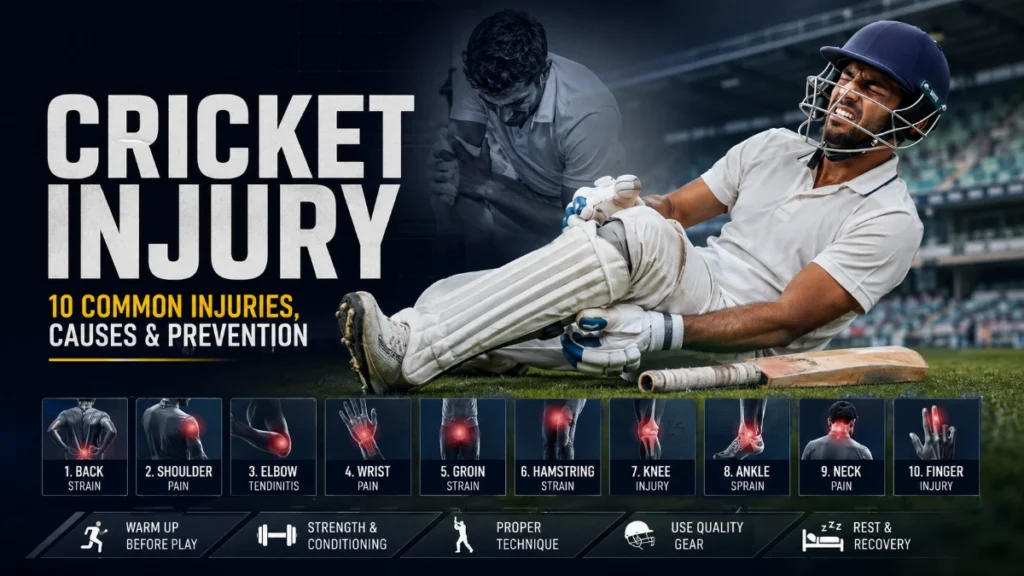

Cricket may not be a full-contact sport, but injuries are still an important part of the game. Fast bowling places repeated stress on the body, batters can be struck by the ball, and fielders are exposed to sprinting, diving and throwing demands. The International Cricket Council (ICC) specifically recognizes player health and injury management as an important part of international cricket.
A cricket injury can be an acute problem caused by a single incident—such as an ankle sprain while fielding—or an overuse problem that develops gradually through repeated training and competition. The type and risk of injury can vary considerably depending on a player’s role, workload, age, technique and previous injury history.
Cricket injuries commonly affect the muscles, joints, bones and head. Fast bowlers can be particularly vulnerable to lower-back and soft-tissue problems because of repetitive high-intensity bowling, while batters and fielders may experience hand, shoulder, knee, ankle and impact injuries. Prevention depends on appropriate training, workload management, protective equipment and adequate recovery.
What Is a Cricket Injury?
A cricket injury is any physical problem associated with cricket participation that affects a player’s health, training or ability to compete. Sports-medicine researchers distinguish between sudden injuries and problems that develop progressively through repeated exposure or overuse. Injury surveillance is important because understanding when and how injuries occur helps teams develop better prevention strategies.
Cricket creates different physical demands for different players. A fast bowler repeatedly runs, jumps, rotates and delivers the ball at high speed. A batter may spend hours at the crease while also facing balls travelling at high velocity. Wicketkeepers repeatedly squat and move laterally, while fielders sprint, dive and throw.
That variety explains why there is no single “cricket injury.”
10 Common Injuries in Cricket
1. Hamstring Injuries
Hamstring strains can occur during explosive activities such as sprinting between wickets, chasing the ball or accelerating during a bowling run-up. Symptoms can include sudden pain at the back of the thigh, tenderness, weakness and difficulty running.
The severity can vary substantially, so return-to-play decisions should be based on assessment and functional recovery rather than an arbitrary number of days.
2. Lower-Back Injuries
The lower back is an important area of concern in cricket, particularly among pace bowlers.
Fast bowling repeatedly places substantial forces through the body. Cricket Australia specifically warns that frequent pace bowling without adequate recovery can place considerable stress on the lower back, with teenage pace bowlers at particular risk of bone stress injuries.
Persistent back pain in a bowler should therefore not simply be treated as normal post-training soreness.
3. Shoulder Injuries
Shoulder problems can affect fast bowlers, fielders and wicketkeepers because cricket involves repeated throwing and overhead movements.
Pain may develop gradually from repetitive workload or suddenly during a forceful throw, dive or awkward movement. Shoulder problems can involve different structures, so persistent pain, weakness or reduced movement warrants professional assessment.
4. Side Strain
Side strains are particularly associated with fast bowling because of the powerful trunk movements involved in the delivery action.
Players may experience pain around the side of the chest or abdomen, especially during bowling, twisting, coughing or other movements involving the trunk.
Because different conditions can cause pain in this area, diagnosis matters before a return-to-bowling program begins.
5. Knee Injuries
Cricket involves sprinting, sudden changes of direction, jumping and diving, all of which place demands on the knees.
A knee injury may range from a relatively minor soft-tissue problem to more significant ligament or cartilage damage. Swelling, instability, locking, severe pain or an inability to bear weight are reasons to seek medical assessment.
6. Ankle Sprains
An ankle can roll during fielding, running between wickets, landing after a bowling delivery or stepping on an uneven surface.
Common features include pain, swelling and difficulty walking. Not every ankle injury is a simple sprain, however, and significant pain or inability to bear weight may require evaluation to exclude a more serious injury.
7. Finger Injuries
Fingers are particularly exposed during catching, wicketkeeping and close-in fielding.
A cricket ball can cause bruising, sprains, dislocations or fractures. Significant deformity, severe swelling, numbness or inability to move a finger normally should be professionally assessed rather than assuming it is merely “jammed.”
8. Wrist and Hand Injuries
Batters can experience wrist or hand problems from repetitive batting or direct impact from the ball. Fielders can also injure the wrist while catching or landing after a dive.
Because the hand and wrist contain many small bones, joints and soft-tissue structures, persistent pain can require specific diagnosis.
9. Groin Strain
Rapid acceleration, lateral movement and sudden changes of direction can stress the muscles around the groin.
A player may notice pain while sprinting, changing direction or moving the leg against resistance. Rehabilitation should restore strength and cricket-specific movement before unrestricted competition.
10. Concussion and Head Injury
A cricket ball can strike the head during batting, wicketkeeping or fielding. A player can also sustain head trauma through a collision or fall.
Concussion deserves particular attention because symptoms are not always immediately obvious.
The ICC’s current concussion guidance states that a player diagnosed with concussion must be removed from participation that day and should not return until cleared by an appropriately trained healthcare practitioner. Signs suggesting a more serious brain injury require urgent hospital assessment.
Cricket Injuries by Player Role
Different cricket roles create different physical demands, so injury patterns can also differ.
| Player Role | Areas Commonly Under Stress | Why |
| Fast Bowler | Lower back, hamstrings, side, ankle, shoulder | Repetitive high-intensity bowling |
| Batter | Hands, fingers, head, hamstrings | Ball impact, sprinting, prolonged batting |
| Wicketkeeper | Fingers, knees, back | Repeated catching and squatting |
| Fielder | Shoulder, knee, ankle, hamstrings | Sprinting, throwing and diving |
| Spin Bowler | Fingers, shoulder, back | Repetitive bowling and rotation |
This table should not be interpreted as predicting which injury an individual player will develop. Injury risk depends on many interacting factors.
Why Are Fast Bowlers More Vulnerable to Injury?
Fast bowling is one of cricket’s most demanding activities.
A bowler must generate speed through a run-up before transferring force through the legs, trunk, shoulder and arm during delivery. Repeating this action many times creates substantial cumulative workload.
Research in elite fast bowlers has found an association between spikes in acute workload and increased injury risk.
This is why simply counting how many overs a bowler delivers in a single match does not tell the whole story. Training, recent matches, recovery and changes in workload also matter.
Junior fast bowlers require particular care. Cricket Australia’s current junior guidelines explicitly incorporate limits on bowling frequency and spell length and emphasize rest between bowling sessions.
What Causes Cricket Injuries?
There is rarely one universal cause. Potential contributors include sudden increases in workload, repetitive movements, insufficient recovery, direct ball impact, sprinting and rapid changes of direction, falls or awkward landings, and the demands created by bowling or throwing technique.
Previous injuries and an athlete’s individual physical characteristics can also influence risk.
This is why injury prevention should focus on the player’s overall training environment rather than relying on one exercise or piece of equipment.
Cricket Injury Symptoms That Should Not Be Ignored
Minor soreness after exercise and a significant injury are not the same thing.
A player should pay particular attention to symptoms such as persistent or worsening pain, significant swelling, visible deformity, loss of strength or movement, inability to bear weight, numbness, repeated pain during bowling, or symptoms following a head impact.
Head trauma requires extra caution. The ICC advises medical involvement when concerning signs follow a significant head knock, and diagnosed concussion requires removal from play.
How Are Cricket Injuries Diagnosed?
Diagnosis depends on the type of injury.
A healthcare professional may assess how the injury happened, where the pain occurs, swelling or bruising, joint movement, muscle strength, stability and cricket-specific function.
Imaging is not necessary for every sports injury. Depending on the suspected problem, a clinician may use an X-ray, ultrasound, MRI, CT scan or another investigation.
The important point is that the diagnosis should guide treatment. Two players who both report “shoulder pain” or “back pain” may have very different underlying problems.
Cricket Injury Treatment and Recovery
There is no single treatment that works for every cricket injury.
Early management depends on the nature and severity of the problem. A minor muscle injury may require a different approach from a fracture, concussion or bone stress injury.
Rehabilitation commonly progresses from restoring comfortable movement toward strength, control and progressively more demanding cricket-specific activities.
For example, a fast bowler recovering from injury may eventually need a structured return-to-bowling progression rather than moving directly from pain-free daily activity to a full match workload.
A qualified sports physician or physiotherapist can determine an appropriate plan for the individual player.
How Long Does a Cricket Injury Take to Heal?
Recovery time depends on the exact diagnosis and severity rather than the name of the body part alone.
| Injury | Recovery Can Depend On |
| Hamstring strain | Location and severity of muscle damage |
| Ankle sprain | Ligaments involved and stability |
| Finger injury | Bruise, sprain, dislocation or fracture |
| Shoulder injury | Structure involved and functional demands |
| Lower-back injury | Cause, severity and bowling workload |
| Concussion | Symptoms, clinical assessment and return-to-sport progression |
For that reason, statements such as “a hamstring injury always heals in two weeks” can be misleading.
Return to cricket should be based on appropriate recovery and function, not simply the number of days since the injury occurred.
How to Prevent Cricket Injuries
Not every injury is preventable, but sensible risk-reduction strategies can help.
Players should build training loads progressively, develop strength and conditioning appropriate to their role, warm up before high-intensity activity, use appropriate protective equipment, allow adequate recovery, and avoid ignoring persistent pain.
Bowling workload deserves special attention. Sudden workload spikes have been associated with injury risk in elite fast bowlers, while junior bowling guidance emphasizes age-appropriate limits and recovery.
Good injury prevention is therefore less about one “perfect warm-up” and more about consistent management across an entire season.
Cricket Injury Prevention for Fast Bowlers
Fast bowlers should pay particular attention to bowling volume and changes in workload.
Strength and conditioning can prepare the legs and trunk for the forces involved in bowling, while sufficient recovery between demanding sessions allows the body to adapt.
Young pace bowlers need additional protection because their bodies are still developing. Cricket Australia’s junior guidelines note that adolescent pace bowlers are particularly vulnerable to lower-back bone stress injuries and advise stopping bowling and seeking appropriate sports-medicine assessment when lower-back pain develops.
Concussion in Cricket
Concussion should never be treated as an ordinary knock to the head.
Possible signs and symptoms can include headache, dizziness, confusion, balance problems, memory difficulty, visual disturbance or unusual behaviour, although presentation varies.
Under the ICC’s June 2025 concussion management guidance, a player diagnosed with concussion must immediately stop participating in the match or training session that day. Return requires clearance from an appropriately trained healthcare practitioner.
This is one area where trying to “play through the pain” can be particularly dangerous.
When Should a Cricketer Seek Medical Attention?
Medical assessment is particularly important after significant head trauma or when a player experiences severe pain, obvious deformity, substantial swelling, neurological symptoms, inability to bear weight, loss of normal movement, or symptoms that persist or worsen.
Young fast bowlers with lower-back pain should also take the symptom seriously rather than continuing to bowl through it.
In an emergency or when a serious head, neck or other major injury is suspected, urgent medical care is appropriate.
Final Thoughts
A cricket injury can range from a minor muscle strain to a serious head or bone injury. The demands also differ substantially between fast bowlers, batters, wicketkeepers and fielders, which means prevention and rehabilitation should be tailored to the player rather than based on a generic formula.
The most useful approach is to combine sensible workload management, appropriate conditioning, recovery, protective equipment and early professional assessment when concerning symptoms develop. At elite level, injury surveillance and formal medical protocols are already an important part of protecting players; the same principle—taking injuries seriously before they become bigger problems—is valuable at every level of cricket.
Frequently Asked Questions
What is the most common cricket injury?
There is no single injury that is universally the most common across every form and level of cricket. Injury patterns vary by playing role, age, competition level, workload and how researchers define and record injuries. This is one reason standardized injury-surveillance methods are important.
Why do fast bowlers get injured?
Fast bowling repeatedly places high physical demands on the body. Bowling volume, inadequate recovery and sudden changes in workload can contribute to injury risk. Research has specifically identified workload spikes as a risk factor among elite fast bowlers.
Can cricket cause lower-back injuries?
Yes. Lower-back problems are particularly important among pace bowlers because repeated bowling places considerable force through the lower back. Teenage pace bowlers require particular attention because of the risk of bone stress injuries.
What injuries can batters suffer?
Batters can experience muscle strains while running, hand or finger injuries from ball impact, and head injuries. The exact pattern depends on factors such as playing level, exposure and individual circumstances
Can cricket injuries be prevented?
Not all injuries can be prevented, but appropriate conditioning, progressive workload management, adequate recovery, protective equipment and early attention to symptoms can reduce avoidable risks.
What is a side strain in cricket?
A side strain generally refers to an injury involving muscles around the side of the trunk. It is particularly relevant to fast bowlers because of the forceful trunk movements involved in bowling.
Should a player continue playing after a concussion?
No. ICC guidance states that a player diagnosed with concussion must be removed from further participation that day and should only return after appropriate healthcare clearance.