
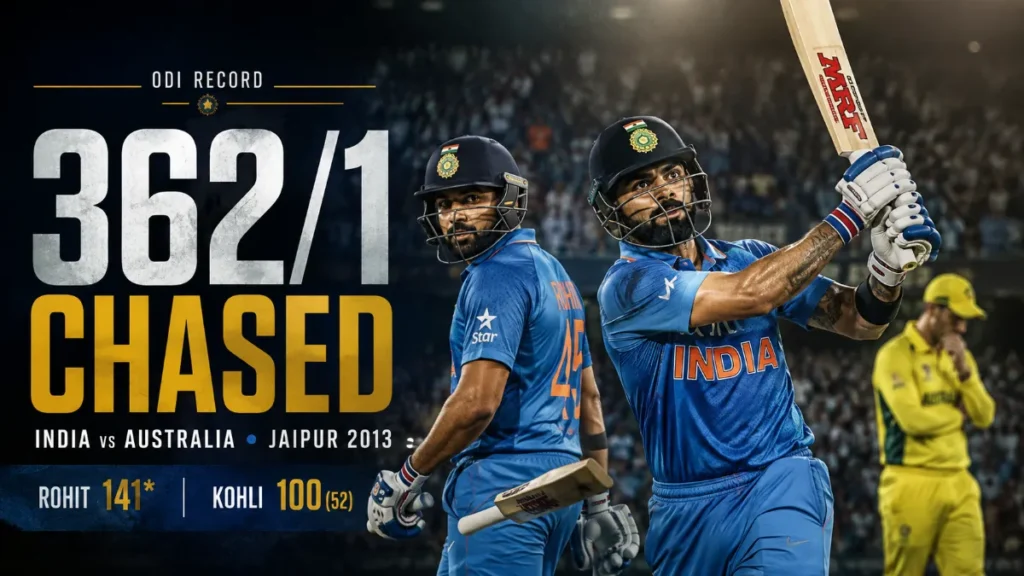

India National Cricket Team Highest Successful Run Chase in ODI
The India national cricket team’s highest successful run chase in ODI cricket is 362/1 against Australia in Jaipur in 2013. Chasing a target of 360, India won by nine wickets with 39 balls remaining, thanks to Rohit Sharma’s unbeaten 141 and Virat Kohli’s blistering 100 off 52 balls. It remains the second-highest successful chase in men’s ODI history and the biggest chase in the India national cricket team’s history to date.
Australia had piled up a total no team had chased against them on Indian soil before, and India were coming off a first-match defeat in the series. What followed wasn’t a tight finish — it turned into a one-sided demolition once Kohli found his rhythm against Australia’s spin options.
The Setup: Bailey and Hughes Punish India First
Australia posted 359/5 in Jaipur, built on George Bailey’s unbeaten 92 and Phillip Hughes’s 83, a total that felt unassailable at the halfway stage. India’s bowling attack, blunt for long stretches, gave Australia’s middle order too many scoring options through the innings.
Bowling Figures That Exposed India’s Attack
India’s pace and spin options struggled to find consistent lines across the 50 overs, and the scorecard reflects it directly. Calling this bowling display toothless isn’t harsh — it’s the accurate read of a performance that forced India’s batting to be flawless just to survive.
Why the attack lacked a plan
India’s bowlers rotated through options without settling on a consistent line against Bailey and Hughes, allowing both batters to score freely through the same areas repeatedly. That lack of adjustment mid-innings is exactly the kind of tactical gap top-ranking match analyses flag and this one should not have ignored for so long.
Pitch Report: Why Jaipur Favored the Chase
Sawai Mansingh Stadium in Jaipur is known for a flat batting surface with square boundaries stretching 65-72 meters and a straight boundary near 70-78 meters, conditions that reward timing over raw power. Evening dew historically helps the ball skid onto the bat under lights, a factor that made stroke play easier for India’s batters as the match progressed.
Boundary Size and Dew Factor
The larger square boundaries at this venue mean batters need genuine timing rather than manufactured power to clear the ropes consistently. Combined with dew assisting the ball onto the bat in the second innings, conditions tilted meaningfully toward the side batting second that night.
Head-to-Head Context: India vs Australia Before 2013
Across their full ODI history, Australia holds a clear historical edge over India, having won 86 of 155 matches to India’s 59, with 10 ending without a result. That imbalance is precisely what made the Jaipur chase so significant — India was chasing not just a target, but a psychological deficit against a side that had dominated the rivalry for decades.
The Series Context Heading Into Jaipur
India had lost the series opener in Pune by 72 runs, meaning the Jaipur ODI was already a must-win fixture to avoid a 0-2 hole in a seven-match series. That pressure is why the tactical execution in this specific chase carries more weight than a routine bilateral fixture would.
Phase-by-Phase Chase Breakdown
Breaking the chase into phases shows exactly how India stayed ahead of the required rate from the very first over rather than needing a late surge. Dhawan’s powerplay assault, Rohit’s controlled middle overs, and Kohli’s spin-target acceleration each played a distinct role in keeping Australia without an answer.
Powerplay Strategy
Shikhar Dhawan set the tone with a bludgeoning 95 off 86 balls, attacking width early rather than settling in, which is exactly the correct read of a flat Jaipur track. His intent from ball one kept India’s required run rate manageable well before the middle overs even began.
Run rate vs required rate through the powerplay
India’s scoring rate through the first ten overs stayed comfortably ahead of the chase requirement, a cushion Dhawan’s approach built almost single-handedly. That early aggression looks reckless only if you ignore the outcome — on a wicket offering seamers nothing, caution would have been the actual mistake.
Middle Overs Acceleration
Rohit Sharma anchored the innings through the middle overs with a marathon 141 off 123 balls, his third ODI hundred and arguably the innings that matured him into a genuine number-three option. His pacing was the smartest part of the innings — he absorbed tempo while Kohli did the accelerating, a split that worked because both batters read their roles instinctively.
How Kohli targeted spin
Virat Kohli’s century, scored off just 52 balls, remains the fastest ODI hundred by an Indian batter, built on repeatedly attacking Australia’s slower bowling options rather than the pacers. Once Kohli found his range against spin, the required rate collapsed from tense to trivial within a handful of overs, and Australia’s body language on the field told the whole story.
Death Overs Situation
By the death overs, India needed barely a run a ball with nine wickets in hand, turning what should have been a tense finish into a formality. Xavier Doherty finished with 0 for 70 and James Faulkner managed just 1 for 60 — figures that read like a horror show for any international bowling attack.
Why the chase became one-sided
Once the Rohit-Kohli stand crossed 150 unbroken, Australia had no fielding plan left to slow the scoring, and captain Michael Clarke’s reluctance to bring back his front-line seamers made the closing overs a non-contest. That was a costly captaincy call, not a neutral one — persisting with spin and part-time options gave Kohli exactly the pace-off bowling he could free his arms against.
Comparing India’s Biggest ODI Chases
India has never come close to matching the 360-run target chased at Jaipur, with every subsequent big chase falling short by a meaningful margin.
India’s Five Highest ODI Run Chases
The table below shows why Jaipur remains untouched more than a decade later — no chase since has come within six runs of that mark.
| Match | Target | Venue | Result |
| vs Australia (2013) | 360 | Jaipur | Won |
| vs England (2017) | 356 | Pune | Won |
| vs Australia (2013) | 351 | Nagpur | Won |
| vs Australia (2016) | 331 | Sydney | Won |
| vs Pakistan (2012) | 331 | Mirpur | Won |
Bowling Failure Breakdown
Australia’s bowling attack made two clear errors that cost them the match: persisting too long with spin against an in-form Kohli, and offering width consistently to Dhawan in the powerplay. Neither mistake was a one-off; both repeated across multiple overs, which is why India’s required rate never once climbed under pressure.
Line and Length Mistakes That Cost Australia
Doherty and Faulkner’s expensive spells weren’t the product of bad luck — both bowlers repeatedly bowled into Kohli’s arc without adjusting length once he started clearing the front boundary. That failure to reset a plan mid-over is a coaching and captaincy lapse as much as a bowling one.
Match Impact: Series and Rankings
India leveled the seven-match series 1-1 with this win, a result that swung momentum firmly toward the hosts for the remainder of the tour. Virat Kohli went on to become the world’s number-one-ranked ODI batter within weeks of this series, a rise this Jaipur innings helped accelerate.
Series Turning Point Expanded
India went on to win the series after this match, and Australia never fully recovered defensively across the remaining fixtures. This single chase is widely regarded as the moment the psychological momentum shifted permanently toward India for that entire tour.
Rohit Sharma’s century gave India the platform, but Kohli’s 52-ball hundred turned a difficult chase into a formality, and that division of labor is what makes this the India national cricket team’s most complete ODI chase rather than just the biggest number on a scoreboard. No Indian team has matched 360 since, and that decade-long gap is the clearest evidence of how rare that Jaipur performance really was.
Read more: West Indies Women vs South Africa Women: Shocking 28-28 Tie
Frequently asked questions
What is the India national cricket team’s highest successful run chase in ODI?
India’s highest successful run chase in ODI cricket is 362/1, achieved against Australia in Jaipur on October 16, 2013, while chasing a target of 360 runs.
Who scored centuries in India’s record ODI chase?
Rohit Sharma scored an unbeaten 141 off 123 balls, and Virat Kohli scored 100 off just 52 balls, the fastest ODI century by an Indian batter at the time.
Where was India’s highest ODI run chase played?
The match was played at Sawai Mansingh Stadium in Jaipur, a venue known for its flat batting surface and dew-assisted evening conditions.
How many wickets did India win by in the 360-run chase?
India won the match by nine wickets, completing the 360-run target with 39 balls remaining in their innings.
Is India’s 362-run chase the highest in men’s ODI history?
No, it is the second-highest successful chase in men’s ODI history, behind South Africa’s famous 438-run chase against Australia in 2006.
What was Australia’s total in the 2013 Jaipur ODI?
Australia scored 359/5 in their 50 overs, built on unbeaten innings of 92 from George Bailey and 83 from Phillip Hughes.
Has any India ODI chase come close to beating 360 since 2013?
No, India’s next-highest successful chase came against England in Pune in 2017, when they chased down 356 runs.
Who bowled for Australia in the record India ODI chase?
Xavier Doherty finished with figures of 0 for 70, and James Faulkner managed 1 for 60, both expensive spells against India’s in-form batters.
Why is the Jaipur chase considered a turning point for India?
The win leveled a seven-match series 1-1 after India had lost the opener, and momentum stayed with the hosts for the rest of the tour.
What is the India vs Australia ODI head-to-head record?
Australia leads the overall ODI head-to-head with 86 wins to India’s 59 from 155 matches played, with 10 ending without a result.
Did this chase impact Virat Kohli’s career trajectory?
Yes, Kohli became the world’s number-one-ranked ODI batter within weeks of this series, with the Jaipur century marking an early peak in that rise.