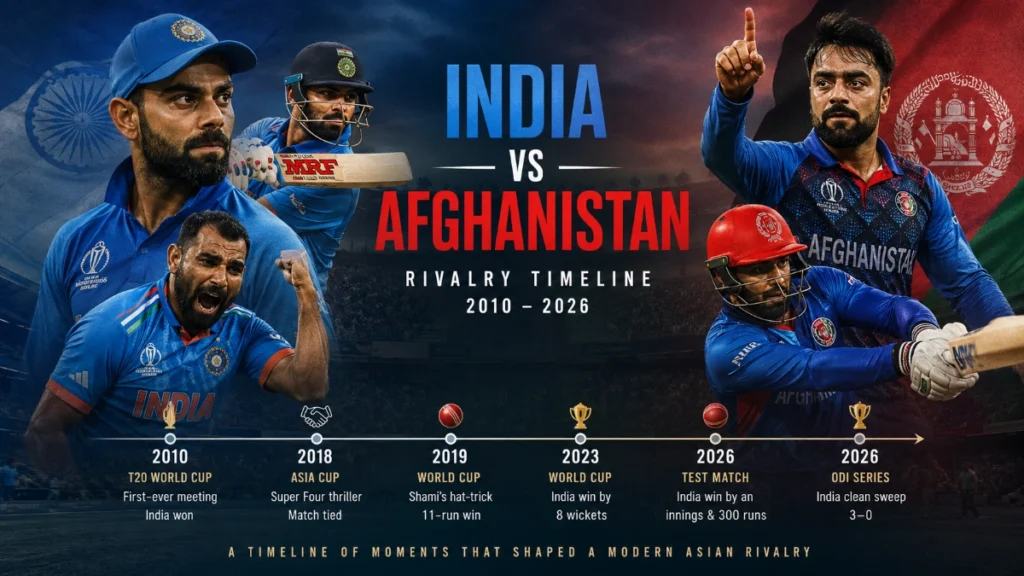

The India vs Afghanistan cricket timeline began in 2010 and has remained one-sided, with India unbeaten across Tests, ODIs and T20Is. Despite India’s dominance, several matches, including the 2018 Asia Cup tie and the 2019 World Cup thriller, came within a single decisive moment, making this rivalry more competitive than the overall record suggests.
India vs Afghanistan Head-to-Head Record
India have won every completed match against Afghanistan across all three formats, with one tied ODI in the Asia Cup and one no-result at the Asian Games. The gap looks wider on paper than it has often felt on the field.
Overall Match Record by Format
The table below breaks down results by format based on completed international fixtures through the June 2026 bilateral series.
| Format | Matches Played | India Won | Afghanistan Won | Tied/No Result |
| Tests | 2 | 2 | 0 | 0 |
| ODIs | 4 | 3 | 0 | 1 (tied) |
| T20Is | [Insert total T20I count] | [Insert wins] | 0 | 0 |
Why the Head-to-Head Looks So One-Sided
Squad depth explains most of the gap: India’s bench strength across batting and bowling has repeatedly absorbed Afghanistan’s best spells without the innings unraveling. Afghanistan’s core group, built around Rashid Khan and Mohammad Nabi, has produced pressure but rarely a complete match-winning performance against India specifically.
The Early Years: 2010 to 2014
Afghanistan’s first meetings with India were shaped by their status as an emerging associate nation still adjusting to top-tier bowling attacks. These early games set a pattern of competitive starts followed by India’s superior depth taking over in the closing stages.
Afghanistan’s T20 World Cup Debut Against India
On 1 May 2010, Afghanistan met India for the first time at the T20 World Cup in the West Indies, with India winning by seven wickets after restricting Afghanistan to 115. Ashish Nehra’s 3/19 was the key bowling contribution, while Murali Vijay’s 48 anchored a comfortable chase.
India’s Bowling Plan on Debut
India used pace early to remove Afghanistan’s top order before spin closed down scoring options through the middle overs. That template, attack with seam first and strangle with spin later, has reappeared in several subsequent meetings between the two sides.
2018: The Asia Cup Tie and a Historic Test Debut
The year 2018 turned this fixture from a formality into genuine theatre, producing both Afghanistan’s closest result against India and their maiden Test appearance. Both events reshaped how seriously Indian fans and broadcasters treated the rivalry.
The Dubai Super Four Thriller
Afghanistan and India tied their Asia Cup Super Four match on 25 September 2018 in Dubai after India were held to 252 and Afghanistan matched the target exactly. Mohammad Nabi’s all-round display carried Afghanistan deep into the chase before the finish went no further than a tie.
Why Afghanistan Couldn’t Finish the Chase
Afghanistan lost regular wickets in the final overs, which meant required-run pressure and dwindling batting resources arrived simultaneously. India’s death bowlers varied pace through the slower ball rather than bowling only yorkers, which cut off the boundary options Afghanistan needed to get ahead of the tie.
Afghanistan’s First Test Match
Weeks later, Afghanistan played their maiden Test, and India won by an innings and 262 runs inside two days after bowling Afghanistan out twice in the same session. Afghanistan’s batting had almost no first-class red-ball experience at that level, which showed immediately against India’s seam-spin combination.
Rashid Khan’s Captaincy Baptism
Rashid Khan captained Afghanistan in that debut Test, a role he would return to years later against the same opponents. Leading a side with almost no Test pedigree against a settled Indian attack was always going to be a steep introduction, regardless of the final margin.
2019 World Cup: Shami’s Hat-Trick Rescue
At the 2019 ODI World Cup in Southampton, Afghanistan again threatened an upset before India closed the game out in the final over. This match is still regarded as the benchmark for how close the fixture has actually been beneath a lopsided overall record.
Match Summary
India were reduced to 224/8 batting first, well below a competitive total by modern World Cup standards. Afghanistan’s chase, built around Mohammad Nabi, kept the result in doubt into the final stages.
India’s Batting Struggles
Afghanistan’s spin trio restricted India’s top order through tight lines outside off stump, denying the boundary balls India typically relies on to build totals. That bowling discipline, rather than any batting collapse, was the reason India’s total stayed below par.
Shami’s Final-Over Hat-Trick
Mohammed Shami took a hat-trick in the final over to seal an 11-run win, dismissing Afghanistan’s last recognized batters in consecutive deliveries. It remains one of the most decisive tournament-saving spells in India’s World Cup history.
Tactical Turning Point
The turning point arrived when Afghanistan needed roughly 16 runs from the final over with wickets in hand, a position that should have favored the chasing side. Shami’s decision to attack the stumps with full-length deliveries, rather than banking on width, removed Afghanistan’s ability to free their arms.
Why Afghanistan Nearly Pulled Off the Upset
Afghanistan’s middle order rotated strike effectively against India’s seamers earlier in the innings, keeping the required run rate manageable until the death overs. Their downfall came from a lack of finishing depth, with recognized batters running out before the equation was settled.
2021 to 2022: T20 World Cup and Asia Cup Battles
The rivalry cooled into more comfortable territory during the pandemic-affected years, with India winning both major tournament meetings by wide margins. Afghanistan’s batting order remained top-heavy, and India’s bowlers exploited that repeatedly.
Momentum Swings in the Shortest Format
India won by 66 runs at the 2021 T20 World Cup and by 101 runs at the 2022 Asia Cup, both wins built on early wickets that forced Afghanistan into rebuilding mode too early in a 20-over innings. A scheduled Asian Games final between the sides in Hangzhou produced no result, with India awarded gold on seeding.
Rashid Khan’s Limited Impact Against India’s Top Order
Despite his IPL success, Rashid Khan has rarely dominated India’s specific top order, partly because Indian batters face comparable wrist spin regularly in domestic and franchise cricket. That familiarity blunts a weapon that troubles most other teams far more severely.
2023 World Cup: A Statement Win in Delhi
By the 2023 ODI World Cup, Afghanistan had already beaten England, Pakistan, and Sri Lanka in the same tournament, making this Delhi fixture a genuine test rather than a formality. India still won comfortably, by eight wickets with 90 balls to spare.
Bowling Plans That Shut Down Afghanistan’s Middle Order
India’s seamers attacked the stumps through the middle overs rather than bowling wide defensive lines, denying Afghanistan’s middle order any easy rotation of strike. That approach prevented the acceleration Afghanistan had used to beat higher-ranked teams earlier in the tournament.
Field Placements and Pressure Building
India kept an extra fielder in the ring during overs 11 to 40, cutting off the ones and twos Afghanistan’s batters relied on to build momentum. Removing that release valve forced risk-taking shots that led directly to India’s wickets.
2024: A Three-Match T20I Series in India
India hosted Afghanistan for a full bilateral T20I series in early 2024, a rare scheduling slot given how infrequently the boards had shared a full series before this point. The series gave a transitional Indian squad direct exposure to Rashid Khan’s variations in home conditions.
Testing a Young Indian Squad Against Spin
Several fringe Indian players used the series to build experience against high-quality wrist spin ahead of bigger assignments later in the year. Afghanistan also tested batting depth away from home, though results again favored the hosts across all three games.
The 2026 Multi-Format Series
Afghanistan’s tour of India from June 6 to June 20, 2026 marked their first full multi-format tour of India, combining a one-off Test with a three-match ODI series. It also gave a young Indian squad a proving ground ahead of the England assignment that followed.
The Only Test: An Innings Victory at Mullanpur
India declared on 564/8 before bowling Afghanistan out twice to win by an innings and 300 runs, one of the heaviest Test margins involving India in recent years. Afghanistan’s red-ball resources remain limited compared with their white-ball strength, and this result underlined that gap clearly.
Why Afghanistan’s Batting Collapsed Twice
Afghanistan’s batters struggled against extra bounce and seam movement on a pitch that offered little for their spin-reliant attack to exploit in return. Without a genuine red-ball opening partnership, India’s pacers found early swing and never let the innings settle.
ODI Series Sweep: Dharamsala, Lucknow, Chennai
India completed a 3-0 sweep, winning by seven wickets in Dharamsala on June 13, by 170 runs in Lucknow on June 17, and by nine wickets in Chennai on June 20 while chasing 218 inside 29 overs. Shubman Gill led the side after Virat Kohli was ruled out through a hamstring injury from the IPL 2026 final, with Yashasvi Jaiswal drafted in as replacement.
Captaincy and Squad Depth Under Gill
Gill rotated bowling combinations across all three venues rather than relying on a fixed attack, using conditions at each ground, drier in Lucknow, more seam-friendly in Dharamsala, to shape his lineup. That flexibility, alongside Jaiswal’s smooth transition into the middle order, was the clearest sign of India’s depth beyond its established core.
Closest Matches Between India and Afghanistan
Two results stand apart from an otherwise one-sided head-to-head: the tied 2018 Asia Cup Super Four game and the 11-run 2019 World Cup finish. Both matches turned on a handful of deliveries rather than a broader gap in quality.
Ranking the Nearest Upsets
The table below ranks the tightest completed matches by margin.
| Match | Year | Result | Margin |
| Asia Cup Super Four, Dubai | 2018 | Tied | 0 runs |
| ODI World Cup, Southampton | 2019 | India won | 11 runs |
| T20I series opener | 2024 | India won | [Insert margin] |
Biggest Winning Margins
India’s largest wins over Afghanistan have come in the Test format, where the gap in experience and conditions preparation is widest. The 2026 Mullanpur Test produced the heaviest margin between the two sides to date.
Where India’s Dominance Has Been Clearest
The table below lists India’s most emphatic results across formats.
| Match | Year | Format | Margin |
| Mullanpur | 2026 | Test | Innings and 300 runs |
| Bengaluru | 2018 | Test | Innings and 262 runs |
| Lucknow ODI | 2026 | ODI | 170 runs |
Complete India vs Afghanistan Cricket Timeline Table
For readers who want the full India vs Afghanistan cricket timeline at a glance, the table below lists every major meeting in chronological order.
| Year | Format | Venue | Result |
| 2010 | T20I | West Indies (World Cup) | India won |
| 2018 | ODI | Dubai (Asia Cup) | Tied |
| 2018 | Test | Bengaluru | India won |
| 2019 | ODI | Southampton (World Cup) | India won |
| 2023 | ODI | Delhi (World Cup) | India won |
| 2024 | T20I | India (bilateral series) | India won |
| 2026 | Test | Mullanpur | India won |
| 2026 | ODI | Dharamsala/Lucknow/Chennai | India won 3-0 |
Why India Have Never Lost to Afghanistan
India’s unbeaten run comes down to batting depth and repeated exposure to spin-heavy attacks in domestic cricket, which blunts Afghanistan’s biggest weapon before it becomes decisive. Afghanistan’s bowling has created scares, but their batting has lacked the depth to finish games India’s way.
The Batting Depth Advantage
India’s top six typically carries three or four players capable of both anchoring and accelerating, a luxury Afghanistan’s order has lacked beyond its top three. That depth allowed India to recover from early trouble in both the 2018 tie and the 2019 World Cup game without the innings fully unraveling.
Domestic Spin Exposure as a Hidden Factor
Indian batters face high-quality wrist and finger spin routinely through IPL and domestic cricket, which explains why Rashid Khan and Mujeeb Ur Rahman have troubled India in patches but rarely dismantled the order completely. That familiarity is arguably a bigger factor than raw batting talent alone.
Afghanistan’s Spin Threat Against India’s Top Order
Rashid Khan, Mujeeb, and Nabi form one of the more dangerous spin combinations in white-ball cricket, and they have created genuine pressure in the middle overs during several meetings. Against that, India’s collective depth has usually meant one recovery act is enough to see out the innings.
What the 2026 Series Means for Both Teams
The 2026 multi-format series offered both boards a read on squad depth ahead of a busier international calendar later in the year. For India, it confirmed bench strength; for Afghanistan, it exposed the gap that still separates their red-ball and white-ball units.
India’s Squad Depth Statement
With Kohli unavailable and Rohit Sharma managing his own workload, India winning every match of the series signaled depth beyond the established core. Selectors used the tour to trial combinations, including Jaiswal’s elevated role, ahead of the subsequent ODI series against England starting July 14.
Afghanistan’s Development Under the Radar
For Afghanistan, the tour offered rare exposure to a full multi-format itinerary against a top-ranked side, even though results did not shift their way. Their Test structure remains the clearest growth area, while their ODI unit continues to show competitiveness in patches without yet converting that into a win over India.
Frequently Asked Questions
-
When did India and Afghanistan first play each other in cricket?
India and Afghanistan first met on 1 May 2010 at the ICC Men’s T20 World Cup in the West Indies, where India won by seven wickets after restricting Afghanistan to 115.
-
Has Afghanistan ever beaten India in international cricket?
No, Afghanistan has never beaten India in a completed international match across Tests, ODIs, or T20Is. The closest result was a tied ODI at the 2018 Asia Cup Super Four stage.
-
What was the closest match between India and Afghanistan?
The 2018 Asia Cup Super Four game in Dubai ended in a tie, while the 2019 World Cup match in Southampton saw India win by just 11 runs after a Mohammed Shami hat-trick.
-
How many times have India and Afghanistan played Test cricket?
India and Afghanistan have played two Tests, in 2018 at Bengaluru and in 2026 at Mullanpur, with India winning both by an innings.
-
Who is Afghanistan’s key bowler against India?
Rashid Khan has been Afghanistan’s central figure against India since 2015, and he also captained the side in their maiden Test appearance against India in 2018.
-
What happened in the 2026 India vs Afghanistan series?
India won the one-off Test by an innings and 300 runs at Mullanpur, then completed a 3-0 ODI sweep across Dharamsala, Lucknow, and Chennai between June 6 and June 20, 2026.
-
Why does India rarely lose to Afghanistan despite Afghanistan’s strong spin attack?
India’s batters face comparable spin regularly in domestic and franchise cricket, which reduces the shock value of Afghanistan’s attack. Combined with greater batting depth, this has repeatedly allowed India to recover from early pressure.
-
Who captained India during the 2026 series against Afghanistan?
Shubman Gill captained India for the 2026 series after Virat Kohli was ruled out with a hamstring injury sustained during the IPL 2026 final.
-
What is India’s overall head-to-head record against Afghanistan?
India have won every completed match against Afghanistan across formats, with one tied ODI at the 2018 Asia Cup and one no-result at the Asian Games.
-
Did Mohammed Shami’s hat-trick come against Afghanistan?
Yes, Mohammed Shami took a hat-trick in the final over of India’s 2019 World Cup match against Afghanistan in Southampton, sealing an 11-run win.
-
Is Afghanistan improving faster in ODIs or Tests against India?
Afghanistan has shown far more competitiveness in ODIs, including the 2018 tie and 2019 near-upset, than in Tests, where their two matches against India have both ended in innings defeats.