
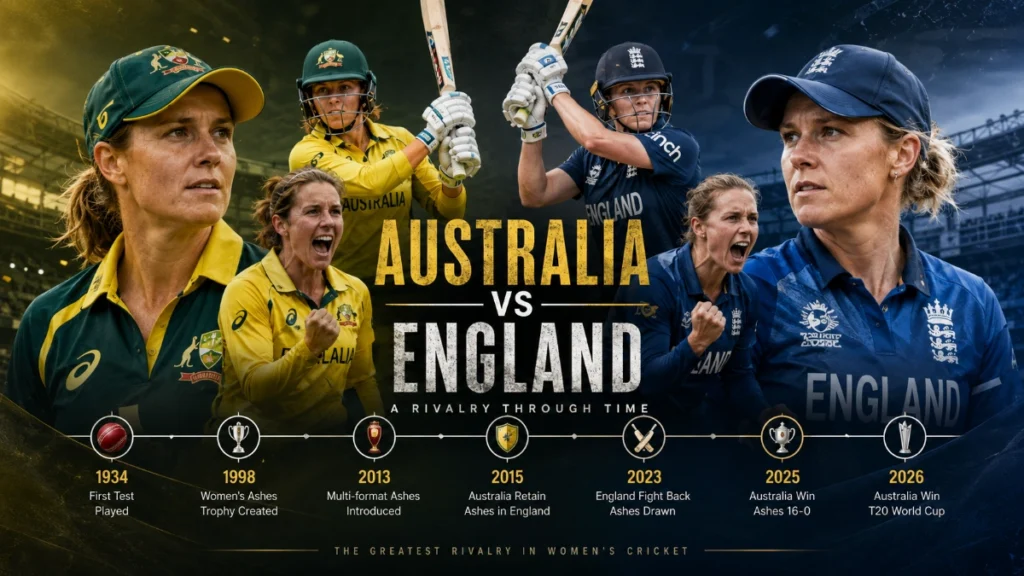

Australia Women vs England Women is the premier rivalry in women’s cricket because it combines nearly a century of Ashes history with repeated clashes in World Cups across Tests, ODIs and T20Is. Australia lead most historical records, while England remain their closest long-term challenger. That balance of history and competitiveness reached its newest chapter on July 5, 2026, when Australia beat England by seven wickets at Lord’s to win a record seventh Women’s T20 World Cup title.
Australia Women vs England Women Head-to-Head Record
Australia hold the overall edge across every format against England, though the margins vary sharply depending on venue and match type. Australia lead T20Is 23-21, ODIs 61-24, and have won the majority of Test meetings since 1934, giving them the strongest cross-format record in the women’s game.
| Format | Matches Played | Australia Wins | England Wins |
| Tests | 12 | 8 | 1 (3 draws) |
| ODIs | 89 | 61 | 24 |
| T20Is | 45 | 23 | 21 |
Head-to-Head By Format
Each format tells a slightly different story about where England can realistically compete and where Australia’s advantage is nearly unassailable.
Tests
Test matches between the two sides are rare, but Australia’s recent record is dominant, including a 2025 innings victory that ended the series 16-0 within the multi-format Ashes points system. England’s last Test win over Australia came years earlier, reflecting a gap in red-ball depth that has widened as fixtures have grown scarcer.
ODIs
Australia’s 61-24 ODI record reflects consistent depth in middle-order batting and a spin attack that has troubled England’s top order for over a decade. England’s ODI wins have typically come when their new-ball bowlers strike early, denying Australia the platform their batting order relies on.
T20Is
T20Is are the closest format, with Australia’s 23-21 lead built on stronger death-bowling execution rather than raw batting superiority. England have historically performed better at home in this format, narrowing the gap when conditions and crowd support favor them.
Greatest Women’s Ashes Matches
Five encounters stand out as the defining moments of this rivalry, each reshaping how the two boards and players approached the contest afterward. These matches span from the earliest Test tour to the most recent World Cup final.
A Timeline Of Defining Clashes
The table below places these matches in chronological order to show how the rivalry’s stakes escalated over time.
| Year | Match | Significance |
| 1934 | First Ashes Test | Founding fixture of the rivalry, pre-trophy era |
| 2013 | First Multi-Format Ashes | Introduced points-based format across three disciplines |
| 2023 | Drawn Ashes Series | England’s most credible recent challenge to Australia |
| 2025 | 16-0 Whitewash | Complete Australian sweep across all formats |
| 2026 | T20 World Cup Final | Australia’s record seventh world title |
Why The 2023 Draw Still Matters
England’s ability to draw the 2023 Ashes remains the clearest evidence that Australia’s dominance is not automatic. That series showed England could compete when their top order clicked and their bowlers built sustained pressure across multiple sessions.
How Australia’s Style Changed Across Eras
Australia’s approach to this rivalry has shifted fundamentally from a Test-first mentality before 2013 to an aggressive, white-ball-driven identity today. That evolution explains why recent margins have widened even as overall talent gaps have narrowed.
Before The Multi-Format Ashes
Prior to 2013, both nations prioritized Test cricket, with tours built around a single long-format series rather than a compressed multi-discipline contest.
Test-First Strategy
Teams selected primarily for red-ball technique, valuing patience and defensive solidity over the aggressive strokeplay that defines the current era. This approach suited England’s traditional strengths in seam bowling on responsive home pitches.
Modern White-Ball Era
Since 2013, Australia have restructured their entire pathway around white-ball skills, prioritizing power-hitting and death-over specialists in domestic selection. The shift changed the type of player each system produces.
Aggressive Powerplay Batting
Australia’s top order now targets boundary options in the first six overs at a significantly higher rate than a decade ago, forcing opposing captains to set defensive fields earlier than they would prefer. This tempo advantage often decides T20I matches before the middle overs even begin.
Spin-Heavy Middle Overs
Australia’s reliance on wrist-spin and off-spin through overs seven to fifteen has become their signature tactical weapon, restricting scoring while manufacturing wickets through variation. Alana King exemplified this approach during the 2025 Ashes, repeatedly breaking partnerships in that phase.
Elite Fielding Standards
Catching and ground fielding have become measurable differentiators, with Australia converting half-chances into wickets at a higher rate than most rivals, according to match commentary from recent series. That fielding discipline compounds pressure created by their bowling plans.
Key Players Across Eras
Certain players have defined this rivalry in each generation, shaping how fans and analysts remember specific series. Comparing them across eras shows how the rivalry’s tactical demands have evolved alongside the players themselves.
Standout Performers By Generation
The players below represent distinct periods of the Australia Women vs England Women contest, from the all-format era to the current white-ball generation.
| Player | Team | Era | Signature Trait |
| Ellyse Perry | Australia | 2010s-2020s | All-format versatility |
| Meg Lanning | Australia | 2010s-2020s | Captaincy and batting control |
| Heather Knight | England | 2015-present | Leadership under pressure |
| Beth Mooney | Australia | 2020s-present | Chase-anchoring batting |
| Nat Sciver-Brunt | England | 2015-present | Middle-order stabilization |
| Sophie Ecclestone | England | 2018-present | Left-arm spin control |
Beth Mooney’s Growing Legacy
Mooney’s unbeaten 64 in the 2026 final extended a pattern of match-winning innings in must-win Australia Women vs England Women fixtures, reinforcing her reputation as a big-occasion player. Her method relies on rotating strike consistently rather than relying purely on boundary hitting, which reduces scoreboard pressure during tight chases.
Why Australia Keep Winning
Australia’s sustained edge comes from four compounding factors rather than any single advantage: batting depth, fielding standards, spin-bowling variety and bench strength. Each factor reduces the margin for error England need to find to close the gap.
Batting Depth
Australia’s lineup regularly features batters at positions six and seven capable of match-winning innings, a luxury England’s domestic structure has not consistently produced. This depth means early wickets rarely translate into the collapses that decide matches against thinner batting orders.
Spin Attack And Bench Strength
Australia’s spin options extend beyond a single frontline bowler, allowing captains to rotate matchups against specific England batters without losing control. Combined with a domestic system that continuously produces replacement-level talent, this bench strength lets Australia absorb injuries or form dips without a corresponding drop in results.
Tactical Breakdown Of The 2026 Final
Australia’s seven-wicket win over England at Lord’s on July 5, 2026 hinged on a second-wicket partnership between Beth Mooney and Phoebe Litchfield that dismantled England’s bowling plans in the middle overs. That stand removed the scoreboard pressure England needed to control the chase.
Field Placements And Bowling Changes
England repeatedly held deep square and long-on to deny boundary options, but Mooney countered by rotating strike through cover and midwicket rather than forcing risky boundary shots. That tactical patience forced England to abandon their attacking fields before the death overs, effectively deciding the chase well before the final five overs began.
Sophie Ecclestone’s Limited Impact
England’s premier spinner, Sophie Ecclestone, finished with just one wicket for 24 runs, a modest return against a lineup that rarely allowed her sustained rhythm through consecutive overs. Australia’s approach of targeting her early with aggressive intent limited her ability to settle into the tight lines that usually define her spells.
What’s Next For This Rivalry
England’s most urgent priority is rebuilding batting depth and finding bowlers capable of disrupting Australia’s powerplay tempo before the next Women’s Ashes cycle begins. Reports suggest England’s selectors are reviewing domestic pathways specifically to address this gap ahead of the next multi-format series.
Likely Tactical Adjustments
England are expected to prioritize left-arm pace options and more aggressive powerplay fields to disrupt Australia’s top order before it settles, based on patterns from their most competitive recent series. Whether this adjustment translates into results will likely depend on personnel changes just as much as tactics.
Players Expected To Define The Next Chapter
Phoebe Litchfield and emerging England batters are likely to shape the next phase of Australia Women vs England Women contests, as both boards look toward younger cores replacing established veterans. The next multi-format Ashes series, expected on the future tours program, will offer the clearest test of whether England’s adjustments have closed the gap.
Frequently Asked Questions
-
Why is Australia Women vs England Women the biggest rivalry in women’s cricket?
It combines nearly a century of Ashes history with repeated World Cup meetings across Tests, ODIs and T20Is. Australia lead most head-to-head records, while England remain their closest long-term rival across formats
-
How many times have Australia and England women played each other in T20Is?
The two sides have met 45 times in T20Is, with Australia holding a narrow 23-21 lead. Two of those matches were decided by Super Overs.
-
What is Australia’s ODI record against England Women?
Australia have won 61 of 89 ODIs against England, giving them the strongest cross-format advantage of any bilateral rivalry in women’s cricket.
-
When did the Women’s Ashes become an official trophy?
The Women’s Ashes became an official trophy in 1998, formalized jointly by Australian and English cricket boards decades after the first Test in 1934.
-
Why has Australia dominated England in recent years?
Australia have dominated through superior squad depth, disciplined spin bowling, elite fielding and consistent middle-order batting. Their ability to maintain pressure across all match phases has produced sustained success in Ashes series and ICC tournaments
-
What happened in the 2025 Women’s Ashes series?
Australia swept England 16-0 across the multi-format series, winning every T20I and ODI plus the single Test by an innings and 122 runs.
-
Who won the 2026 Women’s T20 World Cup final?
Australia beat England by seven wickets at Lord’s on July 5, 2026, winning a record seventh Women’s T20 World Cup title
-
What was the defining moment of the 2026 final?
The defining moment came through Beth Mooney and Phoebe Litchfield’s second-wicket partnership, which stabilized Australia’s chase after an early wicket and removed scoreboard pressure.
-
Has England ever beaten Australia in a Women’s Ashes series recently?
England’s most recent success was a drawn series in 2023, their most credible challenge to Australia’s dominance in the multi-format era.
-
Who are the key players in the Australia Women vs England Women rivalry?
Key figures include Ellyse Perry, Meg Lanning and Beth Mooney for Australia, and Heather Knight, Nat Sciver-Brunt and Sophie Ecclestone for England, spanning multiple eras of the rivalry.
-
What does England need to improve to beat Australia?
England need greater batting depth at positions six and seven, plus bowling variety capable of disrupting Australia’s powerplay tempo, based on patterns from their most competitive recent series.