
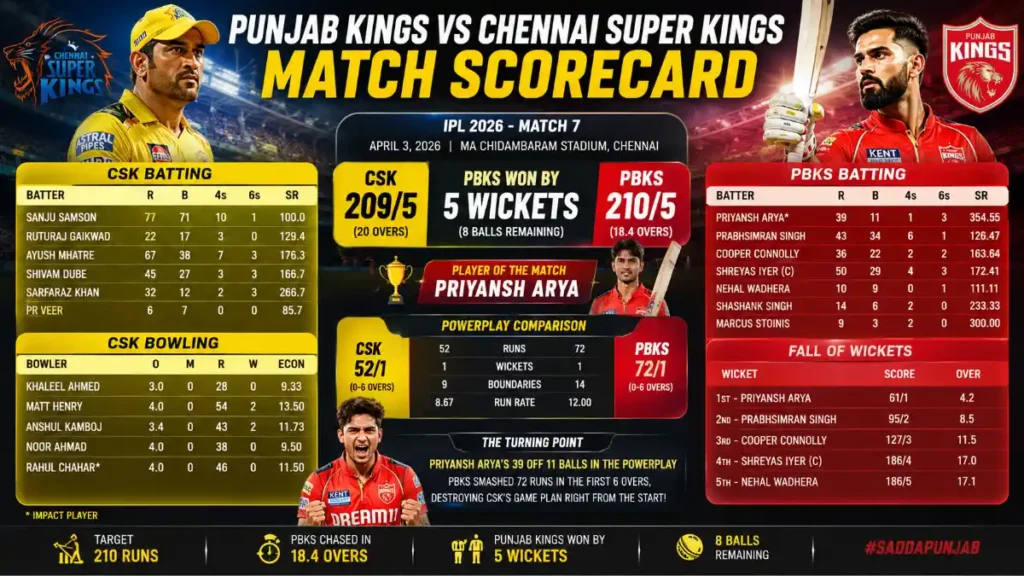

209 runs on the board. A partisan home crowd. The most storied franchise in IPL history is defending their fortress at Chepauk. Most teams would have buckled under the weight of that chase.
Punjab Kings didn’t just win. They dismantled it.
In IPL 2026 Match 7, played on April 3 at MA Chidambaram Stadium in Chennai, Punjab Kings defeated Chennai Super Kings by 5 wickets with 8 balls remaining. The result was emphatic. The manner was calculated. And the tactical decisions that shaped this game deserve far deeper examination than a scorecard alone can provide.
This is the complete Punjab Kings vs Chennai Super Kings match scorecard, with full batting and bowling stats, turning points, tactical breakdowns, and everything that a standard scorecard page leaves out.
Match Result at a Glance
Before diving into the analysis, here is the snapshot every fan is looking for:
| Detail | Info |
| Match | IPL 2026, Match 7 |
| Venue | MA Chidambaram Stadium, Chennai |
| Date | April 3, 2026 |
| CSK Score | 209/5 (20 overs) |
| PBKS Score | 210/5 (18.4 overs) |
| Result | Punjab Kings won by 5 wickets |
| Player of the Match | Priyansh Arya |
What most people assume about Chepauk is that it perpetually favors the home side – slow pitch, gripping spin, a suffocating atmosphere. What actually unfolded here challenged that narrative entirely. The surface played truer and faster than expected, and PBKS exploited it with batting intelligence from the very first ball.
Internal link suggestion: “IPL 2026 Points Table – Updated Standings After Match 7.”
Full CSK Batting Scorecard – First Innings
CSK’s innings of 209/5 was built on partnerships and calculated aggression, rather than a single commanding knock. The top order contributed in bursts, but the innings lacked the finishing crescendo that could have taken the target to an unassailable 225 or beyond.
CSK Batting Breakdown
| Batter | R | B | 4s | 6s | SR |
| Sanju Samson | 7 | 7 | 1 | 0 | 100.0 |
| Ruturaj Gaikwad | 22 | 17 | 3 | 0 | 129.4 |
| Ayush Mhatre | 67 | 38 | 7 | 4 | 176.3 |
| Shivam Dube | 45 | 27 | 3 | 3 | 166.7 |
| Sarfaraz Khan | 32 | 12 | 2 | 3 | 266.7 |
| PR Veer | 6 | 7 | 0 | 0 | 85.7 |
Ayush Mhatre’s 67 off 38 balls was the innings that gave CSK their platform. At 96/2 at the halfway stage, CSK looked squarely on course for 220-plus. But here is what most analysts glossed over entirely.
The Middle-Over Collapse Nobody Talked About
Between overs 13 and 16, CSK scored only 26 runs and lost two wickets. That is a scoring rate of roughly 6.50 per over during a phase where a team batting at this level should be pushing 10-plus. That four-over slowdown cost CSK approximately 15 to 18 additional runs – runs that may well have changed the result of this match.
What people think: CSK batted brilliantly and posted a competitive total.
What actually happened: CSK’s innings peaked too early, lost shape in the critical consolidation phase, and relied on late cameos from Sarfaraz Khan to prop up the final tally.
Sarfaraz Khan’s 32 off 12 balls at a strike rate of 266.7 deserves more credit than it received. Without that late acceleration, CSK were staring at a target closer to 190.
CSK Bowling Figures Against PBKS
CSK deployed five bowlers in their defense of 209, with Rahul Chahar arriving as the Impact Player substitution in place of Kartik Sharma. The bowling figures tell a story of complete powerlessness against PBKS’s batting intent.
CSK Bowling Breakdown
| Bowler | O | M | R | W | Econ |
| Khaleel Ahmed | 3.0 | 0 | 28 | 0 | 9.33 |
| Matt Henry | 4.0 | 0 | 54 | 2 | 13.50 |
| Anshul Kamboj | 3.4 | 0 | 43 | 2 | 11.73 |
| Noor Ahmad | 4.0 | 0 | 38 | 0 | 9.50 |
| Rahul Chahar (Impact) | 4.0 | 0 | 46 | 0 | 11.50 |
Matt Henry was CSK’s most effective wicket-taker, claiming 2 wickets across his four overs. But an economy of 13.50 illustrates precisely why wickets alone did not matter on this occasion. PBKS were scoring so freely that even the bowlers who dismissed batters were still getting punished.
Not one CSK bowler finished with an economy rate below 9.33. That is a collective bowling collapse, not a series of individual failures. The field placements in the powerplay phase appeared reactive rather than pre-planned – CSK consistently offered Priyansh Arya room outside off stump, which is precisely the zone that a batter striking at 354.55 will devastate.
That was a planning failure. Not a bowling failure.
Internal link suggestion: “Anshul Kamboj IPL 2026 bowling stats – full season breakdown.”
Full PBKS Batting Scorecard – Second Innings
This is where the match was truly decided. Punjab Kings came out with a game plan that was visible from the opening delivery – attack the powerplay hard, neutralize CSK’s spin options early, and allow the middle order to consolidate rather than chase at panic-inducing rates.
PBKS Batting Breakdown
| Batter | R | B | 4s | 6s | SR |
| Priyansh Arya (Impact) | 39 | 11 | 3 | 4 | 354.55 |
| Prabhsimran Singh | 43 | 34 | 6 | 1 | 126.47 |
| Cooper Connolly | 36 | 22 | 6 | 0 | 163.64 |
| Shreyas Iyer (C) | 50 | 29 | 4 | 3 | 172.41 |
| Nehal Wadhera | 10 | 9 | 0 | 1 | 111.11 |
| Shashank Singh | 14 | 6 | 2 | 0 | 233.33 |
| Marcus Stoinis | 9 | 3 | 2 | 0 | 300.00 |
Fall of Wickets – PBKS
| Wicket | Score | Over |
| 1st – Priyansh Arya | 61/1 | 4.2 |
| 2nd – Prabhsimran Singh | 95/2 | 8.5 |
| 3rd – Cooper Connolly | 127/3 | 11.5 |
| 4th – Shreyas Iyer | 186/4 | 17.0 |
| 5th – Nehal Wadhera | 186/5 | 17.1 |
Two wickets fell in two consecutive balls at the score of 186 in over 17. 24 runs needed off 17 balls. Two fresh batters at the crease. That was CSK’s only genuine window to mount a comeback. Shashank Singh and Marcus Stoinis shut that window in under three overs, sealing the win with eight balls remaining.
Key Match Stats – Powerplay Comparison
| Metric | CSK PP | PBKS PP |
| Runs scored | 52/1 | 72/1 |
| Boundaries hit | 9 | 14 |
| Run rate | 8.67 | 12.00 |
| Wickets lost | 1 | 1 |
PBKS won the powerplay battle by an enormous margin. Scoring 72 runs in the first six overs of a 210-run chase effectively ended the contest before it had fully begun.
The Real Turning Point – Priyansh Arya’s 39 off 11 Balls
Most scorecard pages show you Arya’s figures as a number. They rarely explain it as a match-defining tactical event.
Priyansh Arya entered the match as PBKS’s Impact Player substitution – a deliberate pre-match decision by Shreyas Iyer to deploy the most destructive powerplay batter available precisely when fielding restrictions made him most dangerous. By the end of over 4.2, PBKS had already posted 61 runs. The required run rate had collapsed from 10.50 to approximately 8.20 before CSK’s preferred death-bowling options had even completed two overs each.
Why This Was Tactical Mastery, Not Just Batting Violence
What people think happened: PBKS overpowered CSK through brute force hitting.
What actually happened: The Impact Player rule was weaponized with precision. Arya’s substitution meant PBKS could deploy their most explosive batter during the maximum fielding restriction window – without sacrificing a regular batting position for the middle overs. This is strategic innovation dressed up as entertainment.
A strike rate of 354.55 means Arya scored a run every 0.28 deliveries in a T20 chase, which translates to starting the innings with an approximate 20-run headstart, entirely for free. No other single tactical decision in this match came close to having that level of impact.
Internal link suggestion: “Top Impact Player performances in IPL 2026 – ranked by match impact.”
Shreyas Iyer’s Captain’s Knock – The Innings Everyone Undervalued
Most post-match coverage gravitated toward Arya. The deeper reading of this Punjab Kings vs Chennai Super Kings match scorecard points firmly at Shreyas Iyer’s 50 off 29 as the innings that kept PBKS calm and clinical throughout.
How Iyer Controlled the Chase
After the powerplay explosion, PBKS still needed someone to bridge the gap between the carnage of the first five overs and the final assault. Iyer walked in at 61/1 and carried the chase from that point to 186/4 across nearly 13 overs, at a strike rate of 172.41.
That is not a cautious innings. That is controlled acceleration – precisely the skill that separates a captain’s knock from a batter’s knock. He never allowed CSK to establish a bowling rhythm, consistently rotating strike while finding boundaries off anything slightly short or full.
Cooper Connolly’s 36 off 22 balls was the partnership contribution that went criminally unnoticed. Six boundaries, zero sixes – pure gap-threading on a fast outfield. CSK’s bowlers had no set field to counter a batter who refused to go aerial. Connolly and Iyer built the third-wicket stand of 32 that effectively buried the chase beyond CSK’s reach.
Why Chepauk Played Differently – The Venue Factor
The MA Chidambaram Stadium has an established reputation for assisting spinners and producing slower surfaces. Historical first-innings averages at this venue in IPL T20s tend to sit in the 160 to 180 range, making CSK’s 209 and PBKS’s successful chase of 210 genuinely unusual results by Chepauk standards.
What Changed on This Night
- Dew factor: Evening conditions in Chennai during the IPL window typically introduce significant dew from over 10 onward, making spin holding less effective in the second innings
- Pace of the outfield: The ground played noticeably faster than expected, with boundaries coming from drives that would have been stopped in the infield on a slower surface
- First-innings scoring rate: CSK’s run rate of 10.45 per over in the first innings confirmed the surface was offering more to batters than Chepauk typically does
This context matters enormously. A 210-run target at Chepauk is not the same as a 210-run target at the Wankhede. PBKS’s chase was impressive. It was also aided by conditions that CSK’s bowlers were powerless to control.
CSK’s Structural Problem – What the Scorecard Cannot Show You
CSK scored 209. That is a strong total by any T20 standard. They still lost comfortably. The question that deserves a direct answer is: why?
The answer lies in how CSK’s innings structure created a false sense of defensive security. Their total appeared competitive, but the innings trajectory – explosive start, middle-over stagnation, late recovery – produced a score that looked stronger than the momentum behind it.
Three Reasons CSK’s Bowling Failed
- No bowler went under 9.33 economy – a collective breakdown, not individual failure.
- Field settings in the powerplay were reactive – Arya was given room outside off on multiple deliveries, exactly where he scores most freely.
- Impact Player choice backfired – Rahul Chahar’s 0/46 from four overs as the Impact substitution produced negative match value at the critical juncture.
CSK’s total appeared competitive enough that the team entered the innings break without urgency to alter their bowling game plan. A team defending 185 would have planned with sharper precision. At 210, there was a structural complacency that PBKS exposed from the opening over.
Internal link suggestion: “CSK IPL 2026 season review – what went wrong.”
IPL 2026 Context – What This Result Meant
After this victory in the Punjab Kings vs Chennai Super Kings match, PBKS moved to 4 wins from 4 games, sitting second in the IPL 2026 standings with 7 points and a net run rate of +0.720.
CSK, meanwhile, dropped to just 2 points from 4 matches, with a net run rate of -1.532 – one of the worst figures in the tournament at that early stage.
This was not simply a match result. It was a statement about team architecture. PBKS under Shreyas Iyer had developed the rarest combination in T20 cricket – an explosive top order and a calm, calculated finish. That duality is structurally very difficult to defend against because you cannot set one type of field for both phases simultaneously.
PBKS vs CSK Head-to-Head – Recent Results
| Match | Year | Venue | Winner | Margin |
| IPL 2026, Match 7 | 2026 | Chennai | PBKS | 5 wickets |
| IPL 2025, Match 22 | 2025 | New Chandigarh | PBKS | 18 runs |
| IPL 2024, Match 53 | 2024 | Dharamsala | CSK | 28 runs |
PBKS have now won back-to-back encounters against CSK. The 2025 result – a 219/6 total successfully defended – demonstrated that this PBKS group can bowl and defend. The 2026 result demonstrated they can also chase 210 at Chepauk with composure. That versatility makes them a genuine title contender, not just a dangerous team on good days.
Internal link suggestion: “PBKS vs CSK all-time head-to-head history – full record since 2008”.
Match Timeline – Key Moments
| Over | Event |
| 0.1–6.0 | PBKS powerplay: 72/1 – Arya blitzes 39 off 11 |
| 6.1–10.0 | Prabhsimran Singh steadies; 95/2 at over 8.5 |
| 10.1–12.0 | Connolly and Iyer build; chase under full control |
| 17.0–17.1 | Double wicket – 186/5, CSK’s final window |
| 18.4 | Stoinis finishes; PBKS seal the win by 5 wickets |
Player of the Match – Priyansh Arya
Priyansh Arya was awarded Player of the Match for his extraordinary 39 off 11 balls as PBKS’s Impact Player substitution. His innings was the decisive blow in this Punjab Kings vs Chennai Super Kings contest – arriving at the most favorable moment, targeting the field restriction window, and collapsing the required run rate before CSK’s key bowlers had warmed up.
Three fours and four sixes in 11 deliveries. A strike rate of 354.55. A powerplay score of 72/1 that made a 210-run chase look like a training exercise. That is the definition of a match-winning performance.
Frequently Asked Questions
Q1. What was the final score in the Punjab Kings vs Chennai Super Kings IPL 2026 match?
CSK scored 209/5 in 20 overs. Punjab Kings chased it down in 18.4 overs, finishing at 210/5. Punjab Kings won by 5 wickets with 8 balls remaining.
Q2. Who won the Punjab Kings vs Chennai Super Kings match in IPL 2026?
Punjab Kings won Match 7 of IPL 2026 by 5 wickets, chasing 210 runs at MA Chidambaram Stadium, Chennai.
Q3. Who was Player of the Match in PBKS vs CSK IPL 2026 Match 7?
Priyansh Arya was named Player of the Match for his explosive 39 off 11 balls as PBKS’s Impact Player, striking at 354.55 during the powerplay.
Q4. Who was the top scorer for CSK in this match?
Ayush Mhatre top-scored for CSK with 67 off 38 balls, striking at 176.3. Shivam Dube (45 off 27) and Sarfaraz Khan (32 off 12) provided crucial support.
Q5. Who was PBKS’s highest scorer in this match?
Shreyas Iyer scored the highest individual total for PBKS – 50 off 29 balls at a strike rate of 172.41. Priyansh Arya’s 39 off 11 as an Impact Player was the most impactful innings of the chase.
Q6. What was the turning point of the PBKS vs CSK IPL 2026 match?
The turning point was Priyansh Arya’s powerplay assault as Impact Player, scoring 39 off 11 balls and reducing the required run rate from 10.50 to approximately 8.20 by the end of over four.
Q7. Who were the Impact Players used in PBKS vs CSK IPL 2026?
PBKS used Priyansh Arya in place of Yuzvendra Chahal. CSK brought in Rahul Chahar in place of Kartik Sharma. Arya’s substitution proved match-defining; Chahar’s substitution produced 0/46.
Q8. Which CSK bowler was most effective in this match?
Matt Henry and Anshul Kamboj each took 2 wickets. Henry was CSK’s best bowling option, though his economy of 13.50 reflects how freely PBKS scored throughout.
Q9. How did this result affect the IPL 2026 standings?
Punjab Kings moved to 7 points from 4 matches (4 wins, 0 losses) with an NRR of +0.720. CSK dropped to 2 points from 4 matches with an NRR of -1.532.
Q10. Why did CSK lose despite scoring 209?
CSK’s bowling had no specialist capable of containing the powerplay. No bowler finished under 9.33 economy. The fielding plans in the first six overs were reactive rather than pre-set, allowing PBKS to post 72/1 and remove the tension from the chase entirely before it began.