
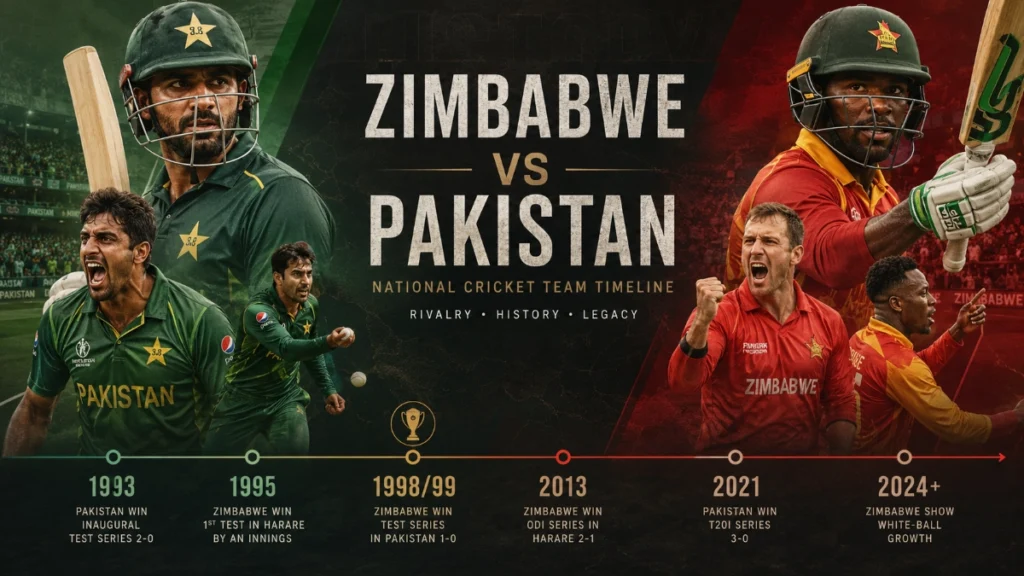

This Zimbabwe national cricket team vs Pakistan national cricket team timeline traces a rivalry dominated by Pakistan across Tests, ODIs, and T20Is since 1993. Zimbabwe have still produced enough shocks — a 1998/99 Test series win in Pakistan, an innings victory in Harare, a Bulawayo chase in 2024 — to make this fixture worth tracking closely heading into 2026.
How Lopsided Is the Zimbabwe vs Pakistan Head-to-Head Record?
Pakistan leads decisively in every format, though the gap is narrowest in Test cricket and widest in the 50-over game. Zimbabwe’s 1998/99 series win remains the biggest exception to a head-to-head record that otherwise reads as one-sided.
| Format | Matches | Pakistan Wins | Zimbabwe Wins | Draws/Ties/NR |
| Tests | 19 | 12 | 3 | 4 |
| ODIs | 65 | 56 | 6 | 3 |
| T20Is | [Insert stat] | [Insert stat] | [Insert stat] | [Insert stat] |
Test Cricket Since 1993
Pakistan has won 12 of 19 Tests, Zimbabwe 3, with 4 draws — a ratio that undersells how disruptive those three Zimbabwean wins were, each arriving at moments when Pakistan looked complacent rather than genuinely outplayed.
ODI Record and Win Percentage
Pakistan’s white-ball superiority is starker still: 56 wins from 65 ODIs, against Zimbabwe’s 6, with 1 tie and 2 no-results. Zimbabwe’s rare wins have almost always come batting first and posting a total well above par, since chasing Pakistan’s seam attacks has rarely worked.
Home vs Away Split
Pakistan’s home Test record against Zimbabwe is close to flawless, but the away record tells a different story — the 1998/99 Peshawar defeat and the 2013 Harare loss both came on tours where Pakistan’s batting approach was passive rather than assertive. That pattern, two losses on the road against a side with a fraction of Pakistan’s resources, is a coaching and selection issue as much as a form one.
T20I Record
The shortest format has historically been Pakistan’s most one-sided hunting ground, though Zimbabwe’s improved batting depth has narrowed that gap noticeably since 2020. Pakistan still leads the head-to-head count comfortably, but recent series have been far less predictable than the all-time numbers suggest.
What Happened in the Early Years of This Rivalry?
Pakistan opened the rivalry with a comfortable Test series win in December 1993, but Zimbabwe answered within fourteen months with one of the biggest upsets in their cricketing history. That early volatility set a template this fixture has followed ever since — long stretches of Pakistani control interrupted by sharp, well-timed Zimbabwean strikes.
Karachi and Rawalpindi Set the Template
Pakistan won the inaugural series 2-0, taking the first Test in Karachi by 131 runs and the second in Rawalpindi by 52 runs, fielding a pace attack built around Wasim Akram and Waqar Younis that Zimbabwe’s batting lineup simply had no answer for. It was professional, efficient cricket that suggested a permanent gulf in class between the two boards.
The Harare Upset of 1995 Changed the Conversation
Zimbabwe bowled Pakistan out twice to win the first Test in Harare by an innings and 64 runs after declaring at 544 for 4, a result that should have forced an immediate rethink in Pakistan’s dressing room. Pakistan responded by winning the next two Tests to close out the series 2-1, but the damage to the narrative of automatic superiority was already done.
Why the Innings Defeat Actually Mattered
An innings defeat against a side of Zimbabwe’s standing in the mid-1990s was a genuine tactical failure, not a statistical blip — Pakistan’s top order folded twice against bowling that had no business troubling a lineup of that pedigree. Calling it an outlier undersells it; it exposed a vulnerability to complacency that would resurface in Peshawar three years later.
Zimbabwe’s Bowling Plan That Won the Match
Zimbabwe’s attack in that Harare Test relied on patient, back-of-a-length bowling into a pitch offering more bounce than pace, forcing Pakistan’s batsmen into false shots rather than searching for wickets through sheer aggression. That discipline, sustained across two innings, was the actual difference-maker — not luck, and not a below-par Pakistan XI on paper.
Why Did Zimbabwe’s 1998/99 Series Win Matter So Much?
Zimbabwe’s win at Peshawar in November 1998 stands as the single biggest result in this rivalry because it came on Pakistani soil against a full-strength home side. It remains proof that Zimbabwe’s peak-era squads could beat Pakistan on merit, not just frustrate them into a draw.
The Peshawar Stunner
Chasing after restricting Pakistan to totals of 296 and 103, Zimbabwe completed a 7-wicket win to seal their first-ever series victory over Pakistan. Pakistan’s collapse to 103 in the second innings was the decisive moment of the match, and it was self-inflicted.
Pakistan’s Second-Innings Collapse
Pakistan’s batting approach in that second innings was passive when the situation demanded intent, and that hesitancy against a Zimbabwe attack without a genuine strike bowler is the real story of the defeat. It ranks among the more avoidable series losses in Pakistan’s Test history and deserved sharper scrutiny at the time.
Zimbabwe’s Winning Strategy
Zimbabwe’s bowlers targeted a fourth-day pitch that was starting to grip, bowling to a defensive off-side field designed to strangle scoring rather than chase wickets through pace. That patience, paired with Pakistan’s batsmen refusing to rotate the strike, turned a gettable target into a collapse.
The 2002/03 Response
Pakistan answered four years later, sweeping both Tests of their 2002/03 tour of Zimbabwe by 119 runs and 10 wickets. That whitewash confirmed Peshawar had been an aberration rather than a shift in class between the two programs.
Wasim and Waqar’s Tactical Reset
Wasim Akram and Waqar Younis returned to full fitness for that tour and reverted to the exact plan that had worked in 1993 — full, swinging deliveries early, followed by relentless pace into the middle overs. Their combined control took the initiative away from Zimbabwe’s top order before it could build any partnership of substance.
How Has Pakistan Reasserted Control in the Modern Era?
From 2011 onward, Pakistan has been almost untouchable in Test cricket against Zimbabwe, with the sole blemish arriving in 2013. That stretch represents the most consistent period of superiority either side has produced in this fixture’s history.
Bulawayo 2011 and the Return of Test Cricket
Pakistan’s solitary Test in Zimbabwe in September 2011 ended in a 7-wicket win that reflected a widening resource gap more than any specific tactical brilliance, with Zimbabwe’s Test infrastructure still recovering from a self-imposed hiatus.
The 2013 Split and Zimbabwe’s Last Test Win to Date
Pakistan won the first Test of the 2013 series by 221 runs, but Zimbabwe hit back to win the second by 24 runs at Harare — their most recent Test win over Pakistan as things stand. That chase, executed under real pressure, deserves credit as a well-run innings rather than a fluke.
Misbah’s Era and a Missed Opportunity
Under Misbah-ul-Haq, Pakistan had the personnel to sweep that series and simply did not close it out, dropping intensity in the decisive fourth innings. That lapse against a side with a fraction of Pakistan’s resources was a genuine tactical failure, and a sharper red-ball team wins that series 2-0.
The 2021 Double Innings Win
Pakistan’s most recent Test tour of Zimbabwe, in April-May 2021, produced two innings victories — by an innings and 116 runs, then an innings and 147 runs — under Babar Azam’s captaincy.
Babar Azam’s Bowling-First Blueprint
Babar’s tactical approach in that series leaned on early new-ball pressure from the seamers rather than waiting for spin to work, attacking Zimbabwe’s top order before it could settle. That front-loaded plan, rather than raw talent gap alone, explains why both results ended inside four days.
Tactical Evolution of Pakistan Against Zimbabwe
Pakistan’s method against Zimbabwe has shifted from pure pace intimidation in the 1990s to a more calculated, situational attack built around early wickets and tighter fielding restrictions. That evolution mirrors changes in Pakistan’s broader captaincy philosophy across three decades.
Pace Strategy Across Eras
Wasim Akram and Waqar Younis relied on reverse swing and raw pace to blow away Zimbabwe’s top order quickly, a method that worked because Zimbabwe’s batting technique against high pace was historically its biggest weakness. Modern Pakistan seamers have kept that early-wicket priority but added more variation in length, reflecting flatter modern pitches.
Spin Usage and Captaincy Philosophy
Spin has typically played a containing role against Zimbabwe rather than a strike-bowling one, brought on to build pressure in the middle overs once the seamers have done early damage. That containment-first philosophy has stayed consistent from Wasim’s captaincy through to Babar Azam’s.
How Captaincy Approaches Shifted from Wasim to Babar
Wasim’s captaincy was reactive and confrontational, setting aggressive fields and backing his bowlers to force errors. Babar’s approach is more structured, built around pre-planned bowling changes and data-informed field settings — a shift that reflects cricket’s broader move toward analytics-driven captaincy.
Zimbabwe’s Biggest Tactical Victories
Zimbabwe’s three wins over Pakistan in Test cricket share a common thread: disciplined, patient bowling exploiting moments of Pakistani complacency rather than isolated brilliance. Each victory came from a specific, identifiable tactical decision rather than luck.
1995 Harare Innings Win
Zimbabwe’s bowlers stuck to a defensive line outside off stump on a pitch offering bounce, refusing to feed Pakistan’s strengths and forcing false strokes across both innings.
1998 Peshawar and 2013 Harare Chases
Both wins came from Zimbabwe’s batting units playing with more patience than Pakistan expected, absorbing pressure in the middle overs before accelerating late — a template Zimbabwe has tried to repeat in white-ball cricket since.
What Zimbabwe’s Bowlers Got Right
In each of these three Test wins, Zimbabwe’s attack avoided bowling too short at Pakistan’s middle order, instead targeting a fuller length that induced mistakes rather than gifting width to cut and pull. That specific line-and-length discipline, more than any single spell, explains the wins.
Which Individual Performances Defined This Rivalry?
Wasim Akram and Waqar Younis dominated the ball for Pakistan, while Brendan Taylor and Sikandar Raza have carried Zimbabwe’s batting hopes in recent decades. Their contributions explain most of the rivalry’s turning points better than team-level totals do.
Pakistan’s Bowling Greats: Wasim Akram and Waqar Younis
Wasim and Waqar’s reverse-swing partnership through the 1990s repeatedly dismantled Zimbabwe’s top order inside the first hour of an innings, setting the tone for whitewash after whitewash. Their control of both new-ball and old-ball swing gave Pakistan’s captains a tactical weapon Zimbabwe simply could not match.
Zimbabwe’s Match-Winners: Brendan Taylor and Sikandar Raza
Brendan Taylor’s composure against pace anchored several of Zimbabwe’s competitive totals in the 2010s, while Sikandar Raza’s all-round value in white-ball cricket has been central to Zimbabwe’s improved results since 2020. Raza’s ability to both stabilize an innings and bowl containing spin in the middle overs makes him the rivalry’s most influential Zimbabwean player of the modern era.
Inzamam-ul-Haq’s Overlooked Impact
Inzamam-ul-Haq’s middle-order batting against Zimbabwe rarely gets the same attention as Pakistan’s bowling attack, but his ability to rebuild innings after early wickets kept several Pakistan totals competitive when the top order faltered. That underrated consistency deserves more credit than it typically receives.
How Competitive Has the Limited-Overs Rivalry Been Recently?
Pakistan’s white-ball superiority has been tested more visibly since 2020 than at any earlier point in this rivalry, largely because Zimbabwe’s batting depth has genuinely improved. The December 2024 Bulawayo T20I series is the clearest recent evidence of that shift.
The Bulawayo 2024 T20I Series
Pakistan won the first two T20Is comfortably — by 57 runs and then by 10 wickets — before Zimbabwe won the third by 2 wickets. That dead-rubber win showed a Zimbabwe batting order capable of closing out a tight chase against full-strength Pakistan bowling.
Death-Overs and Powerplay Shifts
Zimbabwe’s winning chase relied on smarter powerplay scoring, taking calculated risks against the new ball rather than simply blocking, which set up a manageable equation heading into the death overs. Pakistan’s death bowling, by contrast, lacked variation that night, sticking to yorkers that Zimbabwe’s batters had already picked.
The 2025/26 Tri-Series Meetings
The two sides met again in a T20I tri-series hosted in Pakistan in November 2025, with Pakistan winning their head-to-head fixture by 5 wickets. The specific margins across every match in that multi-team event still warrant careful verification, but the broader trend of tighter limited-overs cricket between these two sides has continued.
What Do the Statistical Trends Reveal?
Pakistan’s average winning margin against Zimbabwe has narrowed gradually in white-ball cricket since 2020, even as the overall head-to-head count remains heavily in Pakistan’s favor. Decade-by-decade splits show Zimbabwe’s competitiveness rising specifically in T20Is rather than the longer formats.
| Period | Test Result Trend | ODI/T20I Result Trend |
| 1993–1998 | Pakistan 2-0, Zimbabwe 1 shock win | Pakistan dominant |
| 1999–2010 | Pakistan whitewash (2002/03) | Pakistan dominant |
| 2011–2020 | Pakistan 3, Zimbabwe 1 (2013) | Pakistan mostly dominant |
| 2021–Present | Pakistan 2-0 (2021 tour) | Zimbabwe more competitive |
Average Winning Margins and Home vs Away Splits
Pakistan’s average Test winning margin against Zimbabwe at home exceeds an innings in several recent fixtures, while away wins have generally been narrower and occasionally reversed, as 1998 and 2013 showed. That home-away gap reflects conditions familiarity as much as squad strength.
How Has the Rivalry Changed Since 1993?
The rivalry has moved through four distinct phases: early Pakistani control disrupted by Zimbabwe’s 1995 shock, Zimbabwe’s peak competitiveness around 1998/99, a long stretch of one-sided Pakistani dominance from 2011–2020, and a narrowing white-ball gap from 2021 onward.
| Era | Defining Result | Rivalry Character |
| 1993–1998 | Harare innings win (1995) | Unpredictable, early Zimbabwean upsets |
| 1999–2010 | 2002/03 whitewash | Pakistan reasserts total control |
| 2011–2020 | 2013 Harare Test win | Mostly one-sided, one exception |
| 2021–Present | 2024 Bulawayo T20I win | Test gap wide, white-ball gap narrowing |
Why Future Pakistan vs Zimbabwe Series Could Look Different
Zimbabwe’s improving pace attack and Pakistan’s ongoing squad transition make the next series between these sides harder to predict than the historical record suggests. Emerging players on both sides, combined with ICC scheduling and World Cup qualification stakes, could push this rivalry toward genuinely competitive territory for the first time in over a decade.
Zimbabwe’s Emerging Pace Attack
Zimbabwe’s fast-bowling cupboard has historically been its weakest department against Pakistan, but recent domestic pace prospects suggest that gap could close if given consistent international exposure. A credible pace threat, paired with Zimbabwe’s already-improved batting depth, would change the calculus of any future Test series.
Pakistan’s Transitional Phase and World Cup Qualification Stakes
Pakistan’s squad is mid-transition across formats, and that kind of instability has been exploited by Zimbabwe before — Peshawar 1998 and Harare 2013 both came during periods of Pakistani selection uncertainty. With World Cup qualification implications increasingly tied to bilateral results against associate-adjacent Test nations, neither board can afford to treat these fixtures as routine anymore.
The Subplot Worth Watching
If Zimbabwe’s white-ball progress since 2020 carries over into red-ball cricket, the next full Test series is unlikely to be another straightforward sweep. That is a reasonable read of a trend line visible since the 2024 Bulawayo series, and it is the single most interesting subplot the next time these two boards schedule a full tour.
Frequently asked Questions
1. Who has won more matches in Zimbabwe vs Pakistan cricket history?
Pakistan has won the clear majority of meetings across all three formats — 56 of 65 ODIs and 12 of 19 Tests — making them statistically the far stronger side in this fixture’s overall history.
2. When did Zimbabwe first beat Pakistan in a Test match?
Zimbabwe recorded their first Test win over Pakistan in January 1995 in Harare, winning by an innings and 64 runs after declaring on 544 for 4 in their first innings.
3. What was Zimbabwe’s biggest upset over Pakistan?
Zimbabwe’s 1998/99 Test series win in Peshawar and Bulawayo is widely regarded as their biggest upset, since it came on Pakistani soil against a full-strength home side.
4. How many Test series has Zimbabwe won against Pakistan?
Zimbabwe has won one Test series against Pakistan, the 1998/99 tour, out of the multiple series contested between the two nations since 1993.
5. When was Zimbabwe’s last Test win over Pakistan?
Zimbabwe’s most recent Test win over Pakistan came in the second Test of the 2013 series at Harare, a 24-run victory that remains their last as things stand.
6. Who are the key players in the Zimbabwe vs Pakistan rivalry?
Wasim Akram and Waqar Younis defined Pakistan’s dominance in the 1990s, while Brendan Taylor and Sikandar Raza have been Zimbabwe’s most influential players in the modern era.
7. How competitive has the T20I rivalry been recently?
Zimbabwe won the third T20I of the December 2024 Bulawayo series after losing the first two, signaling improved batting depth even though Pakistan still leads the format overall.
8. Did Pakistan win their most recent Test tour of Zimbabwe?
Yes, Pakistan won both Tests of their April-May 2021 tour of Zimbabwe by an innings and 116 runs, then an innings and 147 runs.
9. What happened in the 2025/26 Pakistan T20I tri-series against Zimbabwe?
Pakistan won their head-to-head fixture against Zimbabwe in the November 2025 tri-series by 5 wickets, though full series-wide results across the multi-team event should be checked against official ICC or Cricinfo records.
10. Could Zimbabwe become more competitive against Pakistan in future series?
Zimbabwe’s improving white-ball depth and any progress in developing genuine pace bowling options suggest future series could be closer than the historical head-to-head record implies, particularly in limited-overs formats.