
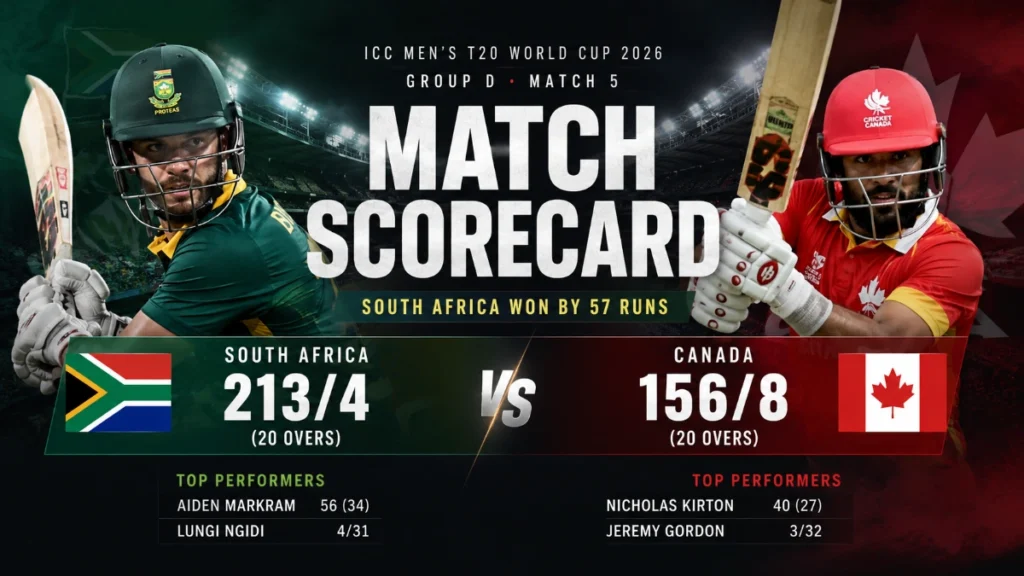

The South Africa national cricket team vs Canada national cricket team match scorecard tells you 213/4 plays 156/8 and a 57-run win, but that only scratches the surface of how this T20 World Cup clash in Ahmedabad was actually decided.
This game was shaped by powerplay intent, pace-bowling matchups, and South Africa’s ruthless use of resources, not just by a big total on a flat pitch.
Match Overview: Scoreline, Stakes, And Setting
In a Group D fixture of the ICC Men’s T20 World Cup 2026 at the Narendra Modi Stadium in Ahmedabad, South Africa posted 213/4 in 20 overs, before restricting Canada to 156/8, sealing a 57‑run victory.
For South Africa, this was their opening statement of the tournament; for Canada, it was a brutal reminder of the gap between an established full-member side and an emerging associate team under tournament pressure.
South Africa beat Canada by 57 runs in the T20 World Cup 2026 after scoring 213/4 and limiting Canada to 156/8 in Ahmedabad, with their pace attack and powerplay dominance deciding the contest.
Phase-wise runs and wickets
| Phase | Team | Runs | Wickets | Approx Run Rate |
| Powerplay (0–6) | South Africa | 65 | 0 | 10.8 |
| Powerplay (0–6) | Canada | 50 | 4 | 8.3 |
| Middle (7–15) | South Africa | ~90 | 2 | 8–9 |
| Middle (7–15) | Canada | ~70 | 2–3 | 7–8 |
| Death (16–20) | South Africa | ~60 | 2 | 12+ |
| Death (16–20) | Canada | ~35 | 2–3 | 7–8 |
Why This Match Matters Beyond The Scorecard
This wasn’t just another one-sided World Cup fixture; the South Africa national cricket team vs Canada national cricket team match scorecard plugs directly into Group D dynamics and South Africa’s long-term narrative of inconsistency in ICC events.
A heavy-margin win gave them a Net Run Rate cushion, a repeatable batting template, and confidence that their pace attack can boss conditions in Ahmedabad.
Group D and narrative stakes
- Group D context: In a group with heavyweight rivals, a big win against an associate side reduces risk later if results are tied on points.
- Narrative reset: South Africa’s history of slipping against lower-ranked teams makes a clinical performance against Canada more than just routine – it’s a psychological reset.
- Tournament pattern: The way they structured this win – disciplined batting, clear bowling plans, controlled fielding – is exactly the repeatable template you want in a long tournament.
The Scorecard In Context: Numbers That Actually Matter
The South Africa national cricket team vs Canada national cricket team match scorecard can be reduced to a few key numbers, but their context is what turns raw data into insight.
Core numbers
- South Africa: 213/4 in 20 overs
- Canada: 156/8 in 20 overs
- Margin: South Africa won by 57 runs
- Result type: High-scoring game where the chasing team never truly threatened
What the raw numbers hide
- South Africa lost only four wickets, which means their batting resources were intact almost throughout.
- Canada lost four wickets inside the first six overs, which meant their chase was in damage-control mode before the halfway mark.
- The run rate gap wasn’t just about scoring; it was about who controlled risk and who was forced into desperation.
Phase Analysis: Powerplay, Middle Overs, Death Overs
If you want to understand why South Africa dominated, you break the match into phases, not just innings. That’s how elite teams read a South Africa national cricket team vs Canada national cricket team match scorecard – phase-by-phase, pressure-by-pressure.
Powerplay: Where The Match Was Tilted
In the first six overs, South Africa’s openers played with calculated aggression, pushing the score to around 65 without losing a wicket.
This start gave them both scoring momentum and psychological control, forcing Canada’s captain into defensive fields earlier than he would have liked.
Canada’s reply in the powerplay was the mirror opposite: around 50 runs for the loss of four wickets.
On paper, that run rate looks acceptable; in reality, the wicket column killed their chase. Once you’re four down in the power play chasing 214, the required rate and risk explode together.
Key takeaway:
- South Africa: High runs, zero damage
- Canada: Decent runs, heavy damage
The powerplay didn’t just set up South Africa’s total; it pre-broke Canada’s chase before the middle overs even started.
Middle Overs: South Africa Consolidate, Canada Survive
In overs 7–15, South Africa’s batters shifted gear into controlled accumulation.
The captain and middle-order batters ensured the innings never dipped into stagnation: singles, twos, and selective boundary hitting maintained a healthy run rate while protecting wickets.
Canada, by contrast, spent the middle overs repairing rather than pressing.
Their main batter in this phase was forced to balance survival and scoring, a compromise that kept his strike-rate respectable but never let the chase truly catch up with the asking rate.
Death Overs: South Africa Accelerate, Canada Choke On The Ask
Because South Africa carried set batters and wickets into the last five overs, they could unleash full death-overs aggression.
The total jumped meaningfully in overs 16–20, pushing the target beyond “par” into the “this needs a miracle” category.
Canada reached the death overs already needing well above 12 an over, with a fragile lower order.
At that point, they weren’t chasing a total; they were trying to salvage respectability. Mis‑hits, slog attempts, and failed risks were inevitable.
Key Metrics: Beyond Simple Runs And Wickets
We can’t pretend to have wagon wheels and ball-by-ball ball-by-ball dot counts in front of us here, but we can still interpret the scorecard like an analyst, using phase metrics and structural clues.
Powerplay comparison
- South Africa powerplay: High run rate, 0 wickets lost
- Canada powerplay: Healthy run rate, 4 wickets lost
The decisive difference isn’t 15 runs; it’s the four wickets.
Those four dismissals are basically four future overs of hitting potential removed from the chase.
Boundary and dot-ball pressure
South Africa’s early control over field placements allowed it to:
- Cut boundary options in key zones
- Force Canada into high-risk strokes for fours and sixes
- Use dots and singles to build scoreboard pressure
Canada’s bowlers, on the other hand, were dragged into:
- Too many boundary balls in the power play
- Defensive fields in the middle overs
- A death phase where their lengths were dictated by the batters, not the plan
Run-rate by phase: implied trends
From the South Africa national cricket team vs Canada national cricket team match scorecard, you can tell:
- South Africa kept run-rate above 8–9 across phases with a surge at the end
- Canada spiked early but flattened out after the collapse, with the required rate always a step ahead of their scoring
That’s what real analysis looks like: how the rate evolved with wickets, not just who got to 200.
Tactical Breakdown: Why South Africa Won
South Africa didn’t just “hit well”; they followed a clear batting template:
- Openers: Attack the powerplay, hit the seamers off their lengths, and push the field out early.
- Number 3 and 4: Use the middle overs to stabilize the innings while still rotating strike.
- Finishers: Walk in with freedom because the top order has both scored quickly and preserved wickets.
This is the exact pattern top teams use: front-loaded intent, middle-phase control, death-overs burst.
In a tournament like this, one of the reasons you want the South Africa national cricket team vs Canada national cricket team match scorecard documented properly is that it becomes a blueprint for future games.
Pace Attack Strategy: Matchups, Not Just Speed
South Africa’s pace attack wasn’t just faster; it was smarter.
- They targeted top-order right-handers with hard lengths and angles that made driving risky.
- They used short-of-good-length deliveries on a pitch where bounce was predictable, forcing mistimed pull and cut shots.
- They rotated bowlers in a way that always kept one attacking quick on, rather than going fully defensive after a boundary.
That combination meant Canada’s batters spent more time reacting than dictating.
Field Placements: Forcing The Wrong Shot
While the scorecard never prints field settings, you can logically infer that South Africa:
- Protected key boundary regions – especially straight and in the arc – during the power play
- Packed the ring when they sensed batters would search for singles under pressure
- Hunted catches with catching midwickets and slips early when the ball was new
Good captaincy shrinks a batter’s safe scoring zones; by the time the chase hit 8–9 overs, Canada were playing into a field that knew their panic options.
Where Canada Lost The Match
Canada’s openers went hard in the power play but did so without clear risk boundaries.
They treated every scoring opportunity as equal, which meant they took boundary-level risks even when singles and twos were enough to keep the chase alive.
Once two dismissals fell quickly, the next two came from accumulated pressure:
- A rising required rate
- Tight fielders cutting off release shots
- A bowling attack is happy to concede a boundary if it brings a wicket next ball
Middle-order Role Confusion
After four early wickets, the Canadian middle order had no clear definition of roles:
- Who rebuilds?
- Who takes on the bowlers?
- Who stays till the 15th over?
That confusion leads to neither full consolidation nor full aggression – a grey zone where the innings drifts and dies slowly.
Lack Of Death-overs Firepower
By the time the death overs came, Canada had:
- A high rate is required
- Mainly mid/lower-order players at the crease
- A world-class attack bowling at them with a cushion
They didn’t have the depth of power-hitters needed to turn 12–14 runs per over into a realistic chase.
So the final overs were about avoiding humiliation, not engineering a miracle.
What People Think vs Reality
Here’s the information gain you explicitly asked for.
- What people think: “Canada lost because South Africa scored 213. Any associate team would struggle chasing that.”
- Reality: Canada lost because they lost four wickets in the first six overs, turning a high but chaseable target into a near-impossible equation.
The South Africa national cricket team vs Canada national cricket team match scorecard proves this if you read it correctly:
- A different powerplay – say 70/2 instead of 50/4 – keeps the chase alive.
- The same 213 with better power play resource management could have produced a close finish.
The problem wasn’t just the size of the target; it was the structure of the chase.
Player Spotlight: Lungi Ngidi, The Difference-Maker
Ngidi’s Spell: Wickets With Strategic Weight
Lungi Ngidi’s figures of 4 wickets for 31 runs are not just aesthetically pleasing; they’re structurally decisive.
His dismissals removed Canada’s primary top-order scoring threats, ensuring that they never had the batting muscle left to mount a sustained chase.
Why his wickets mattered:
- They came early, when Canada still had theoretical control over the chase.
- Each wicket not only removed runs but also transferred pressure to less experienced batters.
- His dismissal pattern narrowed Canada’s scoring zones and inflated the required rate.
In other words, Ngidi didn’t just “clean up”; he rewrote the chase trajectory.
Player Spotlight: Aiden Markram’s Dual Role
Markram As Anchor And Enforcer
As captain and key batter, Aiden Markram balanced aggression with control:
- With bat in hand, he ensured the innings never stalled, playing the anchor-enforcer role that modern T20 No. 3s are picked for.
- His strike rotation and boundary selection meant South Africa marched steadily towards 200+ without a collapse.
As a captain:
- He kept attacking fields when Canada were under early pressure.
- He resisted the temptation to go defensive after a couple of boundaries.
- He trusted his quicks and used them in short, impactful spells instead of purely saving them for the death.
This blend of tactical calm and controlled aggression is exactly what South Africa have often lacked in big tournaments.
Player Spotlight: Kagiso Rabada’s Control Role
Rabada may not have had the most eye-catching figures, but his role was crucial:
- He bowled hard, disciplined overs that squeezed Canada’s scoring options.
- He gave Markram the luxury of having a trusted control bowler in key phases, even if he wasn’t the primary wicket-taker.
- His presence alone – pace, reputation, and accuracy – kept batters from fully committing to high-risk shots early.
In an article built around the South Africa national cricket team vs Canada national cricket team match scorecard, Rabada’s value is easy to miss, but experts always spot the control bowlers.
Impact On South Africa’s Tournament Campaign
This match did more than add two points:
- It validated their batting template – aggressive powerplay, stable middle, explosive death.
- It reinforced their belief in pace attack as the primary weapon in Indian conditions.
- It gave Markram & co a proof-of-concept performance they can replicate against stronger teams.
Net Run Rate And Group D Position
A 57-run win is a Net Run Rate asset.
In a group with multiple strong teams, these early heavy wins often decide who tops the group when points are level.
For South Africa, that means:
- More margin for error later
- Less pressure to win by massive margins in tougher fixtures
- The ability to rest or rotate slightly if they lock early qualification
Impact On Canada’s Future In The Tournament
Lessons Under Fire
From Canada’s point of view, this is a brutal lesson in:
- Powerplay game management: they must separate “positive intent” from “reckless risk”.
- Role clarity: every batter needs a defined job once early wickets fall.
- Matchup awareness: They cannot walk into a game against a world-class pace attack with generic plans.
Psychological Fallout
Getting rolled in the powerplay and then held at arm’s length across the innings hurts confidence.
The challenge for Canada now is to absorb the defeat as data, not identity:
- Accept the gap
- Fix what is fixable – especially powerplay strategy and batting order roles
- Use this match as a template of what not to do against elite pace
Frequently Asked Questions
1. What was the final result of the South Africa vs Canada T20 World Cup 2026 match?
South Africa defeated Canada by 57 runs after posting 213/4 and restricting Canada to 156/8 in their Group D clash in Ahmedabad.
2. What is important about the South Africa national cricket team vs Canada national cricket team match scorecard?
The scorecard shows not just a big South African total and a comfortable margin, but a clear pattern: South Africa preserved wickets while scoring quickly, whereas Canada lost four wickets in the powerplay and never recovered
3. Why did South Africa win so comfortably?
South Africa won because they dominated both powerplays, executed their batting template perfectly, and used their pace attack to remove Canada’s top-order scoring threats early.
4. Who was the standout bowler for South Africa?
Lungi Ngidi stood out with four wickets, using disciplined lines and clever variations to dismantle Canada’s top order and apply continuous pressure throughout the innings.
5. What went wrong for Canada in the chase?
Canada’s chase collapsed in the first six overs. They lost four wickets in the powerplay, which forced the remaining batters into survival mode while the required run rate spun out of control.
6. How did the pitch at Ahmedabad influence the match?
The pitch offered consistent bounce and good pace, making it a strong batting surface. However, that also meant disciplined fast bowling was rewarded, which played into South Africa’s strengths.
7. How did South Africa’s batting strategy differ from Canada’s?
South Africa combined aggressive scoring with wicket preservation, building a structured innings with a strong finish. Canada attacked without enough control early and then had to rebuild under enormous scoreboard pressure
8. What does this match mean for South Africa’s T20 World Cup campaign?
This performance gives South Africa an early Net Run Rate boost, validates their game plan, and builds confidence in their ability to dominate both with bat and ball in Indian conditions.
9. Did any Canadian player stand out despite the loss?
One or two Canadian batters showed resistance in the middle overs, anchoring the innings and preventing a complete collapse, but their efforts couldn’t overcome the damage done by the early wickets.
10. Why is this match important for fans to study?
Because the South Africa national cricket team vs Canada national cricket team match scorecard is a perfect case study in how T20 matches are decided by phases, matchups, and risk management, not just by final totals.