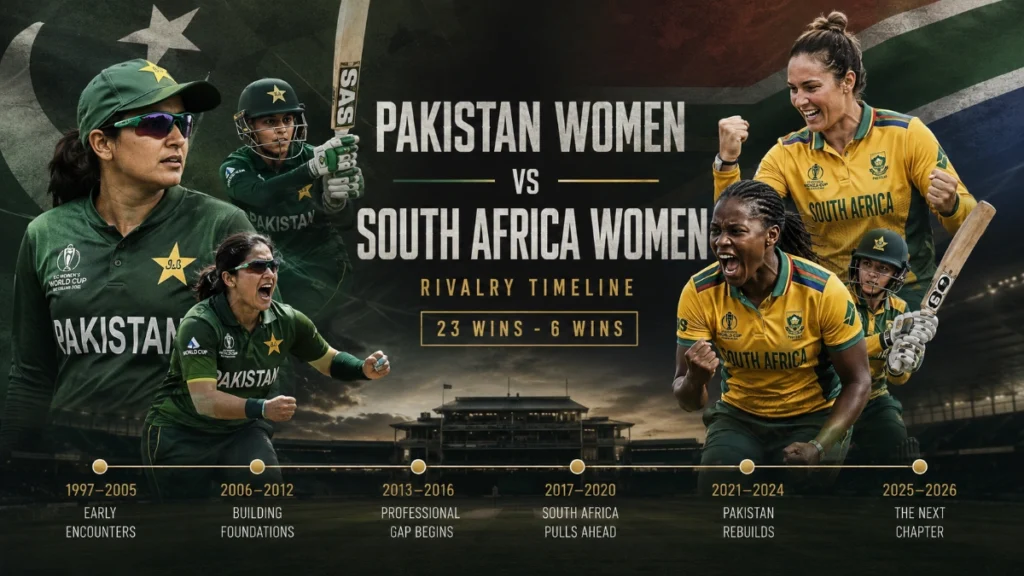

The Pakistan Women vs South Africa Women timeline covers a rivalry that began as an occasional bilateral fixture and has become one of the most one-sided in women’s cricket. Since 1997, South Africa have won 23 of 31 completed ODIs against Pakistan, and their advantage now extends into T20 World Cup cricket as well.
What Is the Pakistan Women vs South Africa Women Timeline?
The Pakistan Women vs South Africa Women timeline runs from their first meetings in the late 1990s to South Africa’s current status as a multi-time global finalist. It reflects a widening structural gap — South Africa professionalized women’s cricket earlier and built a genuine pace attack, while Pakistan has depended more on individual match-winners against stronger opposition.
A Rivalry Shaped by Uneven Investment
Pakistan’s board treated women’s cricket as a secondary priority for most of the 2000s, which limited scheduling and exposure against sides like South Africa. South Africa’s earlier move toward centralized contracts gave its players a head start that compounds with every passing cycle, and that gap is the throughline of this entire timeline rather than any single dramatic match.
Pakistan Women vs South Africa Women Timeline (Year by Year)
Broken into distinct eras, this rivalry moves from sporadic early contests through a period where South Africa pulled decisively ahead, followed by brief Pakistani upsets in 2023 that have since been reversed. Each phase below marks a real shift in form or approach, not just a change of calendar year.
2009–2012: Early, Infrequent Meetings
Pakistan and South Africa’s women’s teams met only occasionally in this period, largely at multi-team tournaments rather than dedicated bilateral tours. Angelique Taai, Dané van Niekerk and Shabnim Ismail were already troubling Pakistan’s batting order in these early T20Is, a sign of the pace depth South Africa would keep building for the next decade.
2013–2016: The Professional Gap Begins
South Africa’s board started backing its women’s program more seriously in this window, while Pakistan’s domestic structure remained comparatively thin. Pakistan still found occasional success — winning a T20I series 2-1 in the UAE in 2014/15 — but South Africa’s overall trajectory in ODIs was already trending toward dominance.
2017–2020: South Africa Pulls Clearly Ahead
This is the period where the head-to-head record tilted decisively. South Africa won a 5-match T20I series 3-2 in 2019 and followed it with a 2-1 series win in 2020/21, while their ODI win rate against Pakistan climbed well past the 70% mark across this stretch.
The 2019 Tied ODI That Almost Changed Things
A tied ODI in 2019, decided in South Africa’s favor only after Masabata Klaas denied Pakistan the winning run off the final ball, was as close as this rivalry has come to a genuine upset in this era. It’s worth calling that moment what it was — a missed opportunity for Pakistan rather than bad luck, since they had the match in hand deep into the chase.
2021–2024: Pakistan’s Brief Rebuild
Pakistan produced their best run against South Africa in over a decade during this window, winning a T20I series 3-0 on home soil in 2023 and an ODI series 2-1 in Karachi the same year. That 2023 run deserves genuine credit — it wasn’t a fluke result but a sign that Pakistan’s spin-heavy attack could trouble South Africa on slower home surfaces.
2024: South Africa’s Swift Response
South Africa toured Pakistan again in September 2024 and won the T20I series 2-1, dropping only the second match by 13 runs before closing out the decider by 8 wickets. That result mattered because it showed Pakistan’s 2023 gains hadn’t closed the underlying gap — they’d simply exploited one favorable series window.
2025–2026: South Africa’s Dominance Reasserts Itself
South Africa won the 2025 ODI series in Lahore 2-1 and then beat Pakistan by 150 runs (DLS) in the 2025 Women’s ODI World Cup in Colombo, a result with no historical parallel in this fixture’s recent record. In the 2026 Women’s T20 World Cup, South Africa beat Pakistan by 2 wickets with 19 balls to spare — their fourth consecutive win over Pakistan in T20 World Cup cricket.
Why the 2026 World Cup Result Stung More Than the Scoreline Suggests
Pakistan’s bowlers restricted South Africa to a chaseable target of 126, and losing from that position reflected fielding lapses under pressure rather than a lack of tactical planning. That’s a fielding and execution failure specifically, not a bowling one, and it’s the kind of detail that gets lost when only the final margin is reported.
Head-to-Head Record Across Formats
South Africa hold a commanding lead in ODIs and a narrower but still clear edge in T20Is, confirming this is not an evenly matched rivalry in any format. The table below reflects the most recently verified figures from ESPNcricinfo’s head-to-head records.
| Format | Matches | South Africa Wins | Pakistan Wins | Tied/No Result |
| Women’s ODI | 31 | 23 | 6 | 2 |
| Women’s T20I | 24 | 13 | 11 | 0 |
| ODI World Cup | 4 | 4 | 0 | 0 |
The ODI World Cup Gap Is the Starkest Number Here
Pakistan have never beaten South Africa at a Women’s ODI World Cup, a 4-0 record that stands apart even from the closer bilateral T20I picture. That single stat is arguably more revealing of the real gap between these sides than the overall head-to-head, since World Cup pressure tends to expose depth differences that bilateral cricket can sometimes mask.
Which Players Have Defined This Rivalry?
South Africa’s pace bowlers have been the single biggest differentiator across this fixture’s history, more than any batting matchup. Pakistan’s competitive periods, by contrast, have leaned on specific individual performances rather than consistent depth through the order.
| Player | Team | Signature Role in This Rivalry |
| Shabnim Ismail | South Africa | Early pace pressure on Pakistan’s top order from 2009 onward |
| Marizanne Kapp | South Africa | Sustained new-ball control across multiple series |
| Laura Wolvaardt | South Africa | Top-order anchor and current captain driving batting-first approach |
| Bismah Maroof | Pakistan | Long-serving captain, stabilized Pakistan’s batting through the 2010s |
| Nida Dar | Pakistan | Consistent all-round contributor across formats |
| Fatima Sana | Pakistan | Current captain, strike bowler leading a more assertive rebuild |
South Africa’s Pace Pipeline vs Pakistan’s Spin Reliance
The emergence of bowlers like Ismail and Kapp gave South Africa a consistent pace option that Pakistan’s attack — built more around spin and medium pace — has rarely had an answer for on South African or neutral pitches. This single tactical mismatch explains a meaningful share of the scoreline gap across formats, more than any batting comparison does.
Fatima Sana’s Bowling Background Could Change the Equation
Fatima Sana’s rise to the captaincy is notable specifically because she’s a strike bowler rather than a specialist batter, giving Pakistan tactical instincts at the top that its setup lacked under previous leadership. Whether that translates into closing South Africa’s pace advantage depends entirely on whether Pakistan’s board backs a genuine fast-bowling pathway, not just one captain’s instincts.
Captaincy and Tactical Evolution
Captaincy contrasts between these sides have been genuinely stark, with South Africa generally backing aggressive batting-first cricket while Pakistan’s leadership has often defaulted to caution in run-chases. That conservatism has cost Pakistan control in matches they had the bowling to win outright.
Bismah Maroof’s Long, Steady but Cautious Tenure
Maroof’s calm leadership was genuinely valuable in stabilizing a young Pakistan side through the 2010s, but her tactical conservatism in the field against South Africa’s pace attack was a repeated, avoidable weakness rather than bad fortune. Praise for her composure shouldn’t excuse how often Pakistan let South Africa’s opening bowlers dictate terms unchallenged during her captaincy.
Laura Wolvaardt’s Batting-First Philosophy
Wolvaardt’s captaincy has doubled down on an aggressive, batting-first template — and given South Africa’s depth through the order, that’s the correct call rather than a gamble. Pakistan’s captains haven’t had comparable batting depth to copy that approach even in periods when they’ve clearly wanted to.
Where Does This Rivalry Stand in 2026?
South Africa remains the clearly stronger side on current form, backed by multiple ICC final appearances and a 4-0 World Cup record, while Pakistan are mid-rebuild under Fatima Sana’s newer, more attacking captaincy. That gap is real and shouldn’t be softened, but Pakistan’s younger bowling core gives it a more credible long-term path than it’s had in years.
South Africa’s Global Pedigree Sets the Benchmark
South Africa’s run to consecutive Women’s T20 World Cup finals has made them the standard against which other developing programs, Pakistan included, are now measured against. That’s the product of a decade of structural investment, not a short-term form spike, which is why South Africa should remain favorites in this fixture for the foreseeable future.
The Next Fixture Is Pakistan’s Real Test
A confirmed bilateral series between these two sides for 2027 had not been officially announced at the time of writing, so specifics on venue and format are best treated as pending rather than assumed. Whatever comes next will be the clearest gauge yet of whether Fatima Sana’s more assertive captaincy is translating into actual results against South Africa specifically, rather than isolated wins elsewhere.
Read more: Zimbabwe vs Pakistan: The Stunning 1998 Peshawar Upset
Frequently Asked Questions
-
What is the head-to-head record between Pakistan Women and South Africa Women in ODIs?
South Africa lead Pakistan 23-6 across 31 completed Women’s ODIs since 1997, with one tie and one no-result match, making it one of the most lopsided bilateral ODI records in women’s cricket.
-
Who has captained Pakistan Women against South Africa most often?
Bismah Maroof led Pakistan through most of the 2010s and early 2020s against South Africa, before Fatima Sana took over the captaincy as part of the team’s current rebuilding phase.
-
Has Pakistan Women ever beaten South Africa Women at a World Cup?
No, Pakistan has lost all four of their Women’s ODI World Cup meetings against South Africa, a record that highlights the gap between the sides at the tournament level specifically.
-
When did Pakistan last win a series against South Africa Women?
Pakistan won a home T20I series 3-0 in 2023, their best run against South Africa in over a decade, though South Africa reversed that momentum with series wins in 2024 and 2025.
-
Why has South Africa dominated the T20 World Cup meetings between these sides?
South Africa’s win over Pakistan in the 2026 Women’s T20 World Cup was their fourth consecutive win in that tournament, specifically reflecting sustained pace-bowling depth and batting consistency Pakistan hasn’t matched at global events.
-
Who are South Africa’s most influential players in this rivalry?
Fast bowlers Shabnim Ismail and Marizanne Kapp, plus current captain Laura Wolvaardt, have been the most consistent difference-makers for South Africa across this rivalry’s history.
-
What is Pakistan Women’s biggest weakness against South Africa?
Pakistan’s reliance on spin and medium pace, rather than genuine fast bowling, has repeatedly struggled against South Africa’s top order on quicker pitches, a gap that outweighs most batting comparisons between the sides.
-
How many T20Is have Pakistan and South Africa women played against each other?
The two sides have played 24 Women’s T20Is, with South Africa holding a 13-11 edge, a considerably closer margin than their ODI head-to-head.
-
What changed in the rivalry after 2023?
Pakistan’s 2023 series wins proved to be a temporary window rather than a lasting shift, as South Africa reasserted control through 2024, 2025, and the 2026 T20 World Cup.
-
Is Fatima Sana expected to change Pakistan’s fortunes against South Africa?
Fatima Sana’s background as a strike bowler gives Pakistan a more attacking captaincy instinct, but closing the gap with South Africa will likely require sustained domestic fast-bowling investment rather than a single leadership change.
-
Where do South Africa Women rank globally compared to Pakistan?
South Africa have reached multiple Women’s T20 World Cup finals in recent cycles, placing them among the sport’s top tier, while Pakistan remain in a rebuilding phase focused on closing the structural gap.