
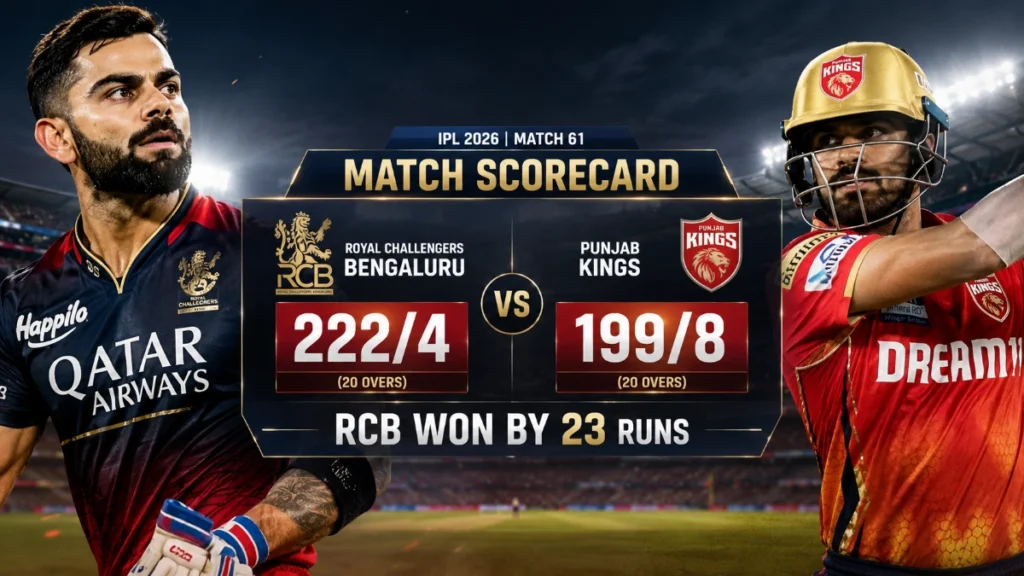

Royal Challengers Bengaluru defeated Punjab Kings by 23 runs in IPL 2026 Match 61 after scoring 222/4 and restricting PBKS to 199/8. The victory confirmed RCB as the first team to qualify for the IPL 2026 playoffs while extending Punjab Kings’ losing streak to six matches.[
RCB vs Punjab Kings Match Scorecard: Overview
The Royal Challengers Bengaluru vs Punjab Kings match scorecard read RCB 222/4 (20 overs) beat PBKS 199/8 (20 overs), with RCB winning by 23 runs at the HPCA Stadium in Dharamsala. Punjab Kings won the toss and chose to field first, a decision that backfired once RCB’s middle order accelerated in the back half of the innings
Match Result and Key Numbers
RCB’s total of 222/4 was built on contributions from three different batters crossing the 40-run mark, a rare balance that made the total difficult to chase down on a true batting surface. Venkatesh Iyer finished unbeaten on 73 off 40 balls, while Virat Kohli made 58 off 37, and Devdutt Padikkal contributed 45 off 25
In reply, Punjab Kings never found the momentum they needed, slipping to 19/3 inside the first four overs before Shashank Singh’s late surge narrowed the margin cosmetically. Harpreet Brar finished with 2 wickets for PBKS
Head-to-Head Snapshot Before This Match
A quick look at how these two franchises have historically matched up gives context to how significant this particular result was for both sides’ momentum.
| Metric | Royal Challengers Bengaluru | Punjab Kings |
| Result this match | Won by 23 runs | Lost by 23 runs |
| Playoff status after Match 61 | Confirmed | Under pressure |
| Recent form entering match | Strong middle order | Six-match losing streak |
Toss Decision and Conditions at HPCA Stadium
Punjab Kings’ decision to bowl first at Dharamsala, a venue known for supporting stroke play once the ball loses its hardness, gave RCB’s top order room to play through the powerplay without early swing troubling them for long. That early platform, despite losing Jacob Bethell off the second ball of the innings to Brar, set up everything that followed by the time Venkatesh Iyer accelerated in the closing overs
Why the Pitch Favored Batting Later in the Innings
Dharamsala’s evening surface typically hardens as dew sets in, which historically makes stroke play easier for batters facing spin after the tenth over. That pattern held true here, since both Kohli and Iyer found their best scoring rates once Chahal and Brar entered the attack rather than against the new-ball pacers.
Points Table Impact after Match 61
This result pushed Royal Challengers Bengaluru to the top of the standings with 16 points from 12 games, ahead of Gujarat Titans on net run rate at that stage of the season. Punjab Kings, in contrast, remained stuck on 13 points from 12 matches, a tally that left their qualification scenario dependent on results elsewhere
Batting Onslaught Powers RCB to 222/4
RCB’s innings turned on a middle-overs rebuild led by Padikkal and Kohli, followed by an explosive finish from Venkatesh Iyer batting out of position at No. 4. The 222/4 total was shaped by sustained pressure applied across three separate batting phases
Padikkal-Kohli Partnership Sets the Platform
After Bethell fell early, Devdutt Padikkal and Virat Kohli steadied the innings with a partnership built on quick running and controlled aggression rather than one-dimensional hitting. Padikkal’s 45 off 25 balls came at better than a run a ball, while Kohli’s 58 off 37 kept the scoreboard ticking through the middle overs without exposing RCB to a cluster of dot balls
Their stand absorbed the loss of an early wicket and denied Punjab Kings the second breakthrough they badly needed. Yuzvendra Chahal eventually dismissed Kohli, but by then the platform for a big finish had already been laid
Kohli’s Innings in Context of Season Form
Kohli’s 58 continued a pattern of measured, tempo-setting innings that RCB had relied on through the 2026 group stage rather than isolated boundary-hitting. That consistency allowed Venkatesh Iyer to arrive at the crease with the required intensity already established, rather than needing to rebuild from a stalled position.
Phase-Wise Scoring Breakdown
Breaking RCB’s innings into three phases shows exactly where the acceleration happened and why Punjab Kings struggled to adjust their lines in time.
| Phase | Overs | Approx. Run Rate | Key Contributor |
| Powerplay | 1-6 | Around 8 per over | Padikkal |
| Middle overs | 7-15 | Just under 8 per over | Kohli, Padikkal |
| Death overs | 16-20 | Beyond 12 per over | Venkatesh Iyer, Tim David |
Venkatesh Iyer’s Career-Best Knock at No.4
Promoted to No. 4 in the absence of regular captain Rajat Patidar, Venkatesh Iyer produced the standout innings of the match, remaining unbeaten on 73 off 40 deliveries. He targeted Chahal in particular, hitting the leg-spinner for two sixes in a single over, even as the bowler claimed Kohli’s wicket in that same spell
Why Promotion to No.4 Worked
PBKS repeatedly bowled into Iyer’s arc after the 15th over, allowing him to attack the shorter square boundaries with minimal risk. RCB intentionally delayed their primary finisher until spin entered the attack, maximizing the matchup advantage against Chahal rather than exposing him to the new-ball seamers early.
How PBKS Failed to Stop Iyer
Punjab Kings’ bowling changes did not adjust once Iyer found his range, continuing to attack his pads with length deliveries that sat up into his favoured hitting zone. Tim David added late impetus with a six and a four off Arshdeep Singh in the final over, pushing RCB past 220
PBKS Chase Falls Apart Early
Punjab Kings’ chase was effectively decided inside the powerplay, when disciplined new-ball bowling reduced them to 19/3 and forced the middle order into recovery mode for the rest of the innings. The chase probability dropped sharply once that top-order damage was done
Bhuvneshwar Kumar and Rasikh Dar Strike in Powerplay
Bhuvneshwar Kumar and Rasikh Dar combined to reduce Punjab Kings to 19/3 inside four overs, dismissing Prabhsimran Singh, Priyansh Arya, and captain Shreyas Iyer in quick succession. Prabhsimran toe-ended a catch to slip, Arya mistimed a shot to mid-on, and Shreyas Iyer edged behind off Rasikh
Win Probability Shift After the Power Play
After 4 overs, PBKS stood at 19/3, and the estimated chase probability had already dropped below 20 percent based on the required-rate trajectory from that point. Losing three top-order wickets that early forced every subsequent Punjab Kings partnership to play with the required run rate already climbing past eight an over.
Middle-Order Fightback Falls Short
Cooper Connolly attempted to steady the innings with 36 off 20 balls, and Suryansh Shedge added 35 before falling to Suyash Sharma, caught by Kohli in the deep. Marcus Stoinis, used as the Impact Player substitute, scored 37 off 25 but was dismissed by a knee-high full toss from Josh Hazlewood immediately after the strategic timeout
Key Tactical Matchups That Shaped the Chase
Individual bowler-batter matchups told much of this match’s real story, beyond what the raw scorecard shows.
| Matchup | Outcome |
| Hazlewood vs Stoinis | Stoinis was dismissed by a full toss right after the timeout |
| Bhuvneshwar vs Prabhsimran | Early wicket inside the powerplay |
| Chahal vs Iyer | Iyer hit two sixes in one over off Chahal |
| Brar vs Kohli | Bethell was dismissed early, and Kohli survived the phase |
Shashank Singh’s Rapid Half-Century
Shashank Singh provided the chase’s most eye-catching cameo, racing to a 22-ball fifty and finishing unbeaten on 56 off 27 balls, including three sixes in one over during his surge. Even so, Punjab Kings still needed 40 runs from the final two overs, a gap that Shashank’s fireworks narrowed but could not close.
Bowling Strategy in the Death Overs
RCB’s death-overs plan relied on slower-ball variations into the pitch, denying Shashank Singh the pace he needed to free his arms on the leg side. Romario Shepherd and Rasikh Salam closed out the innings, with Rasikh claiming two wickets in the final over to complete the 23-run win.
Tactical Turning Points That Decided the Match
The match hinged on two separate phases: RCB’s middle-innings acceleration through Venkatesh Iyer, and Punjab Kings’ powerplay collapse against the new ball. Both moments occurred within a five-over window on either side of the innings break.
Captaincy and Bowling Changes
RCB’s decision to hold Josh Hazlewood back for the timeout period paid off directly, as his full toss removed Stoinis at the exact moment Punjab Kings were building momentum. On the Punjab Kings side, opening with Brar rather than a pure pace option gave them an early wicket but did not stop RCB’s innings from accelerating once Iyer arrived.
Field Placements That Limited the Boundary Options
RCB packed the square boundaries with fielders during Shashank Singh’s assault, forcing him toward straighter hitting zones where the outfield was deeper. That deep midwicket and long-off setup cost Punjab Kings at least one boundary that would have narrowed the equation further in the final two overs.
Turning Point Timeline
Laying out the innings over-by-over highlights exactly where the momentum swung in RCB’s favour and where Punjab Kings lost control of the chase.
| Over | Event |
| Over 1 | Bethell dismissed by Brar |
| Over 4 | PBKS reduced to 19/3 |
| Over 15 | Iyer accelerates against Chahal |
| Over 18 | Stoinis was dismissed after a timeout |
| Over 20 | Rasikh claims two wickets to seal the win |
What This Result Means for Both Teams
The 23-run win carried direct standings implications, confirming RCB’s playoff spot while adding further pressure on Punjab Kings’ qualification hopes. Both storylines shaped how each side approached its remaining fixtures.
RCB’s Playoff Qualification
By defeating Punjab Kings, Royal Challengers Bengaluru became the first team to seal a place in the IPL 2026 playoffs, finishing the league phase on 16 points from 12 matches at that stage of the table. The victory reflected the depth RCB showed across the middle order all season, with contributions from Padikkal, Kohli, and Iyer in the same innings.
Key Player Stats From the Match
Summarizing the standout individual performances gives a quick reference for how the result was built.
| Player | Team | Contribution |
| Venkatesh Iyer | RCB | 73* off 40 |
| Virat Kohli | RCB | 58 off 37 |
| Shashank Singh | PBKS | 56* off 27 |
| Rasikh Salam | RCB | 2 wickets in the final over |
Punjab Kings’ Fading Campaign
For Punjab Kings, the defeat marked their sixth loss in a row, a slump that put their net run rate and qualification chances under serious strain heading into the closing rounds of the group stage. Shashank Singh’s late fifties offered a positive individual note, but the top-order collapse against Bhuvneshwar Kumar and Rasikh Dar highlighted a batting fragility that Punjab Kings needed to address before their remaining matches.
Frequently asked questions
-
What was the final result of the RCB vs Punjab Kings match?
Royal Challengers Bengaluru won by 23 runs, posting 222/4 in 20 overs before restricting Punjab Kings to 199/8 in reply. The result came in Match 61 of IPL 2026 at the HPCA Stadium, Dharamsala.
-
Who was the highest scorer in the RCB vs Punjab Kings match scorecard?
Venkatesh Iyer top-scored with an unbeaten 73 off 40 balls for RCB, batting at a promoted No. 4 position. Virat Kohli added 58 off 37 in the same innings.
-
Why did RCB promote Venkatesh Iyer to No.4?
RCB moved Iyer up the order in the absence of regular captain Rajat Patidar, aiming to exploit the matchup against Punjab Kings’ spin options in the middle overs. The move paid off as he finished unbeaten on 73.
-
How many wickets did the Punjab Kings lose in the power play?
Punjab Kings lost three wickets inside the first four overs, slipping to 19/3 against the new-ball bowling of Bhuvneshwar Kumar and Rasikh Dar. That early damage shaped the rest of their chase.
-
Who scored a half-century for Punjab Kings in the chase?
Shashank Singh scored an unbeaten 56 off 27 balls, reaching his fifty in just 22 deliveries with three sixes in a single over. His innings narrowed the margin, but he could not complete the chase.
-
Did this match confirm RCB’s playoff spot in IPL 2026?
Yes, the win over Punjab Kings made Royal Challengers Bengaluru the first team to officially qualify for the IPL 2026 playoffs. RCB finished the phase with 16 points from 12 matches at that stage.
-
How many consecutive losses did the Punjab Kings suffer after this match?
This defeat extended the Punjab Kings’ losing streak to six matches in a row, putting significant pressure on their net run rate and remaining qualification hopes. It was their sixth straight loss of the IPL 2026 season.
-
Where was the RCB vs Punjab Kings match played?
The match was played at the HPCA Stadium in Dharamsala on May 17, 2026, as Match 61 of the IPL 2026 season. Punjab Kings won the toss and chose to field first.
-
Which bowler took the most wickets for RCB in this match?
Rasikh Salam played a key role in the death overs, taking two wickets in the final over to seal the 23-run win for RCB. Bhuvneshwar Kumar and Suyash Sharma also contributed key wickets earlier in the innings.
-
What was Punjab Kings’ required run rate after the powerplay collapse?
After slipping to 19/3 in four overs, Punjab Kings’ required run rate climbed past eight an over almost immediately, and it exceeded eleven by the halfway stage of the chase. That pressure limited the risks their middle order could take.
-
How did the toss affect the outcome of this match?
Punjab Kings won the toss and chose to bowl first at Dharamsala, a decision that backfired once RCB’s middle and late order accelerated past 220. The pitch supported stroke play more as the match progressed, favouring the team batting first.