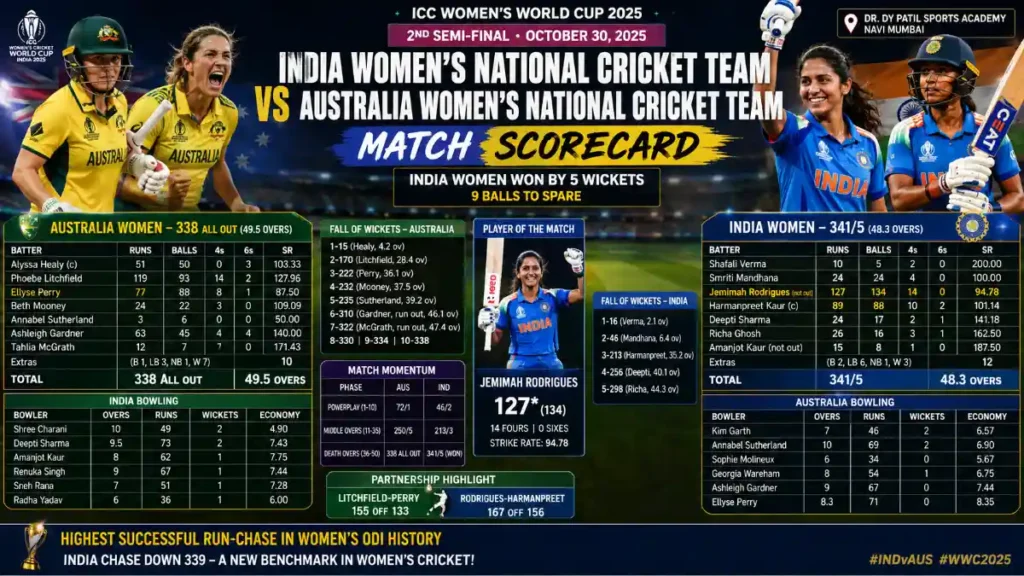

India Women defeated Australia Women by 5 wickets in the ICC Women’s World Cup 2025 semi-final on October 30, 2025, at the Dr. DY Patil Sports Academy, Navi Mumbai. Chasing 339, India finished at 341/5 in 48.3 overs — the highest successful run-chase in women’s ODI history. Jemimah Rodrigues scored an unbeaten 127 off 134 balls, and Harmanpreet Kaur contributed 89 off 88 to script one of the greatest victories in women’s cricket.
Navi Mumbai, October 30, 2025. India needed 339 runs. Fourteen days earlier, Australia had chased 331 against India in the same tournament — and won. No team in women’s cricket history had ever successfully chased more than that. Now India had to do exactly that. Against the same opponents. In a knockout match. On a ground where dew was already forming by the 20th over.
What followed was not just a cricket match. It was a complete recalibration of what women’s cricket is capable of.
The India women’s national cricket team vs Australia women’s national cricket team match scorecard from this semi-final stands today as one of the most studied pages in women’s cricket history — not just for the numbers, but for the tactical story behind every single run.
Full Match Scorecard – At a Glance
Snippet Summary: India Women beat Australia Women by 5 wickets in the ICC Women’s World Cup 2025 semi-final. Australia scored 338 all out in 49.5 overs. India chased it down in 48.3 overs, finishing at 341/5. Jemimah Rodrigues (127*) was Player of the Match.
| Match Details | Information |
| Match | 2nd Semi-Final, ICC Women’s World Cup 2025 |
| Venue | Dr. DY Patil Sports Academy, Navi Mumbai |
| Date | October 30, 2025 |
| Toss | Australia Women won, elected to bat |
| Result | India Women won by 5 wickets (9 balls to spare) |
| Player of the Match | Jemimah Rodrigues (127*) |
Australia Women – 338 All Out (49.5 Overs)
| Batter | Runs | Balls | 4s | 6s | SR |
| Alyssa Healy (c) | 5 | 15 | 0 | 0 | 33.33 |
| Phoebe Litchfield | 119 | 93 | 14 | 2 | 127.96 |
| Ellyse Perry | 77 | 88 | 8 | 1 | 87.50 |
| Beth Mooney | 24 | 22 | 3 | 0 | 109.09 |
| Annabel Sutherland | 3 | 6 | 0 | 0 | 50.00 |
| Ashleigh Gardner | 63 | 45 | 4 | 4 | 140.00 |
| Tahlia McGrath | 12 | 7 | 2 | 0 | 171.43 |
Fall of Wickets — Australia:
1-15 (Healy, 4.2 ov) | 2-170 (Litchfield, 28.4 ov) | 3-222 (Perry, 36.1 ov) | 4-232 (Mooney, 37.5 ov) | 5-235 (Sutherland, 39.2 ov) | 6-310 (Gardner, run out, 46.1 ov) | 7-322 (McGrath, run out, 47.4 ov) | 8-330 | 9-334 | 10-338
India Bowling:
| Bowler | Overs | Runs | Wickets | Economy |
| Shree Charani | 10 | 49 | 2 | 4.90 |
| Deepti Sharma | 9.5 | 73 | 2 | 7.43 |
| Amanjot Kaur | 8 | 62 | 1 | 7.75 |
| Renuka Singh | 9 | 67 | 1 | 7.44 |
| Sneh Rana | 7 | 51 | 1 | 7.28 |
| Radha Yadav | 6 | 36 | 1 | 6.00 |
India Women – 341/5 (48.3 Overs)
| Batter | Runs | Balls | 4s | 6s | SR |
| Shafali Verma | 10 | 5 | 2 | 0 | 200.00 |
| Smriti Mandhana | 24 | 24 | 4 | 0 | 100.00 |
| Jemimah Rodrigues (not out) | 127 | 134 | 14 | 0 | 94.78 |
| Harmanpreet Kaur (c) | 89 | 88 | 10 | 2 | 101.14 |
| Deepti Sharma | 24 | 17 | 2 | 1 | 141.18 |
| Richa Ghosh | 26 | 16 | 3 | 1 | 162.50 |
| Amanjot Kaur (not out) | 15 | 8 | 1 | 1 | 187.50 |
Fall of Wickets — India:
1-16 (Verma, 2.1 ov) | 2-46 (Mandhana, 6.4 ov) | 3-213 (Harmanpreet, 35.2 ov) | 4-256 (Deepti, 40.1 ov) | 5-298 (Richa, 44.3 ov)
Australia Bowling:
| Bowler | Overs | Runs | Wickets | Economy |
| Kim Garth | 7 | 46 | 2 | 6.57 |
| Annabel Sutherland | 10 | 69 | 2 | 6.90 |
| Sophie Molineux | 6 | 34 | 0 | 5.67 |
| Georgia Wareham | 8 | 54 | 1 | 6.75 |
| Ashleigh Gardner | 9 | 67 | 0 | 7.44 |
| Ellyse Perry | 8.3 | 71 | 0 | 8.35 |
Match Momentum Timeline
| Phase | Australia | India |
| Powerplay (Ov 1–10) | 72/1 | 46/2 |
| Middle Overs (Ov 11–35) | 250/5 | 213/3 |
| Death Overs (Ov 36–50) | 338 all out | 341/5 (won) |
| Partnership Highlight | Litchfield-Perry: 155 off 133 | Rodrigues-Harmanpreet: 167 off 156 |
Australia Women’s Innings: Litchfield, Perry, and the 338 Problem
Snippet Answer: Australia Women scored 338 all out in 49.5 overs. Phoebe Litchfield scored 119 off 93 balls and shared a 155-run partnership with Ellyse Perry (77). Ashleigh Gardner hit 63 off 45 in the death overs. India’s Shree Charani and Deepti Sharma took 2 wickets each.
Australia won the toss and elected to bat first. Their power play was aggressive — 72 runs in 10 overs with just one wicket down. That is when most analysts declared the match Australia’s to lose. But here is the real problem with that reading: the DY Patil surface in evening conditions consistently favored the chasing team, and dew formation — a pattern well-documented across all matches at this venue during the 2025 Women’s World Cup — made late-innings bowling progressively harder.
Australia’s toss decision, in hindsight, may have cost them the match before a single ball was bowled.
The Litchfield-Perry Partnership That Defined Australia’s Innings Total
Phoebe Litchfield’s 119 off 93 balls was the innings that built Australia’s total. Her 155-run second-wicket partnership with Ellyse Perry came off just 133 balls and formed the structural backbone of the chase target. Litchfield struck 14 fours and 2 sixes and operated at a strike rate of 127.96, relentlessly targeting the off-side.
What most analyses skip entirely: Litchfield systematically neutralized India’s spinners through superior crease work. She swept, reverse-swept, and used the depth of her crease against Deepti Sharma and Radha Yadav — the two bowlers who had taken the most wickets in India’s group-stage campaign. For 25 overs, India’s primary wicket-taking threat was effectively defused.
Ellyse Perry’s 77 off 88 balls provided the steadiness that allowed Litchfield to attack freely. Perry focused on rotation and straight hitting rather than boundary-seeking, keeping the scoreboard pressure constant while Litchfield took the risks.
Gardner’s Blitz and India’s Death-Over Containment
When Sutherland fell cheaply, and Australia were in some danger of only reaching 290, Ashleigh Gardner changed the script completely. Her 63 off 45 balls — 4 fours and 4 sixes — was a brutal, boundary-heavy assault that pushed Australia from 235/5 to 310 in barely 40 balls.
Gardner’s knock also made her the first batter in women’s ODI World Cup history to aggregate 300-plus runs batting at No. 6 or lower in a single edition — a statistical achievement that underlines how dominant Australia’s lower-middle order was throughout this tournament.
But here is what everyone missed: two run-outs in the final three overs — Gardner and Tahlia McGrath — cost Australia at least 20 to 25 runs. Those two moments were the difference between 338 and a total that may genuinely have been unreachable. India’s fielding pressure in the death overs created two self-destructions that partially defined the match.
Shree Charani’s 10-over spell of 2/49, with 29 dot balls, was the standout bowling performance for India. She dismissed both Beth Mooney and Annabel Sutherland at critical junctures, preventing Australia from building any further acceleration in the middle phase.
India Women’s Innings: The Greatest Chase in Women’s ODI Cricket
Snippet Answer: India Women chased 341 in 48.3 overs, losing 5 wickets. Jemimah Rodrigues scored 127 not out off 134 balls. Harmanpreet Kaur hit 89. The Rodrigues-Harmanpreet partnership of 167 off 156 balls was the highest for India in any Women’s World Cup knockout match. India won by 5 wickets with 9 balls to spare.
The India women’s national cricket team vs Australia women’s national cricket team match scorecard shows India at 46/2 after just 6.4 overs. That is the entry point that every post-match account dramatically underweights. This was not a blip. This was a crisis.
Australia had executed their blueprint precisely: Kim Garth, swinging early and hitting the seam hard, removed both openers within the power play. Shafali Verma was gone for 10 off 5 balls in the second over. Smriti Mandhana, who had been India’s most reliable batter in the tournament, was dismissed for 24 in the seventh over. The required run rate was sitting at approximately 7.5 per over with two of India’s best three gone.
What came next was not a comeback. It was a complete takeover.
Early Scare – Powerplay Wickets and the Pressure Setup
Kim Garth took both wickets inside the powerplay — and what made her spell genuinely threatening was not raw pace but the movement she generated off the pitch. Both dismissals were top-quality deliveries that demanded the best from any batter. Australia had manufactured the exact conditions they needed to defend 339.
The required rate after the power play was 7.8. In women’s ODI cricket at this point in history, only one team had ever successfully maintained that kind of asking rate from the 7th over onwards in a major tournament knockout — and that team had scored only 298. India needed 341. The numbers looked impossible.
The 167- Run Stand That Changed Everything
Jemimah Rodrigues arrived at No. 3. Harmanpreet Kaur, India’s captain, joined at No. 4. The partnership they built — 167 runs off 156 balls — is the most important batting stand in India women’s cricket history in any knockout context.
But the raw number still does not tell the full story. What made this partnership structurally remarkable was the division of roles that never once became rigid. Rodrigues was the anchor — controlled, technically correct, finding gaps rather than forcing boundaries. Harmanpreet was the aggressor — pulling Sutherland over midwicket, driving Gardner through extra cover, accelerating precisely when the required rate threatened to spiral.
Annabel Sutherland, Australia’s best bowler on the day, was driven and punched through the covers repeatedly without the fielding setup ever properly adjusting. Harmanpreet’s ability to read Sutherland’s length and attack her consistently through the off-side forced Healy to keep moving the field — creating gaps on the leg side that Rodrigues quietly exploited.
Australia dropped at least two catches during this phase — both off Rodrigues, both in the 25-to-32 over window. In a knockout, those moments are not just dropped catches. They are dropped matches.
Jemimah Rodrigues: An Innings Beyond Statistics
127 not out off 134 balls. 14 fours. 88% control percentage. The scorecard numbers for Rodrigues are exceptional. They are also incomplete.
The true measure of this innings is what Rodrigues was asked to do after Harmanpreet’s dismissal at 213/3 in the 35th over. At that point, India still needed 128 more runs off 90 balls. The recognized batting had gone. Deepti Sharma and Richa Ghosh — brilliant contributors in their own right — were support acts, not match-anchors.
Rodrigues carried the chase alone. She never once let the required rate go above 9. She manipulated singles with surgical precision. She accelerated at exactly the right moments — taking 37 runs from the final three overs she faced, finishing with Amanjot Kaur in an unbroken stand that put India home with nine balls remaining.
She was later named ESPNcricinfo’s Women’s ODI Batting Performance of the Year for 2025, and the citation from ESPNcricinfo described it as one of the most unforgettable nights in Indian women’s cricket history.
The counterintuitive truth about this innings: India’s fragile middle order, which had been a source of public criticism throughout the tournament, was actually the reason Rodrigues arrived at this game better prepared than any other batter. She had already batted in high-pressure, wickets-tumbling situations multiple times in the group stage. She had already practiced this exact scenario. Her composure was not talent in isolation — it was repetition paying off at the worst possible moment.
Key Turning Points You Probably Missed
Snippet Answer: Three decisive turning points shaped this match — the dew factor reducing Australia’s bowling effectiveness, two dropped catches during the Rodrigues-Harmanpreet partnership, and two run-outs in Australia’s death overs costing them 20-plus runs.
The Toss and the Dew Problem
Australia won the toss and chose to bat. The DY Patil venue, over the course of the 2025 ICC Women’s World Cup, showed a consistent pattern: the dew that formed in the second innings heavily impacted the team bowling. Balls became harder to grip, swing disappeared, and the fast bowlers lost their primary weapon. By the 35th over of India’s chase, boundaries were coming with noticeably less fielding resistance.
Australia’s bowlers — particularly their seamers — rely on their line-and-length discipline as their primary control mechanism. When grip is compromised, that discipline is the first thing to erode. This is not speculation. The scorecards across multiple evening ODIs at this venue show a consistent increase in wides, no-balls, and boundary concession rates from the 30th over onwards when teams are bowling second.
The Two Dropped Catches
Cricket analysts fixated on the batting heroics — as they should. But the two dropped catches Australia spilled during the 25-to-32 over window off Rodrigues were the structural moments that allowed the chase to stay on track. Each drop came when the required rate was still in Australia’s favor. Had either been taken, India would have been 167/4 or worse — with no real batting left — and the match would almost certainly have gone the other way.
The Death-Over Run-Outs – Australia’s Self-Inflicted Wound
Gardner (run out, 46.1 ov) and McGrath (run out, 47.4 ov) cost Australia at least 20 to 25 additional runs in the final three overs. Both run-outs were the result of India’s exceptional outfield pressure rather than poor running judgment. Amanjot Kaur’s direct hit on Gardner’s wicket was one of the most important individual fielding moments of the entire tournament — not because it was spectacular, but because it turned a 340-plus total into 338.
Records Broken in This Match
Snippet Answer: India’s 341/5 while chasing 339 set the record for the highest successful run-chase in women’s ODI history. It also marked the first time a 300-plus total was successfully chased in any men’s or women’s World Cup knockout match.
- Highest successful run-chase in women’s ODI history — India’s 341/5 surpassed Australia’s own record of 331, set against India in the same 2025 tournament three weeks earlier
- First 300-plus successful chase in any World Cup knockout — men’s or women’s; the previous highest was 298 by New Zealand vs South Africa in 2015
- Rodrigues-Harmanpreet partnership of 167 — the highest third-wicket stand by India in any Women’s World Cup knockout game
- Australia’s 338 — their highest-ever ODI total against India in a Women’s World Cup match
- Ashleigh Gardner — first batter to aggregate 300-plus runs batting at No. 6 or lower in a single Women’s World Cup edition
- Only India’s 12th win against Australia across all Women’s ODIs in 61 career meetings between the two sides
Player Performance Ratings
| Player | Role | Key Stats | Rating |
| Jemimah Rodrigues (IND) | Chase anchor | 127* (134b), 14 fours, 88% control | 10/10 |
| Harmanpreet Kaur (IND) | Batting aggressor | 89 (88b), 10 fours, 2 sixes | 9.5/10 |
| Phoebe Litchfield (AUS) | Top-order aggressor | 119 (93b), 14 fours, 2 sixes | 9/10 |
| Shree Charani (IND) | Spin control | 2/49 in 10 overs, 29 dots | 8.5/10 |
| Ashleigh Gardner (AUS) | Death-over batter | 63 (45b), 4 fours, 4 sixes | 8/10 |
| Annabel Sutherland (AUS) | Seam all-rounder | 2/69, effective but expensive | 6.5/10 |
| Kim Garth (AUS) | New-ball bowler | 2/46 in 7 overs, dismissed both openers | 8/10 |
| Deepti Sharma (IND) | Spin and bat | 2/73 bowling, 24 batting | 7.5/10 |
What This Win Means – Beyond the Scorecard
Snippet Answer: India’s semi-final win over Australia ended a decade-long knockout barrier and confirmed a genuine power shift in women’s cricket. It sent India to the ICC Women’s World Cup 2025 final against South Africa and ended Australia’s hold on both the T20 and ODI World Cups within 12 months.
The complete India women’s national cricket team vs Australia women’s national cricket team match scorecard tells one story. The context tells a bigger one.
India had lost to every single team that reached the knockout stage during the group phase. They arrived at the semi-final not on the back of a dominant run, but as a team that had found ways to win through individual brilliance rather than structural consistency. They lost the toss. They lost both openers in the power play. They still chased 339 and won with nine deliveries to spare.
That is not luck. That is something more difficult to measure: the ability to absorb adversity and still find a way.
Australia, a seven-time ODI World Cup champion, had never been eliminated from a knockout without at least one dominant performance on the day. On October 30, Litchfield gave them one — 119 off 93 is dominant by any definition. Gardner gave them one — 63 off 45 in a pressure chase situation. It was not enough. India simply played better cricket when it mattered most.
The defeat ended Australia’s status as holders of both the T20 and ODI World Cups within a 12-month period — a double-exit that marks a genuine structural shift in global women’s cricket. New challengers are not just competitive. They are now dominant. India proved that on the night that mattered.
India went on to face South Africa in the final at the same venue on November 2, 2025 — a meeting that would not have been possible without the night Jemimah Rodrigues refused to surrender.
Frequently Asked Questions
Q1: What was the final score of India Women vs Australia Women in the ICC Women’s World Cup 2025 semi-final?
India Women won by 5 wickets. Australia Women scored 338 all out in 49.5 overs. India chased it down in 48.3 overs, finishing at 341/5 with 9 balls remaining.
Q2: Who won Player of the Match in the IND-W vs AUS-W semi-final?
Jemimah Rodrigues was named Player of the Match for her unbeaten 127 off 134 balls — the highest score by an Indian batter in Women’s World Cup knockout history.
Q3: Was India’s chase of 339 a world record?
Yes. India’s successful chase of 341 became the highest successful run-chase in women’s ODI history, surpassing Australia’s 331, which had itself been a world record set against India just three weeks earlier in the same tournament.
Q4: Who took the most wickets for India against Australia in the semi-final?
Shree Charani and Deepti Sharma each took 2 wickets. Charani’s spell of 2/49 in 10 overs, with 29 dot balls, was the standout bowling effort of the match for India.
Q5: What was Harmanpreet Kaur’s score in the Women’s World Cup 2025 semi-final?
Harmanpreet Kaur scored 89 off 88 balls, striking 10 fours and 2 sixes before being caught by Ashleigh Gardner off Annabel Sutherland in the 35th over.
Q6: How many runs did Phoebe Litchfield score for Australia?
Phoebe Litchfield scored 119 off 93 balls — her highest score in a World Cup knockout. She shared a 155-run second-wicket partnership with Ellyse Perry (77 off 88) that formed the structural foundation of Australia’s total.
Q7: What was the highest partnership in India’s chase of 339?
The Jemimah Rodrigues and Harmanpreet Kaur third-wicket partnership of 167 runs off 156 balls was the highest for India in any Women’s World Cup knockout game and was the defining stand of the chase.
Q8: Did Australia miss any catches during India’s chase?
Yes. Australia dropped at least two chances during the Rodrigues-Harmanpreet partnership between the 25th and 32nd overs. Both were off Rodrigues, and both proved critical to the match result.
Q9: What record did Ashleigh Gardner set in this match?
Ashleigh Gardner became the first batter in Women’s ODI World Cup history to aggregate 300-plus runs batting at No. 6 or lower in a single edition. Her 63 off 45 balls in this match was a central part of that achievement.
Q10: Which venue hosted the India Women vs Australia Women semi-final?
The match was played at the Dr. DY Patil Sports Academy in Navi Mumbai, India, on October 30, 2025 — a venue where evening dew became a decisive factor in the result.