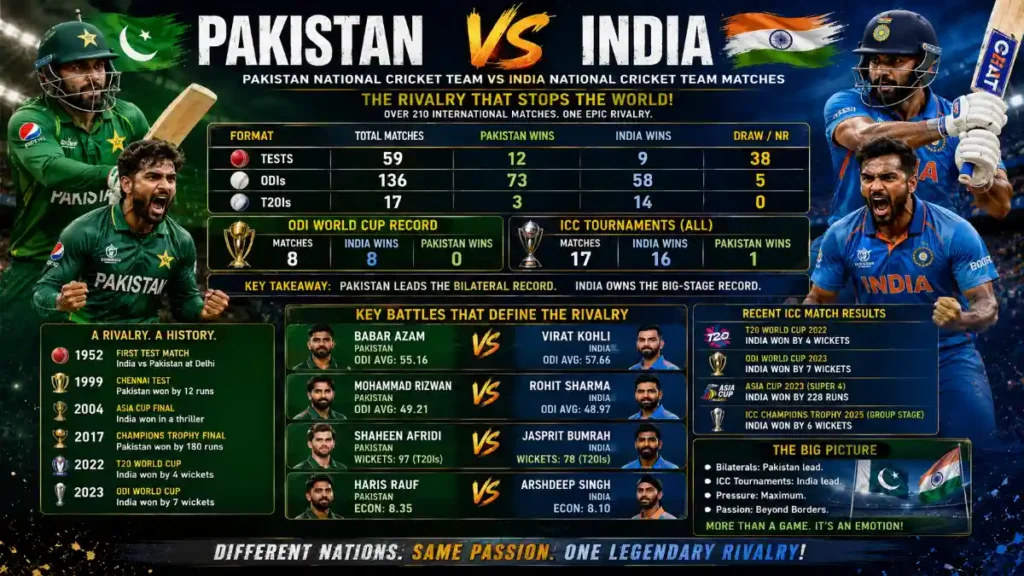

India and Pakistan have played over 210 international cricket matches across Tests, ODIs, and T20Is, making the Pakistan national cricket team vs India national cricket team matches rivalry the most emotionally charged contest in world sport. Pakistan leads the overall ODI record 73–58 and the Test series record 12–9, while India dominates T20Is at 14–3. In ICC tournament cricket, India has won 16 of their last 17 encounters against Pakistan. The bilateral edge belongs to Pakistan. The big-stage record belongs to India. That paradox is the heartbeat of this rivalry.
Quick Stats: India vs Pakistan Head-to-Head at a Glance
Snippet answer: India and Pakistan have played across three formats. Pakistan lead Tests 12–9 and ODIs 73–58. India leads T20Is 14–3. In ICC tournament cricket, India has won 16 of 17 matches, including a perfect 8–0 record in ODI World Cup clashes.
| Format | Total Matches | India Wins | Pakistan Wins | Draw/NR |
| Tests | 59 | 9 | 12 | 38 |
| ODIs | 136 | 58 | 73 | 5 |
| T20Is | 17 | 14 | 3 | 0 |
| ODI World Cup | 8 | 8 | 0 | 0 |
| ICC Tournaments (All) | 17 | 16 | 1 | 0 |
Key takeaway: Pakistan leads the bilateral head-to-head. India owns the tournament record. That gap is the defining paradox of this entire rivalry, and most fans never stop to ask why.
The Rivalry That Stops the World
When India and Pakistan walk onto a cricket field, television ratings explode across two continents, cities grind to a halt, and pressure unlike anything else in sport descends on 22 players standing 22 yards apart. No other fixture in cricket arguably in all of sport carries the weight that a Pakistan national cricket team vs India national cricket team match carries.
Two nuclear-armed neighbours. One shared colonial history. A partition in 1947 that carved two nations from one land. And cricket is the only arena where they still face each other with any regularity.
There are no bilateral tours. No annual series. No home-and-away scheduling. Every time these teams meet, it happens in a neutral country, at a neutral venue, under ICC or ACC supervision. That scarcity alone makes each encounter feel seismic. When it comes once every year or two in a tournament context, the anticipation builds into something no marketing team could manufacture.
What most articles get wrong is that they list scorecards and call it rivalry coverage. They miss why the numbers look the way they do. They ignore the structural cricket differences, the psychological dynamics, and the tactical evolution that explains every result.
This guide breaks down every format, every era, and every turning point in the India vs Pakistan cricket rivalry from the first Test in 1952 to the latest ICC clash in 2026.
Format-by-Format Breakdown: Where Each Team Dominates
Test Cricket: A Diplomatic Casualty
Snippet answer: India and Pakistan have played 59 Tests since 1952. Pakistan leads 12–9 with 38 draws. No bilateral Test series has been played since 2007–08 because of suspended diplomatic ties between the two nations.
The Pakistan national cricket team vs India national cricket team Test matches represent some of the finest five-day cricket ever contested, and the tragedy is that only 59 such games have been played across over seven decades. Political tensions have meant entire generations of fans have been denied this fixture in its purest form.
The suspension is stark. The last bilateral Test series took place in India in 2007–08. Since then, geopolitical tensions have made scheduling impossible. An entire generation of cricket fans has never watched India and Pakistan compete in Test whites.
What Most People Miss About the Test Record
Pakistan’s 12–9 Test lead is heavily weighted toward results from the 1950s through the 1980s, when Pakistan’s pace attack was built around Fazal Mahmood in the early era, and Imran Khan, Sarfraz Nawaz, and later Wasim Akram were world-class by any measure. Modern comparative analysis suggests the current gap would be far narrower if both sides played regularly.
The 1999 Series stands as the landmark moment that most clearly illustrates how closely matched these sides are at the Test level. Pakistan won the Chennai Test by just 12 runs, one of the tightest finishes in all of Test history. India responded by winning the Delhi Test by 212 runs. The series ended 1–1, but the cricket was so exceptional that the Chennai Test is still discussed among the greatest ever played. That level of competition has been denied to cricket for nearly 20 years.
ODI Cricket: Pakistan’s Era, India’s Stage
Snippet answer: Pakistan leads India vs Pakistan ODI head-to-head 73–58. However, India has never lost an ODI World Cup match against Pakistan, winning all eight encounters from 1992 to 2023. The bilateral lead and the tournament record tell two completely different stories.
The ODI head-to-head is one of cricket’s most misunderstood statistics. Pakistan’s 73–58 advantage is real, but it was built predominantly on bilateral series from the 1980s and 1990s, when Pakistan fielded arguably the most lethal pace attack ever assembled: Wasim Akram, Waqar Younis, Imran Khan, and later Shoaib Akhtar.
The Bilateral vs Tournament Split
This distinction is critical for understanding the India vs Pakistan ODI rivalry:
- In bilateral ODI series outside ICC events, Pakistan holds a clear and historically significant advantage
- In ICC tournament ODIs, including World Cup and Champions Trophy group stages, India’s record is dominant
- In ODI World Cups specifically, India 8, Pakistan 0, an unbroken record since 1992
Common mistake fans make: Quoting Pakistan’s overall ODI lead as definitive proof of superiority. That lead disappears almost entirely when you filter for high-pressure ICC knockout and group-stage environments.
Why Does This Happen?
Three structural reasons explain India’s tournament ODI dominance:
- Batting depth: India’s middle order is built for one-off high-pressure chases in a way that bilateral series do not consistently demand
- Spin bowling quality: India’s wrist spinners and finger spinners exploit Pakistan’s well-documented middle-order weakness on Asian neutral surfaces consistently used in ICC events
- Coaching infrastructure: Tournament preparation under coaches like Gary Kirsten, Duncan Fletcher, Ravi Shastri, and Rahul Dravid has been systematically superior for ICC knockout formats
T20 International Cricket: India’s Most Dominant Format
Snippet answer: India leads Pakistan 14–3 in T20 Internationals. This includes a 6–1 advantage in T20 World Cup encounters specifically. India has dominated this format since the very first T20I between the two nations in Durban in 2007.
The India vs Pakistan T20I head-to-head is the most one-sided format in this rivalry. India’s 14–3 advantage is not simply a reflection of talent, it reflects a structural transformation in how India approaches T20 cricket that began in 2007 and accelerated dramatically with the IPL.
The IPL Effect on This Rivalry
Since the Indian Premier League launched in 2008, India’s players have accumulated more high-pressure franchise T20 cricket experience than any other national squad in the world. Batting in front of 80,000 screaming fans with a franchise title on the line creates a pressure-management skillset that bilateral domestic cricket in Pakistan before the PSL gained real traction in the early 2020s simply did not replicate at the same scale.
Pakistan’s only win in the T20 ICC tournament cricket against India in recent history came at the 2021 T20 World Cup in Dubai, where Pakistan won by 10 wickets, a historic, stunning performance, and still the most complete Pakistan victory in the modern era of this rivalry. That result remains the exception, not the pattern.
Five Matches That Defined Pakistan vs India Cricket History
Miandad’s Last-Ball Six Sharjah, 1986
This is where the modern mythology of the Pakistan national cricket team vs India national cricket team rivalry truly begins.
Pakistan needed four runs off the final delivery of the 1986 Australasia Cup final in Sharjah. Chasing 246, they were one wicket down with one ball remaining. Javed Miandad, already a legend, stepped across and deposited Chetan Sharma’s waist-high full toss deep into the stands. Six. Pakistan won by one wicket.
What most people miss: Cricket analysts and historical ODI data from the late 1980s and early 1990s consistently show that Pakistan’s win percentage against India increased significantly in the years that followed the 1986 Sharjah final. Former Pakistan captain Imran Khan has stated in multiple interviews that Miandad’s six redefined Pakistan’s psychological belief in crunch situations against India. One delivery did not just win a match; it reshaped an entire decade of competition.
Bold opinion: Miandad’s six is the single most consequential delivery in the history of this rivalry. Not Tendulkar’s cut off Akhtar. Not Bumrah’s final-over precision. One ball in 1986, and India were playing catch-up psychologically for the rest of the 1990s.
Sachin Tendulkar’s 98, 2003 World Cup, Centurion
India faced Pakistan in the 2003 ICC World Cup group stage, a match billed as the greatest rivalry fixture outside a final. Pakistan fielded Wasim Akram, Waqar Younis, and Shoaib Akhtar simultaneously, three of the fastest and most experienced bowlers in the world at that precise moment in cricket history.
India needed to chase 274. Tendulkar walked out and deliberately, premeditatively targeted Akhtar, the fastest bowler in the world, from the very first over. A cut shot off a 90+ mph delivery that sailed over point for six sent a message heard across cricket. Tendulkar made 98. India won by 6 wickets.
The Tactical Insight Most Articles Miss
Tendulkar’s decision to attack Akhtar in the opening overs was not instinct; it was pre-planned aggression designed to disrupt Pakistan’s bowling rhythm at its psychological source. By targeting the strike bowler, India unsettled Wasim and Waqar before they could settle into their lines. Neither bowler found their rhythm. It remains a masterclass in match-reading that modern batting coaches still reference in pressure-game preparation.
The 2007 T20 World Cup Two Matches, One Rivalry Elevated
The very first T20 international between India and Pakistan produced the format’s first bowl-out cricket’s equivalent of a penalty shootout. India posted 141/9. Pakistan needed 12 off the final over with Misbah-ul-Haq nearly stealing victory. Both teams finished tied. India won the bowl-out 3–0.
The two teams then met in the tournament final. India won by 5 runs to become inaugural T20 World Champions. An entire format’s identity was authored by this single rivalry across two matches in one tournament.
Counterintuitive idea: The 2007 T20 World Cup was more consequential for Indian cricket’s long-term future than any ODI World Cup. It triggered the IPL, redefined India’s white-ball philosophy, and directly produced the generation that would dominate ICC events for the next 15 years. The rivalry elevated T20 cricket from novelty to a serious format simply by being itself.
Asia Cup 2025 Final, Dubai
In September 2025, India and Pakistan met in the first-ever Asia Cup final between the two nations, a historic occasion that deserved its billing. Pakistan’s innings looked commanding at 113/1 in the 13th over. Then came the collapse.
Kuldeep Yadav, India’s left-arm wrist spinner, dismantled Pakistan’s middle order, finishing with 4 wickets for 30 runs. Pakistan fell from 113/1 to 146 all out. Tilak Varma, India’s next-generation match-winner, anchored the chase with 69 off 53 balls. India won by five wickets with two balls to spare, claiming a record ninth Asia Cup title.
The tactical turning point: Pakistan’s middle order had no answer for quality wrist spin on slow, turning Dubai surfaces. This is not a one-off vulnerability; it is a structural problem that has persisted across multiple generations of Pakistan batting. Kuldeep Yadav simply exposed it at the highest possible stage.
ICC Men’s T20 World Cup 2026 Colombo
The most recent chapter of Pakistan national cricket team vs India national cricket team matches was written in Colombo in February 2026. India posted 175/7. Pakistan were bowled out for 114, losing by 61 runs. India advanced to the Super 8s while Pakistan’s qualification depended on other results.
India’s pattern in ICC tournaments is no longer a coincidence or a hot streak. It is a system built on squad depth, opponent-specific tactical preparation, and the mental infrastructure to deliver when a billion people are watching simultaneously.
The ICC Tournament Paradox: Why India Wins When It Matters Most
Snippet answer: India has won 16 of 17 ICC tournament matches against Pakistan across all formats. The three core reasons are superior batting depth for pressure chases, quality wrist spin bowling that consistently exploits Pakistan’s middle-order weaknesses on Asian neutral surfaces, and better mental preparation for one-off high-stakes knockout scenarios. Pakistan’s bilateral ODI advantage does not translate to ICC tournament environments.
This is the most important analytical question in the entire India vs Pakistan cricket rivalry and most articles either skip it entirely or offer vague answers. Here is the actual breakdown.
Batting Depth vs Middle-Order Fragility
India’s middle order, from MS Dhoni and Yuvraj Singh to Virat Kohli and Rohit Sharma, and now Tilak Varma, Yashasvi Jaiswal, and Shubman Gill, has been consistently constructed for high-pressure tournament chases. Pakistan’s middle order, while capable of brilliance in bilateral cricket, has shown repeated structural fragility under the specific pressure of ICC tournament fixtures against India.
The data point that illustrates this most clearly: In the 2021 T20 WC, Pakistan’s lone ICC tournament win over India in recent history, Pakistan’s victory was almost entirely built on a 152-run opening partnership between Babar Azam and Mohammad Rizwan. When those two openers fail, as they have in most other India encounters, Pakistan’s middle order has historically been unable to compensate under tournament pressure.
Spin Bowling as India’s Structural Advantage
India’s wrist spin arsenal, Yuzvendra Chahal, Kuldeep Yadav, Ravichandran Ashwin, and Ravindra Jadeja, have systematically dismantled Pakistan’s batting on the slow, turning pitches that ICC tournaments in Asia and the UAE consistently produce. This is not about individual brilliance; it is about a structural match-up that India has identified and exploited with tactical discipline across multiple tournaments.
Former Pakistan opener Saeed Anwar acknowledged in interviews that India’s wrist spinners in the modern era create match-up problems Pakistan’s batters have never comprehensively solved in tournament conditions.
Mental Conditioning and Process Cricket
India’s team management from Dhoni’s captaincy era through to the current coaching setup has invested heavily in structured pressure simulation for ICC-specific scenarios. Multiple Indian players, including Kohli and Rohit Sharma, have spoken publicly about how differently they prepare for a World Cup encounter versus a bilateral series. The preparation gap is real and measurable in outcomes.
What people think: India wins because they are simply the better cricket team overall.
The reality: India loses bilateral ODI series regularly. The performance gap is format-specific, surface-specific, and context-specific. Understanding that distinction is not just interesting; it is the beginning of genuine cricket analysis.
India vs Pakistan Rivalry: Key Player Records
Snippet answer: Sachin Tendulkar holds the record for most runs in India vs Pakistan ODIs with 2,636 runs across 73 matches. Wasim Akram leads Pakistan’s bowling list with 57 wickets in ODIs against India, the most by any bowler in the rivalry’s history.
Most Runs in India vs Pakistan ODIs
| Player | Country | Runs | Matches |
| Sachin Tendulkar | India | 2,636 | 73 |
| Inzamam-ul-Haq | Pakistan | 1,697 | 71 |
| Virat Kohli | India | 1,230+ | 31+ |
| Saeed Anwar | Pakistan | 1,144 | 45 |
| Mohammad Yousuf | Pakistan | 900+ | 38 |
Key Bowling Records
- Wasim Akram has 57 wickets in ODIs against India, the most by any bowler from either side in the rivalry
- Anil Kumble leading wicket-taker for India in Tests against Pakistan across the rivalry
- Kuldeep Yadav’s best modern tournament performance: 4/30 in the Asia Cup 2025 Final, the most devastating spell in recent head-to-head history
Rivalry Timeline: 1952 to 2026
Snippet answer: India and Pakistan first played Test cricket in 1952. Major milestones include Miandad’s six in 1986, India’s first ODI World Cup win over Pakistan in 1992, Tendulkar’s 98 in 2003, India’s 2007 T20 WC triumph, Pakistan’s 2021 T20 WC win, and India’s recent Asia Cup 2025 and T20 WC 2026 victories.
- 1952 First Test series; Pakistan won on their debut tour of India
- 1978 First ODI between the two nations
- 1986 Miandad’s last-ball six in Sharjah was the rivalry’s defining psychological moment
- 1992, India defeated Pakistan for the first time in the ODI World Cup cricket (Australia)
- 1999, Pakistan won the Chennai Test by 12 runs, the closest match in rivalry history
- 2003 Tendulkar’s 98 in Centurion; India win 2003 World Cup group clash by 6 wickets
- 2007 India defeat Pakistan in T20 WC bowl-out and final; the T20I era officially begins
- 2011, India defeated Pakistan in World Cup semi-final at Mohali, attended by both Prime Ministers
- 2017 Pakistan beat India in the ICC Champions Trophy final at The Oval, their last bilateral ICC title win over India
- 2021, Pakistan’s only recent ICC tournament win over India, T20 WC in Dubai, by 10 wickets
- 2023, India beat Pakistan in the ODI World Cup, Ahmedabad, by 7 wickets in front of 90,000+
- 2025 India beat Pakistan in Asia Cup 2025 Final, Dubai, by 5 wickets
- 2026, India beat Pakistan in T20 World Cup group stage, Colombo by 61 runs
What Changed After 2007: India’s Tournament Transformation
This is the section no competitor article covers adequately, and it is essential to understanding the modern rivalry.
The 2007 T20 World Cup was not just a trophy. It was the trigger event that structurally transformed Indian cricket from a bilateral powerhouse into a tournament-winning machine. According to ESPNcricinfo’s analysis of post-2007 Indian cricket infrastructure, the shift was comprehensive and deliberate.
The IPL launched in 2008. Indian players began accumulating more high-pressure franchise T20 experience than any other national pool in the world. By the early 2010s, India’s bench strength in white-ball formats had become structurally superior to any other Asian nation.
Pakistan’s Simultaneous Decline
Pakistan’s instability during the same period, the spot-fixing scandal in 2010, frequent captaincy changes, and political interference in cricket administration created exactly the opposite trajectory. Between 2010 and 2015, Pakistan cricket cycled through multiple head coaches and selection controversies that disrupted the continuity essential for tournament-specific preparation.
Data and analytics adoption inside the BCCI also accelerated significantly after 2007. By the 2023 ODI World Cup, India’s backroom team possessed detailed ball-by-ball tendency data for every Pakistan batter against specific bowling types, match situations, and surface conditions. That analytical edge shows in the consistency of results in Pakistan national cricket team vs India national cricket team matches at ICC events.
Bold opinion: The 2021 T20 WC loss to Pakistan in Dubai was, paradoxically, the best thing that happened to Indian cricket in the short term. It triggered tactical introspection and produced a more complete, more adaptive squad by 2022 onward. India has won every ICC tournament encounter against Pakistan since that Dubai defeat.
The Venues: Where History Gets Made
Snippet answer: India vs Pakistan cricket matches are played exclusively on neutral ground. The main venues are Dubai and Sharjah in the UAE, Colombo in Sri Lanka, and occasionally in other ICC tournament host nations. No bilateral home series has been played between the two nations since 2012–13.
The geography of this rivalry is unlike anything else in international sport. Without bilateral cricket, neutral venues have become the only stage for the India vs Pakistan cricket rivalry, creating an almost mythological relationship between specific grounds and specific moments.
- Sharjah, UAE, home of 1980s and 1990s ODI drama, and the ground where Miandad’s six permanently altered the rivalry’s psychological balance
- Dubai International Cricket Stadium is the modern neutral hub, hosting ICC Champions Trophy 2025 and the Asia Cup 2025 Final
- Colombo, Sri Lanka, Asia Cup home and the site of India’s 61-run T20 WC 2026 win over Pakistan
- Ahmedabad, India, 90,000+ in attendance for the 2023 ODI World Cup clash; the largest crowd in rivalry history
- Mohali, India site of the emotionally charged 2011 World Cup semi-final, attended by the Prime Ministers of both countries
Every venue adds its own emotional geography. Sharjah is heartbreak and myth. Dubai is a clinical modern rival. Ahmedabad is a billion-viewer spectacle made physical.
Recent Results: 2023 Onward
| Date | Format | Tournament | Venue | Winner | Margin |
| Oct 14, 2023 | ODI | World Cup | Ahmedabad | India | 7 wickets |
| Feb 23, 2025 | ODI | Champions Trophy | Karachi | India | 6 wickets |
| Sep 28, 2025 | T20I | Asia Cup Final | Dubai | India | 5 wickets |
| Feb 15, 2026 | T20I | T20 World Cup | Colombo | India | 61 runs |
India has won the last four consecutive clashes across formats. Pakistan’s last victory over India in any ICC event remains the 2021 T20 World Cup in Dubai, a gap of over four years and counting.
What the Future Looks Like for This Rivalry
Pakistan’s rebuild since 2023 shows genuine and measurable improvement. Their 2025 Champions Trophy campaign demonstrated sharper bowling plans, more aggressive powerplay intent, and a restructured pace attack built around Shaheen Shah Afridi and Naseem Shah. The structural problem of middle-order reliability and death bowling execution under knockout pressure remains the gap that needs solving before Pakistan can realistically challenge India’s ICC tournament dominance.
For India, the challenge is generational transition. Rohit Sharma and Virat Kohli, two of the three pillars of India’s ICC dominance in this era, are approaching the end of their international careers. Whether the next generation of Yashasvi Jaiswal, Shubman Gill, and Tilak Varma can maintain the same tournament-level execution that has defined Pakistan national cricket team vs India national cricket team matches over the past decade remains the most interesting cricket question of the next five years. One bold, logical opinion: The day Pakistan defeats India in a World Cup knockout match will produce one of the greatest sporting moments in history precisely because that result has not occurred since 1992. Every Indian win in a World Cup adds compounding pressure to the next encounter. The tension does not dissipate. It accumulates. That is what makes this rivalry irreplaceable, permanent, and unlike anything else in sport.
Frequently Asked Questions
Q1. Who leads the India vs Pakistan head-to-head cricket record?
Pakistan leads in Tests (12–9 with 38 draws) and ODIs (73–58). India leads in T20Is (14–3). In ICC tournament matches across all formats, India dominate with 16 wins from 17 encounters, including a perfect 8–0 ODI World Cup record.
Q2. Has India ever lost to Pakistan in the ODI World Cup?
No. India has won all eight ODI World Cup matches against Pakistan, from the 1992 World Cup in Australia through the 2023 World Cup in Ahmedabad. This unbeaten run across three decades is India’s most statistically consistent record in the entire rivalry.
Q3. When did India and Pakistan last play a Test match?
The last bilateral Test series between India and Pakistan was played in India in 2007–08. No Test cricket has taken place between the two nations since, due to the suspension of diplomatic and sporting ties that has persisted for nearly two decades.
Q4. What is Pakistan’s only recent ICC tournament win over India?
Pakistan’s sole ICC tournament victory over India in recent history came at the T20 World Cup 2021 in Dubai, where Pakistan won by 10 wickets, their most dominant performance in the modern rivalry era. Babar Azam and Mohammad Rizwan both made half-centuries in an unbeaten 152-run opening partnership.
Q5. Who has scored the most runs in India vs Pakistan matches?
Sachin Tendulkar holds the record with 2,636 runs in ODIs against Pakistan across 73 matches. Inzamam-ul-Haq leads Pakistan’s list with 1,697 ODI runs against India. Tendulkar’s 98 in the 2003 World Cup group match in Centurion remains the most iconic individual innings in the rivalry’s history.
Q6. What happened in the Asia Cup 2025 Final between India and Pakistan?
India won the Asia Cup 2025 Final in Dubai by five wickets in September 2025. Pakistan were cruising at 113/1 before Kuldeep Yadav’s 4/30 triggered a dramatic collapse to 146 all out. Tilak Varma’s 69 off 53 balls guided India to victory with two balls to spare, earning India a record ninth Asia Cup title.
Q7. Why does India dominate Pakistan in ICC tournaments despite losing the overall ODI record?
India’s ICC tournament dominance over Pakistan comes from three structural factors: superior batting depth built for high-pressure chases, quality wrist spin bowling that consistently exploits Pakistan’s middle-order weaknesses on Asian neutral pitches, and better mental preparation for one-off knockout scenarios. Pakistan’s bilateral ODI advantage was built in different conditions against a different India.
Q8. Where do India and Pakistan play their cricket matches?
All India vs Pakistan cricket matches are currently played at neutral venues. The primary locations are Dubai and Sharjah in the UAE, Colombo in Sri Lanka, and other ICC tournament host nations. No bilateral series has been hosted by either country since 2012–13 for Pakistan touring India.
Q9. What was the significance of Miandad’s last-ball six in 1986?
Javed Miandad hit Chetan Sharma’s final delivery for six in Sharjah to win the 1986 Australasia Cup final for Pakistan by one wicket. Cricket analysts widely consider this the most psychologically significant moment in the entire India-Pakistan rivalry. Historical ODI data from the following decade shows Pakistan’s performance against India improved substantially after the Sharjah final, reflecting the lasting confidence shift Miandad’s six produced.
Q10. What was the result of India vs Pakistan in the 2026 T20 World Cup?
India beat Pakistan by 61 runs in the ICC Men’s T20 World Cup 2026 group stage match in Colombo. India posted 175/7, and Pakistan were bowled out for 114. India advanced to the Super 8s, while Pakistan’s tournament progression depended on results elsewhere in the group.