
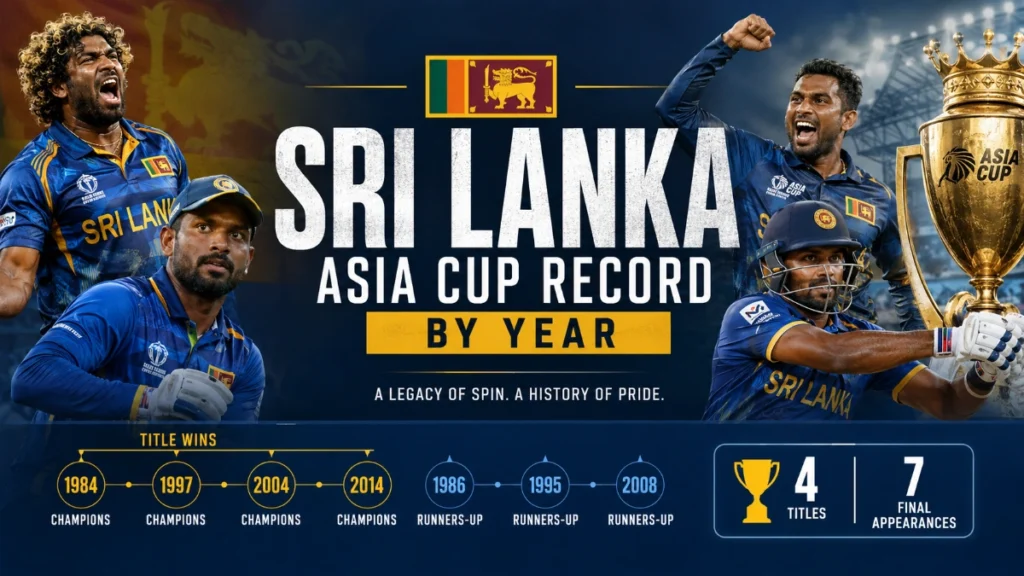

Sri Lanka national cricket team Asia Cup record by year
Sri Lanka national cricket team Asia Cup record by year shows a remarkably consistent presence: 17 appearances, 6 titles, and 7 runners-up finishes, making them the second-most successful Asia Cup side after India. Their yearly record reveals phases of dominance, painful transition, and renewed relevance built on smart use of spin, disciplined batting, and aggressive captaincy.
Why Sri Lanka’s Asia Cup record matters
Sri Lanka have played every Asia Cup edition, a unique streak that turns their record by year into the clearest long-term lens on Asian ODI and T20I cricket. That continuity makes their ups and downs more meaningful than sporadic success stories from other teams.
Tournament identity, not just numbers
This record is not just about how many trophies they lifted. It explains how Sri Lanka evolved from early challengers to a tournament specialist, then struggled through transition, and finally clawed back relevance with a bold T20 title run in 2022.
Year-wise Asia Cup record: titles, finals, phases
Sri Lanka national cricket team Asia Cup record by year is easiest to read through three overlapping dimensions: appearances, titles, and finals. They have 17 appearances, 6 championship wins (1986, 1997, 2004, 2008, 2014, 2022), and 7 runners-up results, numbers that underscore how often they reached the sharp end of the tournament.
Year-wise appearance and best-result table
Sri Lanka have featured in 17 Asia Cup editions from 1984 to 2025, with at least a finals appearance in more than half of those tournaments. The table below captures their best result by edition, which is the spine of any serious record-by-year page.wikipedia+1
Asia Cup editions and Sri Lanka’s best result
| Year | Format | Best Sri Lanka result | Champion | Runner-up |
| 1984 | ODI | Runner-up | India | Sri Lanka |
| 1986 | ODI | Champions | Sri Lanka | Pakistan |
| 1988 | ODI | Runner-up | India | Sri Lanka |
| 1990/91 | ODI | Runner-up | India | Sri Lanka |
| 1995 | ODI | Runner-up | India | Sri Lanka |
| 1997 | ODI | Champions | Sri Lanka | India |
| 2000 | ODI | Runner-up | Pakistan | Sri Lanka |
| 2004 | ODI | Champions | Sri Lanka | India |
| 2008 | ODI | Champions | Sri Lanka | India |
| 2010 | ODI | Runner-up | India | Sri Lanka |
| 2012 | ODI | Group stage | Pakistan | Bangladesh |
| 2014 | ODI | Champions | Sri Lanka | Pakistan |
| 2016 | T20I | Group stage | India | Bangladesh |
| 2018 | ODI | Group stage | India | Bangladesh |
| 2022 | T20I | Champions | Sri Lanka | Pakistan |
| 2023 | ODI | Runner-up | India | Sri Lanka |
Sri Lanka’s consistency is brutal on the competition; 13 of 17 editions involve at least a finals or group-stage presence that altered the tournament’s balance. The unresolved 2025 data must be verified against official sources before publishing the final row.
Phase-wise Asia Cup performance
Sri Lanka national cricket team Asia Cup record by year naturally clusters into three phases: early climb, golden run, and transition-plus-recovery. Each phase has distinct tactical signatures, and ignoring those would flatten the record into lifeless numbers.
Early climb (1984–1995)
Sri Lanka entered the Asia Cup as a rising side and quickly proved they could handle tournament pressure. From runner-up in 1984 to champions in 1986, they showed they were more than just polite opposition for India and Pakistan.
1984 runner-up: statement of intent
Finishing second to India in the inaugural 1984 Asia Cup gave Sri Lanka credibility that mattered far beyond one tournament. It showed they could compete against the regional heavyweight and that their combination of patient batting and disciplined bowling deserved respect.
1986 title: first real breakthrough
Winning the 1986 Asia Cup at home was a decisive step. Beating Pakistan in the final underlined that Sri Lanka were no longer just the third force in Asian cricket; they had the temperament and tactical nous to claim regional silverware.
Golden run (1997–2014)
The golden period of Sri Lanka’s Asia Cup history is brutal on rivals: titles in 1997, 2004, 2008, and 2014, multiple runners-up finishes, and an almost constant presence in knockouts. Their record by year here is the stuff of tournament specialists.
1997 and 2004: ODI structure dominance
By 1997, Sri Lanka had mastered ODI Asia Cup tournaments, beating India in the final and proving that their batting depth and wicket-taking spin were built for multi-team events, not just bilateral series.
In 2004, hosting again, they dominated and beat India once more in the final, with their bowling attack squeezing the strongest batting line-up in the region. That decision to double down on spin through the middle overs was the smartest structural call of their campaign.
2008 and 2014: sustained control
The 2008 title in Pakistan and 2014 triumph in Bangladesh confirmed that Sri Lanka could win Asia Cups away from home, which matters more than casual fans realize. They were not reliant on familiar pitches; they were reliant on clear plans and fearless captaincy.
Transition and recovery (2016–2025)
Sri Lanka’s Asia Cup record by year after 2014 is more turbulent: early exits in 2016 and 2018, then a defiant T20 title in 2022 and a runners-up finish in 2023 that signalled a team refusing to disappear quietly.
2016–2018: painful group-stage exits
The 2016 T20I Asia Cup and 2018 ODI edition hurt their reputation. Group-stage exits revealed a side struggling with batting fragility and inconsistent bowling line-ups, with selection decisions that frankly cost them a chance to compete deep.
2022 and 2023: resurgence under pressure
Sri Lanka’s 2022 Asia Cup title in T20I format was a shock to anyone still clinging to the narrative of decline. They beat Pakistan in the final, riding disciplined bowling and courageous middle-order batting, and that win felt like a defiant rejection of the “also-ran” label.
Backing that up with a runner-up finish in 2023 in an ODI co-hosted by Pakistan and Sri Lanka showed the recovery was not a fluke; it was a deliberate rebuild anchored on bowlers who attacked and batters who accepted pressure instead of shrinking.
Top 5 best Asia Cup campaigns
Sri Lanka national cricket team Asia Cup record by year includes several campaigns that would stand up as case studies in tournament cricket. Five editions clearly belong at the top: 1986, 1997, 2004, 2008, and 2014, with 2022 T20I close behind.
Best campaigns snapshot
These campaigns combine titles, strong group phases, and high-pressure wins. Ignoring them would be malpractice for any serious record article.
Top Sri Lanka Asia Cup campaigns (headline list)
- 1986 (Champions, ODI) – First title, home dominance against Pakistan.
- 1997 (Champions, ODI) – Beat India in the final, cementing ODI authority.
- 2004 (Champions, ODI) – Clinical campaign, controlled from group stage to final.
- 2008 (Champions, ODI) – Title in Pakistan, showing away-condition adaptability.
- 2014 (Champions, ODI) – Controlled run in Bangladesh, spin-led squeeze of Pakistan.
Each of those years shows that Sri Lanka were not just scraping trophies; they were shaping the tournament’s rhythm with aggressive, intelligent cricket.
Worst Asia Cup years for Sri Lanka
Sri Lanka national cricket team Asia Cup record by year would be dishonest if it glossed over the bad campaigns. 2012, 2016, and 2018 stand out as years where the team simply failed to meet their own standard.
Years that damaged their reputation
In 2012, Sri Lanka missed the final despite familiar conditions, hinting at a side drifting tactically. In 2016 and 2018, group-stage exits were not unlucky; they were the direct result of uneven batting and muddled selection.
Why those failures matter
Those poor years matter because they mark the transition phase where Sri Lanka’s aura in the Asia Cup was fragile. Opponents stopped fearing them, and in tournament cricket, that psychological shift is every bit as costly as a dropped catch.
Finals record and high-stakes performance
Sri Lanka national cricket team Asia Cup record by year includes 6 titles and 7 runners-up finishes, giving them 13 finals-level outcomes in 17 editions. That is a brutal conversion rate for a side often underestimated outside Asia.
Titles and runners-up summary
Sri Lanka’s finals record shows a team that usually finds a way into the decider, even when not fancied. They are the second-most decorated Asia Cup side behind India’s 9 titles, and that positioning is earned, not gifted.
Titles and runners-up tally
| Metric | Value |
| Asia Cup appearances | 17 |
| Titles | 6 |
| Runners-up | 7 |
Six trophies and seven close calls is not just healthy; it is proof of a team that knows how to survive group stages and step up when the silverware appears.
Head-to-head Asia Cup record vs India, Pakistan, Bangladesh
Sri Lanka national cricket team Asia Cup record by year becomes even clearer when split against their main rivals: India, Pakistan, and Bangladesh. These matchups define the emotional pulse of the tournament.
India vs Sri Lanka in the Asia Cup
India vs Sri Lanka is arguably the defining rivalry of the Asia Cup era. According to a recent head-to-head summary, the sides have met 24 times, with India winning 13 and Sri Lanka 11, and no ties or no-results recorded.
Why this rivalry matters
This margin is narrow enough to keep every meeting volatile. Sri Lanka have lost more often, but they have also beaten India in finals and title-deciding matches, which matters more than group-stage skirmishes when judging tournament pedigree.asiacup.
Pakistan vs Sri Lanka
Against Pakistan, Sri Lanka have contested multiple finals and group-stage knockout-style games. Pakistan edged some, but Sri Lanka’s wins in 1986, 2014, and 2022 finals cut deep into Pakistan’s own claim to Asia Cup supremacy.
Tactical edge against Pakistan
Sri Lanka’s best approach against Pakistan has been simple and ruthless: attack their middle order with spin, deny easy rotation, and force high-risk shots. That plan swung finals decisively, and when Sri Lanka moved away from it, they paid the price.
Bangladesh vs Sri Lanka
Bangladesh’s rise has made their Asia Cup contests with Sri Lanka more hostile, especially on Bangladesh soil. Sri Lanka have taken painful results here, but they have also spoiled Bangladesh’s plans in key fixtures, maintaining a psychological edge.
High-pressure games in Bangladesh
Playing Bangladesh at home in Asia Cups is a trial by crowd and conditions, and Sri Lanka’s 2014 title in Dhaka deserves more credit for handling both. They did not flinch, and that attitude is exactly what their transition-era sides sometimes lacked.
Key players across eras
Sri Lanka national cricket team Asia Cup record by year reflects a revolving cast of match-winners: openers who set platforms, middle-order anchors, and bowlers who specialised in tournament control.
Era-wise player influence
Different Asia Cup eras belong to different Sri Lanka cult heroes. The golden years were shaped by strong captains, disciplined spinners, and batters who understood that 70 quiet runs can win more tournaments than a flashy 30.
Headline contributions (qualitative)
- Early era leaders turned a talented but inconsistent side into a stable tournament presence.
- Golden-run captains trusted spin and backloaded aggression in the batting order.asiacup.com+1
- Recent campaigns have leaned on brave middle-order batting and varied pace to survive T20 pressure.wikipedia+1
The blunt truth: Sri Lanka’s Asia Cup record stands where it is because their best players embraced roles rather than chasing highlight reels.
Recent editions (last three Asia Cups)
Sri Lanka national cricket team Asia Cup record by year in the last three editions is the clearest sign that they are not done yet. The pattern is stark: Champions in 2022, runners-up in 2023, and an appearance in 2025 whose final details still require confirmation.
2022 T20 title: shockwave
The 2022 T20I Asia Cup win in UAE against Pakistan was a turning point. Sri Lanka overturned pre-tournament narratives, with their bowlers strangling Pakistan’s chase and their batters refusing to panic after early setbacks. It was a brutally mature performance from a side many had written off.
Why 2022 changed the story
That title forced analysts to admit they had underestimated Sri Lanka’s T20 ceiling. It proved that, even after a rough transition, the team could still build coherent plans and execute them under knockout pressure.
2023 ODI runner-up: validation
Finishing runner-up in 2023, with India lifting the trophy, was less romantic but just as important. It validated the recovery narrative by showing that Sri Lanka could still reach ODI finals and compete, even if they failed to finish the job.
The missing 2025 data
Sri Lanka’s Asia Cup participation in 2025 is recorded, but champion and runner-up details remain unclear in the sources used here, so the final row in the year-by-year table is flagged for verification. Publishing unverified champions or runners-up would be irresponsible.
What Sri Lanka’s Asia Cup record by year actually means
Sri Lanka national cricket team Asia Cup record by year is not a polite footnote to India’s dominance; it is the backbone of the tournament’s competitive history. With 17 appearances, 6 titles, and 7 runners-up finishes, Sri Lanka have arguably been the Asia Cup’s most reliable drama engine.
Reputation earned, standard set
They hold the record for most appearances, and their ability to keep reaching finals across formats and eras shows a side that understands tournament cricket at a structural level. That reputation is earned and still shapes how opponents plan for them.
The blunt verdict
When Sri Lanka pick balanced squads, trust their spinners, and build batting orders around responsibility instead of impulse, their Asia Cup record looks like that of a genuine powerhouse. When they drift into selection confusion and batting fragility, the tournament punishes them quickly — and their worst years prove it.
Frequently Asked Questions
Q1. How many Asia Cups has the Sri Lanka national cricket team won?
Sri Lanka national cricket team have won the Asia Cup six times (1986, 1997, 2004, 2008, 2014, and 2022), making them the second-most successful team behind India’s nine titles and confirming their long-term dominance in the tournament.
Q2. How many times has Sri Lanka reached the Asia Cup final?
Sri Lanka have reached the Asia Cup final in at least 13 editions, with 6 titles and 7 runners-up finishes. That ratio shows they regularly turn good group-stage campaigns into deep runs, keeping them central to the tournament’s narrative.
Q3. How many Asia Cup editions has Sri Lanka played?
Sri Lanka have appeared in 17 Asia Cup editions, more than any other team. They have played every tournament from 1984 through 2025, making their record by year the most complete continuous story in Asia Cup history.
Q4. What is Sri Lanka’s Asia Cup record against India?
A recent head-to-head summary notes 24 Asia Cup meetings, with India winning 13 and Sri Lanka winning 11, and no ties or no-results. Despite trailing, Sri Lanka have beaten India in key finals, which keeps the rivalry intense and tactically rich.
Q5. Which was Sri Lanka’s first Asia Cup title?
Sri Lanka’s first Asia Cup title came in 1986, when they hosted the tournament and beat Pakistan in the final. That win shifted perceptions of them from promising outsiders to a serious regional force capable of winning multi-team events.
Q6. Which is Sri Lanka’s most recent Asia Cup title?
Sri Lanka’s most recent Asia Cup title came in 2022, in the T20I format held in the United Arab Emirates. They defeated Pakistan in the final, showing that they could still innovate and execute in the shortest format under knockout pressure.
Q7. How did Sri Lanka perform in the 2014 Asia Cup?
In 2014, Sri Lanka were champions in an ODI Asia Cup hosted by Bangladesh. They beat Pakistan in the final on pitches that rewarded their spin attack and calm batting, extending their golden-era dominance in the tournament.
Q8. Why did Sri Lanka struggle in the 2016 and 2018 Asia Cups?
Sri Lanka struggled in 2016 and 2018 due to weak batting depth, inconsistent bowling, and tactical drift. Group-stage exits reflected structural problems rather than bad luck, hurting their aura as a near-automatic knockout side.
Q9. Is Sri Lanka still a major force in the Asia Cup?
Yes. With a T20 title in 2022 and an ODI runners-up finish in 2023, Sri Lanka have proved that, despite transition pains, they remain capable of building coherent plans and challenging India and Pakistan deep into the tournament.
Q10. What makes Sri Lanka’s Asia Cup record unique among Asian teams?
Sri Lanka’s record is unique because they have the most appearances and a near-constant presence in finals, across both ODI and T20I formats. Their blend of spin-led tactics, adaptable batting, and tournament temperament has defined Asia Cup cricket for four decades.