
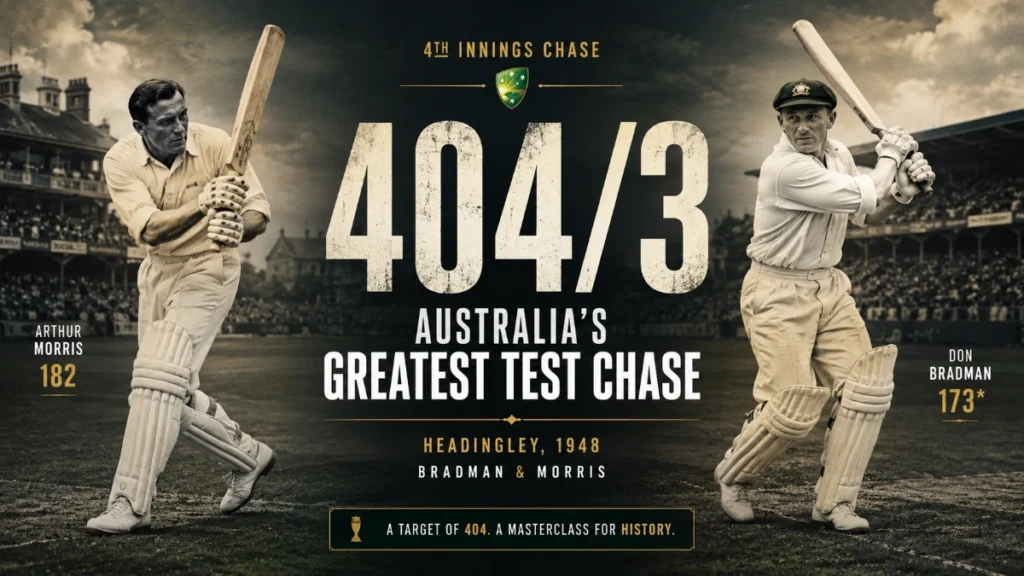

Australia national cricket team highest successful run chase in Test cricket stands at 404/3, achieved against England at Headingley in 1948. Led by Arthur Morris(182) and Don Bradman(173*), this remains Australia’s biggest fourth-innings chase and one of the greatest successful run chases in Test history.
No Australian side has come within 35 runs of matching it in the 78 years since, and that gap tells its own story about how far ahead of its era this Australian batting effort really was.
What Is Australia National Cricket Team Highest Successful Run Chase In Test Cricket?
Australia national cricket team highest successful run chase in Test cricket is 404 for the loss of three wickets, completed against England in the fourth Test of the 1948 Ashes series at Headingley, Leeds. The chase was carried by twin centuries from Morris and Bradman and remains Australia’s benchmark fourth-innings performance.
Match Situation Before The Chase
England had posted 496 in their first innings, built on centuries from Cyril Washbrook and Bill Edrich, before Australia replied with 458, just 38 runs short, thanks to Neil Harvey’s 112 and useful contributions from Keith Miller, Sam Loxton and Ray Lindwall. England then declared their second innings at 365/8, with half-centuries across their top four, setting Australia a target of 404 on a fifth-day surface expected to break up badly.
England’s Target Strategy
England’s declaration was built on the assumption that a used Headingley pitch would turn sharply enough to make 404 unreachable inside a single day. That assumption was the single biggest miscalculation of the match — England had the runs on the board but never accounted for a batting pair capable of simply refusing to let the pitch dictate terms.
Pitch Deterioration Expectations
Fifth-day Headingley pitches in that era were routinely expected to assist spin heavily once the shine wore off and cracks widened. What actually unfolded exposed a real gap between theoretical pitch behavior and Australia’s ability to counter it with intent rather than caution.
Australia National Cricket Team Highest Successful Run Chase In Test Cricket – 1948 Headingley
Australia’s 404-run chase at Headingley stands as the definitive answer to any question about Australia national cricket team highest successful run chase in Test cricket, and it held as the world record for 55 years before West Indies broke it in 2003. That longevity across more than five decades of Test cricket, spanning multiple generations of batting talent, is what separates this chase from every other Australian effort on the list.
Session-By-Session Breakdown Of The 1948 Chase
Australia batted through the final day without ever surrendering the initiative, and that session-by-session control — not a single moment of fortune — is what made the chase inevitable rather than dramatic. Morris and Bradman took the attack to England from the first hour, refusing the conservative start that most sides in their position would have chosen.
Morning Session Approach
Morris opened the chase against the new ball and immediately looked to score rather than survive, a decision that set the tempo for the rest of the day. That early intent forced England’s opening bowlers onto the defensive far sooner than a cautious start would have, and it was the smartest tactical call of the entire innings.
Afternoon Acceleration
By the afternoon session, Bradman had settled and began rotating strike freely against both pace and spin, denying England any sustained period of pressure. Once the required rate dropped into single figures per over, Australia’s position shifted from difficult chase to formality, and England had no answer left to change that trajectory.
Why England’s Bowling Plan Failed Tactically
England’s bowling plan failed because captain Norman Yardley persisted with defensive fields even after Bradman had clearly settled, rarely committing to close-in catchers who could manufacture pressure. The absence of sustained short-leg and slip pressure allowed both batters to rotate strike without ever facing a genuine wicket-taking threat, and that passivity cost England the match as surely as Australia’s batting won it.
Missed Opportunities With The New Ball
England’s quicks had the best chance to strike early against Morris, but the fields set were too orthodox for a side that desperately needed wickets rather than containment. Persisting with a defensive length instead of attacking the stumps was a costly misjudgment that let Australia’s most vulnerable moment pass without incident.
Key Players Behind Australia’s Record Chase
The chase belonged to two batters playing at contrasting but complementary registers: Morris’s attacking 182 and Bradman’s unbeaten 173, in what turned out to be Bradman’s final Test century. Their stand remains the defining partnership behind Australia national cricket team highest successful run chase in Test cricket, and no later Australian pairing has matched its scale under equivalent pressure.
Standout Performers From The 1948 Chase
The table below captures the key contributors from both innings, giving context to how comprehensively Australia’s batting outperformed England’s bowling attack on the final day.
| Player | Score | Team |
| Arthur Morris | 182 | Australia |
| Don Bradman | 173* | Australia |
| Neil Harvey | 112 | Australia |
| Cyril Washbrook | 143 | England |
| Bill Edrich | 111 | England |
Bradman’s Farewell Test Century Context
Bradman’s 173 not out is remembered today largely because it turned out to be the last Test hundred of his career, adding a historical weight to the innings beyond its statistical size. Treating it as a mere footnote to his career average would be a disservice — this was arguably the most important century he ever scored in terms of shaping how the chase was remembered.
Comparing Australia’s Biggest Test Chases
Australia’s 404-run chase dwarfs every other run chase the team has completed, with the next best still nearly 35 runs short. This gap in scale is why Headingley 1948 remains the clear reference point whenever pundits assess Australia national cricket team highest successful run chase in Test cricket.
Top Australian Test Chases Ranked
The list below ranks Australia’s most significant successful fourth-innings chases by target size, illustrating just how far ahead 1948 sits above the rest.
| Rank | Chase | Opponent | Year |
| 1 | 404/3 | England | 1948 |
| 2 | 369/6 | Pakistan | 1999 |
| 3 | 362/7 | West Indies | 1978 |
The 1999 Hobart chase deserves more credit than it typically gets, since Adam Gilchrist and Justin Langer both scored centuries in a genuine last-day scramble against Pakistan, and it remains Australia’s highest chase on home soil. Dismissing it as a footnote to 1948 misses how it proved a new generation could replicate that same fourth-innings nerve decades later.
Comparison With Modern Fourth Innings Chases
Modern Test cricket has produced faster scoring rates, but no side — including recent Australian teams — has come close to replicating a 400-plus successful chase against a strong attack on a deteriorating pitch. That absence says less about modern batting quality and more about how genuinely exceptional the conditions and execution were in 1948.
How Scoring Rates Have Shifted Since 1948
Australia’s 1948 chase was completed at roughly 3.5 runs per over, a pace considered aggressive for its era despite looking modest by today’s T20-influenced Test scoring standards. Judging the innings purely by modern run-rate benchmarks understates its difficulty; the real comparison should be against the bowling quality and fielding pressure of the day, both of which were substantial.
Why This Record Still Defines Australian Batting
Australia’s 1948 chase still defines the team’s batting identity because it set the template other sides are measured against: patience against the new ball, aggression once set, and senior batters taking ownership rather than deferring to the tail. Modern Australian top-order batters are still coached toward that exact mindset whenever a stiff fourth-innings target appears on the board.
Legacy In Modern Test Cricket
Every time an Australian side gets within reach of a 300-plus target in the fourth innings, commentators inevitably invoke Headingley 1948, and that comparison is earned rather than lazy nostalgia. No later Australian chase — including the celebrated 1999 Hobart victory — has matched the combination of target size, opposition quality and pitch difficulty that Morris and Bradman overcame.
How The Record Was Eventually Broken
Australia’s 404 stood as the world record until 2003, when West Indies chased down 418 against Australia itself at the Antigua Recreation Ground, built on centuries from Ramnaresh Sarwan and Shivnarine Chanderpaul. There is a sharp irony in Australia losing the record it had held for 55 years in a Test it lost by three wickets while defending 418, and that defeat did more damage to the Steve Waugh-era side’s aura than any single Ashes loss.
Australia national cricket team highest successful run chase in Test cricket remains the 1948 Headingley effort domestically, even though the world record has since moved to the Caribbean. The next time an Australian batting order faces a daunting final-innings target, the Morris-Bradman blueprint from 1948 is still the standard being chased.
Read along: What Is the India National Cricket Team’s Highest Successful Run Chase in T20I?
Frequently Asked Questions
What is Australia’s highest successful run chase in Test cricket?
Australia national cricket team highest successful run chase in Test cricket is 404/3, achieved against England at Headingley in 1948. Arthur Morris scored 182 and Don Bradman finished unbeaten on 173, guiding Australia to victory by seven wickets.
Who set the target of 404 for Australia in 1948?
England set the target by declaring their second innings at 365/8, backed by half-centuries from their top four batters. Combined with their first-innings total of 496, this left Australia needing 404 to win.
How long did Australia’s 404-run chase remain a world record?
Australia’s 404-run chase stood as the highest successful run chase in Test cricket history for 55 years. It was finally surpassed in 2003 when West Indies chased 418 against Australia in Antigua.
What is Australia’s highest successful run chase at home in Tests?
Australia’s highest successful home run chase is 369/6 against Pakistan at Bellerive Oval, Hobart, in 1999. Adam Gilchrist and Justin Langer both scored centuries to complete that chase.
Why is the 1948 Headingley chase considered so significant?
The chase combined a genuinely difficult target, a deteriorating pitch, and two batters at the peak of their powers, and it remains a benchmark for fourth-innings batting under pressure. It also produced Don Bradman’s final Test century.
Did England make tactical mistakes during Australia’s 1948 chase?
Yes, England’s captain persisted with defensive fields even after Bradman had settled, rarely using close-in catchers to manufacture pressure. That passive approach let Australia’s batters rotate strike freely and remove scoreboard pressure.
Who holds the current world record for highest successful Test run chase?
West Indies hold the current record, chasing 418 against Australia at the Antigua Recreation Ground in 2003. Ramnaresh Sarwan and Shivnarine Chanderpaul were the key contributors in that chase.
How many runs did Neil Harvey score in Australia’s first innings at Headingley 1948?
Neil Harvey scored 112 in Australia’s first innings of 458, which came just 38 runs short of England’s first-innings total of 496. His century helped Australia stay competitive before the fourth-innings chase began.
What was Don Bradman’s final Test century score?
Don Bradman’s final Test century came in the 1948 Headingley chase, where he finished unbeaten on 173. It was his 29th and last Test hundred before his retirement later that year.
How does the 1948 chase compare to other Australian fourth-innings totals?
At 404, the 1948 chase remains nearly 35 runs ahead of Australia’s next-best successful chase of 369/6 against Pakistan in 1999. No Australian side has approached that gap in the decades since.