
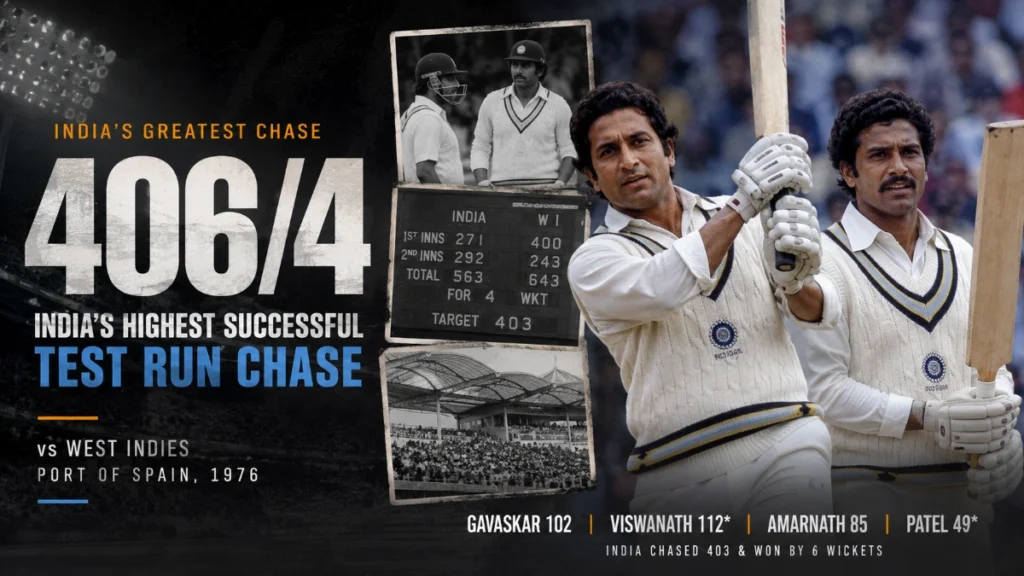

India’s highest successful run chase in Test cricket is 406/4, achieved against the West Indies at Queen’s Park Oval, Port of Spain, in April 1976. Chasing a target of 403, India won by six wickets on the back of centuries from Sunil Gavaskar (102) and Gundappa Viswanath, in a result that remains India’s only successful 400-plus Test chase.
What Is India’s Highest Successful Run Chase in Test Cricket?
India’s highest successful run chase in Test cricket came in 1976, when the side chased down 403 against the West Indies at Port of Spain. The victory stands as India’s only successful 400-plus Test chase and is widely cited among the greatest fourth-innings performances in the sport’s history.
The Historic 1976 Port of Spain Chase
Before this Test, India had never chased more than 256 in their entire Test history, which makes the leap to 403 a genuinely outsized jump rather than an incremental record. Sunil Gavaskar later said that going into the final day, he was confident of saving the match — the idea of actually winning it hadn’t occurred to him.
Why 403 Was Considered Unreachable
A target above 400 on a fifth-day pitch against a Test attack was treated as functionally safe territory for the fielding side in 1976, since no team anywhere had come close to chasing such a total. Clive Lloyd reportedly told his bowlers afterward that he had given them roughly 400 runs to work with and still failed to take ten wickets.
Series Context Before the Port of Spain Test
This chase happened in the third Test of a four-match series that India entered already 1-0 down. West Indies had beaten India by an innings and 97 runs in the first Test, before the second Test at Port of Spain was drawn.cricbuzz+1
1976 India–West Indies Series Result Card
The table below tracks how the series moved before, during, and after India’s record chase.
Match Overview: How the Chase Was Set Up
West Indies chose to bat first on a pitch expected to assist spin, and Clive Lloyd’s decision to drop fast bowler Andy Roberts in favor of three spinners was one of the most consequential selection calls of the series. That call backfired badly once India batted last, leaving West Indies without the pace to finish the chase.
First and Second Innings Scorecard Summary
Michael Holding’s Devastating Spell
Holding took 6 for 65 in India’s first innings, including Gavaskar’s wicket for just 26, after the opener had strung together five consecutive 50-plus scores at the same ground. That spell is the clearest evidence of how dangerous West Indies’ pace attack still was, even with Roberts left out.
Chase Timeline: Session by Session
India’s chase unfolded across two full days, moving from cautious survival on day four to outright pursuit on day five.
Day-by-Day Progression
The Run-Out That Nearly Derailed the Chase
Viswanath was run out at 336 for 3 after a miscommunication with Amarnath, briefly threatening India’s momentum with 67 runs still needed. Amarnath himself was run out shortly after for 85, following 440 minutes at the crease.
Required Run Rate and Why the Target Felt Impossible
India scored their 406 at a run rate of just 2.76 per over, reflecting how attritional fourth-innings batting was in the 1970s compared to today. The chase was built on batting through 147 overs without losing wickets in clusters, not on aggression.
Key Partnerships That Built the Chase
No single stand carried the entire chase; three separate partnerships each absorbed a distinct phase of pressure.
Partnership Breakdown
Bowling Figures and West Indies’ Tactical Errors
West Indies’ spin attack of Raphick Jumadeen, Imtiaz Ali, and Albert Padmore bowled the bulk of the fourth-innings overs, with Jumadeen the most successful. Leaving out Andy Roberts meant West Indies had no genuine pace option to break the chase once the ball got old.
Fourth-Innings Bowling Figures
| Bowler | Overs | Wickets | Runs Conceded |
| Raphick Jumadeen | 41 | 2 | 70 |
| Imtiaz Ali | — | 1 | — |
| Bernard Julien | — | 0 | — |
| Albert Padmore | — | 0 | — |
Clive Lloyd’s Field-Setting Debate
Lloyd’s attacking fields have often been cited by historians as a contributing factor, since they continued to offer scoring opportunities well after India passed 300. He only shifted to defensive settings once Patel began accelerating late.
Why This Record Has Lasted Nearly Five Decades
The 406/4 chase has survived as India’s record for close to fifty years mainly because touring teams have rarely handed India a fourth-innings target above 350 since — most Tests in India end inside four days on turning pitches.
India’s Biggest Successful Test Run Chases
| Rank | Score | Target | Opponent | Venue | Year |
| 1 | 406/4 | 403 | West Indies | Port of Spain | 1976 |
| 2 | 387/4 | 387 | England | Chennai | 2008 |
| 3 | 329/7 | 328 | Australia | Brisbane (Gabba) | 2021 |
| 4 | 276/5 | 276 | West Indies | Delhi | 2011 |
| 5 | 264/3 | 264 | Sri Lanka | Kandy | 2001 |
How India’s 1976 Chase Compares to World Record Test Chases
India’s 406 remains well short of the outright world record for a successful Test chase, held by West Indies’ 418/7 against Australia at St John’s in 2003.
World Record vs. India’s National Record
| Chase | Team | Target | Venue | Year |
| World record | West Indies | 418 | St John’s | 2003 |
| India’s national record | India | 403 | Port of Spain | 1976 |
| Modern Bazball comparison | England | 378 | Edgbaston | 2022 |
The Modern Bazball Comparison
England’s 378-run chase against India at Edgbaston in 2022 came at well over four runs an over, compared to India’s 2.76 in 1976. India’s chase is remembered more for its historical improbability than for its tempo.
Historical Significance and Impact on Indian Cricket
The Port of Spain win leveled the series 1-1 heading into the fourth Test in Jamaica, though West Indies responded by shifting entirely toward hostile fast bowling and won the finale and the series 2-1. For India, the chase proved that a daunting fourth-innings target wasn’t automatically a lost cause — a marker later Indian teams, including the 2008 Chennai and 2021 Gabba sides, have referenced when chasing steep targets themselves.
Frequently Asked Questions
What is India’s highest successful run chase in Test cricket?
India’s highest successful run chase in Test cricket is 406/4, achieved against the West Indies at Queen’s Park Oval, Port of Spain, in April 1976. India chased a target of 403 and won by six wickets, powered by centuries from Sunil Gavaskar and Gundappa Viswanath.
Why is India’s 1976 Test chase considered historic?
The 1976 chase is historic because India had never previously chased more than 256 in a Test innings, making the jump to 403 a huge leap. It remains India’s only successful 400-plus Test chase almost fifty years later.
Who scored centuries in India’s 406/4 chase against West Indies?
Sunil Gavaskar scored 102 and Gundappa Viswanath scored a century in the middle order during the chase. Mohinder Amarnath supported both with a defiant 85 before being run out.
What target did India chase in the 1976 Port of Spain Test?
India chased a target of 403 runs in the fourth innings, set after West Indies declared their second innings once Alvin Kallicharran completed his century. India reached 406 for 4 in 147 overs to win by six wickets.
Why did West Indies lose despite setting a 403-run target?
West Indies dropped fast bowler Andy Roberts for the match and relied on spin on a turning pitch, leaving them without the pace to break India’s batting on a flattening fifth-day surface. Captain Clive Lloyd’s attacking fields also kept scoring opportunities open well after India crossed 300.
What is the world record for the highest successful run chase in Test cricket?
The world record for the highest successful run chase in Test cricket is 418 for 7, achieved by the West Indies against Australia at St John’s in 2003. India’s 406/4 remains a national record but sits below the global mark.
How does India’s 1976 chase compare to modern Bazball-era run chases?
India’s 1976 chase was completed at 2.76 runs per over, far slower than modern aggressive chases such as England’s 378 chase against India at Edgbaston in 2022, which came at well over four runs an over. The difference reflects changes in over rates, fielding restrictions, and batting approach rather than a decline in the achievement itself.
What was India’s biggest successful run chase at home in Tests?
India’s biggest successful run chase on home soil is 387 for 4 against England at Chennai in December 2008, sealed by MS Dhoni with a century from Sachin Tendulkar. It remains lower than the 1976 overseas record because touring teams rarely set India targets above 350 in India.
Who were the standout bowlers for West Indies in the 1976 Port of Spain Test?
Michael Holding took 6 for 65 in India’s first innings, while Raphick Jumadeen was the most successful bowler in the fourth-innings chase with 2 for 70 off 41 overs. B.S. Chandrasekhar and Bishan Bedi combined for ten wickets in West Indies’ first innings for India
How did the 1976 series between India and West Indies finish?
West Indies won the four-Test series 2-1, after winning the first Test by an innings and 97 runs, drawing the second, losing the third to India’s record chase, and winning the fourth in Jamaica. That final Test marked West Indies’ full shift toward a fast-bowling-dominated attack
Has any Indian team come close to breaking the 1976 run-chase record?
India’s next-largest successful chases — 387 against England in 2008 and 329 against Australia at the Gabba in 2021 — both fall short of 403, meaning the 1976 record has stood for nearly fifty years. A genuine challenge to the record would require an opponent setting India a target above 400, which has not happened again since.