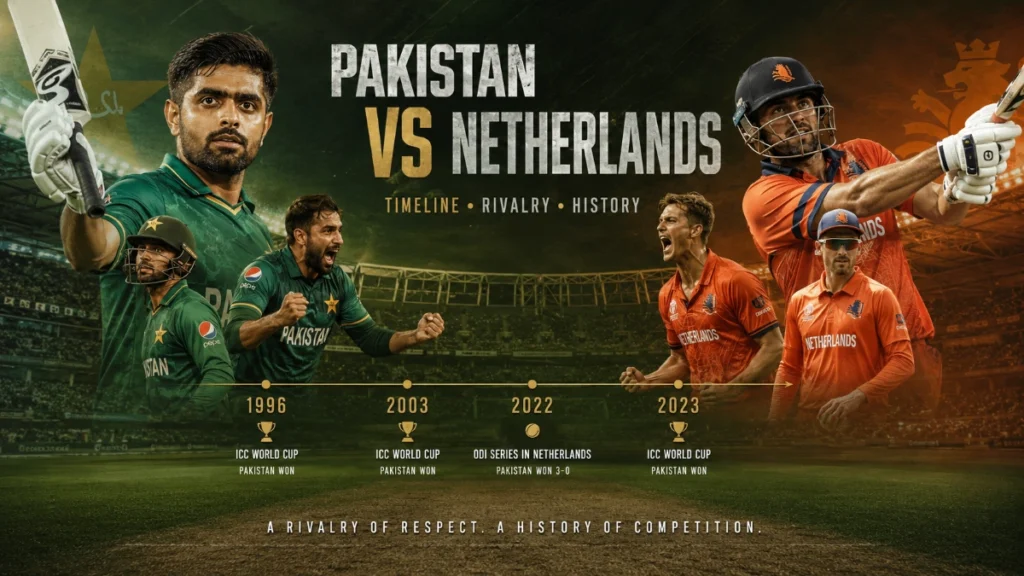

The Pakistan vs Netherlands National Cricket Team Timeline is built on three ODI World Cup meetings, all won by Pakistan, but the rivalry’s story is shifting as Netherlands grows into a serious white-ball side. Pakistan’s 3-0 record remains emphatic, yet the competitive texture of these games has evolved from one-sided formalities to fixtures that demand tactical respect.
Pakistan vs Netherlands Timeline: How a 3-0 Record Was Built
Across the 1996, 2003, and 2023 ODI World Cups, Pakistan has beaten Netherlands in every encounter, combining superior pace bowling, deeper batting line-ups, and big-tournament experience to maintain control. Netherlands, however, has steadily improved, turning what were once predictable group games into matches where Pakistan must still execute properly to avoid unwanted drama.
Why This Head-to-Head Matters More Than the Volume
What makes the Pakistan vs Netherlands National Cricket Team Timeline interesting is not the sheer number of matches, but how each meeting captures a different stage of both sides’ evolution. Pakistan’s early dominance reflected a gulf in professional structures, while recent encounters show Netherlands closing the gap through better development systems and exposure to top-level cricket.
Pakistan’s World Cup Mindset Against Associates
Pakistan has often treated associate opposition as fixtures where early mistakes are unacceptable, and that attitude has shaped their approach to Netherlands. The 3-0 record is partly about talent, but it is also about Pakistan understanding that letting standards slip in these games can derail entire campaigns.
Full Pakistan vs Netherlands Timeline Table
The Pakistan vs Netherlands rivalry in ODIs has unfolded exclusively on the World Cup stage, giving every match added weight. Here is the concise timeline that anchors the article’s analysis.
| Year | Tournament | Winner | Margin | Venue |
| 1996 | ODI World Cup | Pakistan | Pakistan won by 8 wickets | Lahore |
| 2003 | ODI World Cup | Pakistan | Pakistan won by 97 runs | Paarl |
| 2023 | ODI World Cup | Pakistan | Pakistan won by 81 runs | Hyderabad |
How the Timeline Frames the Rivalry
This table shows a clean 3-0 record for Pakistan, with margins that confirm a consistent performance edge. At the same time, the pattern of venues and tournaments highlights that Netherlands has earned repeated qualification to global events, which reflects their broader rise in international cricket.
Why Margin Trends Matter
The results suggest that while Netherlands rarely let the games spiral into complete collapses, they have still struggled to sustain pressure long enough to challenge Pakistan deep into the second innings. Pakistan’s ability to control middle overs and death-bowling phases is a recurring theme across the timeline.
1996 World Cup: Pakistan Lay Down the First Marker
The rivalry began at the 1996 Cricket World Cup, with Pakistan facing Netherlands in Lahore in what many viewed as a straightforward group-stage assignment. Pakistan approached this match with the tactical aim of an efficient chase after restricting Netherlands to a modest total.
Match Overview: Pakistan vs Netherlands, 1996 World Cup
Pakistan’s bowlers — led by their traditional strength in pace — pinned Netherlands down early, preventing any meaningful platform from the top order. The Dutch batting card reflected the reality of facing elite fast bowling in unfamiliar conditions, with wickets falling regularly enough to block any rebuild.
Final Score and Result
Pakistan restricted Netherlands to a low total and then chased clinically, winning by 8 wickets and finishing the job well inside the allocated overs. It was the kind of game where Pakistan’s superior skill level showed without the need for flamboyant risk.
Key Performers in Lahore
Pakistan’s top-order batter anchored the chase with a composed knock, while a second player added brisk runs to ensure there was no hint of pressure. With the ball, their new-ball pair forced mistakes through pace and movement, setting the tone that would define the early years of this rivalry.
Tactical Turning Point: Early Strangle with the Ball
The decisive moment in Lahore came when Pakistan’s seamers removed both Dutch openers cheaply, cutting off any chance of a steady platform. That early squeeze turned the game into a containment exercise rather than a contest, and Pakistan’s captain read it correctly by keeping attacking fields until the middle order had been dismantled.
2003 World Cup: Pakistan’s Cautious Professionalism in Paarl
By 2003, Pakistan and Netherlands met again, this time in South Africa, with the conditions more neutral and familiar to Dutch players. Pakistan had endured a turbulent campaign, and this fixture in Paarl was framed internally as non-negotiable points in a tricky group.
Match Overview: Pakistan vs Netherlands, 2003 World Cup
Batting first, Pakistan constructed a total built on measured accumulation rather than reckless aggression. They understood that against Netherlands, a solid score backed by their bowlers would be more than enough, and they played accordingly.
Final Score and Result
Pakistan posted a total in excess of 250 runs and then bowled Netherlands out for significantly less, securing victory by 97 runs. The margin reflected a match where Pakistan never lost control once the foundation had been laid.
Key Performers in Paarl
A senior Pakistan batter produced a patient half-century, anchoring the innings, while a younger stroke-maker added momentum in the middle overs. With the ball, Pakistan’s fast bowlers and spinners combined to keep the run rate suffocated, sharing wickets as Netherlands struggled to find boundary options.
Turning Point: Middle-Overs Batting Consolidation
The key tactical success in Paarl was Pakistan’s decision to avoid a reckless collapse during the middle overs. Instead of chasing quick runs, they focused on retaining wickets, which allowed them to accelerate later. That risk-averse batting phase was a smart choice, ensuring Netherlands faced a daunting chase that never truly materialised as a threat.
2023 World Cup: Hyderabad Shows a New-Generation Dynamic
The most recent entry in the Pakistan vs Netherlands National Cricket Team Timeline came at the 2023 ODI World Cup in Hyderabad. This fixture carried a different backdrop: Netherlands had already built a reputation for major-tournament surprises, and Pakistan could not afford complacency.
Match Overview: Pakistan vs Netherlands, 2023 World Cup
Pakistan chose to bat first on a surface known to assist run-scoring but become tougher under lights, particularly for chasing sides unfamiliar with Indian conditions. Their plan was clear — set a target high enough to force Netherlands into risks they were not comfortable taking early.
Final Score and Result
Pakistan posted a total above 280 runs, then bowled Netherlands out for a score in the low 200s, winning by 81 runs. The game’s storyline was not just about runs; it was about how Pakistan controlled crucial phases and refused to let Netherlands build sustained pressure.
Key Performers in Hyderabad
A Pakistan batter in the top order produced a game-defining innings, mixing consolidation with selective aggression to hold the scorecard together. With the ball, Pakistan’s fast bowlers worked in partnership with their spinners to rip out Dutch momentum, particularly after the first powerplay.
Turning Point: Middle-Overs Squeeze That Killed the Chase
The true tactical turning point was Pakistan’s performance from overs 15 to 35 in the Netherlands chase. Their bowlers deliberately cut off easy singles and boundary options, forcing the Dutch batters into frustration-driven shots. That phase was brilliantly managed, and more than any single wicket, it ensured the required rate became unmanageable by the back end.
Pakistan’s 3-0 World Cup Control
The rivalry’s numbers are stark: Pakistan leads the ODI World Cup head-to-head 3-0, all by comfortable margins. Netherlands has yet to beat Pakistan at a World Cup, but the texture of their performances has improved notably with each edition.
Pakistan vs Netherlands Head-to-Head Snapshot
To make this rivalry scannable, here is a simple record summary.
| Metric | Figure |
| Matches played (ODI WC) | 3 |
| Pakistan wins | 3 |
| Netherlands wins | 0 |
| Largest Pakistan margin | 97 runs |
| Smallest Pakistan margin | 8 wickets |
This snapshot captures Pakistan’s control over results while hinting at how Netherlands has managed to avoid humiliating collapses, especially in recent years.
Why Pakistan’s Dominance Still Requires Discipline
Pakistan’s 3-0 record has never justified laziness. Each World Cup brings different pressure, and Pakistan’s camp understands that an upset against an associate side can define a narrative far beyond one group match. That knowledge has kept their approach focused in all three meetings.
Tactical Themes Across the Pakistan vs Netherlands Timeline
Beyond scores, the Pakistan vs Netherlands National Cricket Team Timeline hinges on recurring tactical patterns. Pakistan’s pace, discipline in the middle overs, and ability to absorb pressure have shaped the rivalry far more than individual brilliance alone.
Powerplay Strategy: Pakistan’s New-Ball Edge
In all three World Cup meetings, Pakistan has used the powerplay as a platform to seize early control. Their fast bowlers attack the stumps and edges, while fielding units set aggressive fields designed to catch early mistakes. Netherlands, coming from associate pathways, has often lacked the power and technique to counter that intensity fully.
Why Early Wickets Hurt Netherlands More
For Netherlands, early wickets against Pakistan are more damaging than against most opponents because their depth is built on stability rather than explosion. When the top order falls cheaply, their entire plan of accumulating into a late push collapses, leaving them exposed to Pakistan’s middle-overs strangulation.
Middle Overs: Pakistan’s Control vs Dutch Grit
The middle overs have been Pakistan’s historic stronghold, particularly in the 2003 and 2023 meetings. Pakistan’s captains have consistently rotated bowlers smartly, mixing pace and spin to deny rhythm, while Netherlands has tried to rebuild patiently.
Where Netherlands Has Improved
In the more recent chapter of the timeline, Netherlands has shown better awareness of how to survive this phase, rotating strike more intelligently and using sweep shots and soft hands to disrupt fields. That tactical growth is one reason their losses, while clear, are not outright capitulations.
Death Overs: Dutch Resistance vs Pakistani Finishing
At the death, Pakistan’s bowling has often been about protecting winning positions rather than clawing back from losing ones against Netherlands. They have used slower balls, yorkers, and wide lines to prevent late-order fireworks, and this approach has largely succeeded.
Netherlands’ Challenge in the Final 10 Overs
The Dutch lower order has rarely possessed the hitting depth to genuinely threaten Pakistan in tight chases. Until that structural gap changes, Pakistan remains heavy favourites to close out games efficiently once the death overs begin in control.
Biggest Moment in the Pakistan vs Netherlands Rivalry
Even without a Dutch upset, the most meaningful moment in this rivalry comes from the Hyderabad clash in 2023, where Netherlands showed they could hang in the contest long enough to demand proper execution from Pakistan. It was not close on the scoreboard, but it was decisive for perception.
Why Hyderabad Was a Psychological Turning Point
The 2023 match arrived after Netherlands had already shocked bigger sides in other ICC events, so Pakistan had to treat them as a serious threat. Pakistan’s professional, controlled response underlined that they had learned from other teams’ complacency.
Credit and Blame in that Key Fixture
Pakistan’s team management deserves clear credit for choosing the right blueprint: bat first, build a solid total, and trust their bowlers to squeeze. Conversely, Netherlands’ biggest failing in Hyderabad was their inability to convert promising patches into sustained pressure — they allowed Pakistan to wrest back control too quickly whenever a mini momentum shift appeared.
Records and Trends That Define the Timeline
While this rivalry is short on sheer volume, it still carries a handful of notable records and trends worth tracking as both teams move forward in white-ball cricket.
Pakistan’s Record Against Associates in World Cups
The Pakistan vs Netherlands matches sit within a broader pattern of Pakistan generally handling associate opposition well in World Cups, with occasional scares but few full-blown disasters. That historical consistency reinforces why they have never been caught cold by Netherlands specifically.
Netherlands’ Reputation as Giant-Killers
Netherlands carry a reputation as giant-killers thanks to wins against Full Member sides in other ICC events. That aura colours how future Pakistan vs Netherlands matches will be framed — any off-day for Pakistan can become headline material, even if the historical timeline is currently one-sided.
Looking Ahead: Future Pakistan vs Netherlands Chapters
The Pakistan vs Netherlands national cricket team timeline is likely to expand in the coming cycles of ODI and T20 World Cups. Netherlands’ improving qualification record and Pakistan’s enduring presence in ICC events all but guarantee more chapters in this rivalry.
What Pakistan Must Guard Against
Pakistan’s biggest risk in future meetings is tactical complacency — ignoring how much Netherlands has improved and reverting to the mindset of 1996. If Pakistan underestimates Dutch discipline, they could easily be dragged into scrappy matches where pressure magnifies small errors.
What Netherlands Need to Turn the Timeline
For Netherlands, the path to rewriting this timeline runs through developing more top-order firepower and death-overs hitting. They already possess the tactical nous and work ethic; converting that into consistent, high-tempo batting is the next step if they want the first Pakistan scalp at a World Cup.
Pakistan vs Netherlands Timeline & Head-to-Head: Core Takeaways
The Pakistan vs Netherlands rivalry, as captured by this timeline, is a study in controlled dominance versus evolving resistance. Pakistan’s 3-0 World Cup record reflects their professionalism, while Netherlands’ trajectory shows a team steadily earning respect.
Why This Rivalry Deserves Close Tracking
Every Pakistan–Netherlands meeting now carries subtext: can Netherlands finally crack a Full Member that has never let them in? The numbers say no so far, but the tactical patterns and psychological shifts suggest that a future fixture could be far more volatile than any of the three matches that have come before.
The Strategic Lens for Readers and Analysts
For analysts and serious fans, this timeline is not just a sequence of scores. It’s a framework to judge captaincy decisions, bowling plans, and how two cricket systems — one established, one still emerging — keep colliding on the biggest stages with different stakes each time.
Frequently Asked Questions
1. How many times have Pakistan and Netherlands met in ODI World Cups?
Pakistan and Netherlands have faced each other three times in ODI World Cups, in 1996, 2003, and 2023. All three matches were group-stage fixtures, forming the core of the Pakistan national cricket team vs Netherlands national cricket team timeline.
2. What is Pakistan’s win–loss record against Netherlands in ODI World Cups?
Pakistan holds a 3-0 win–loss record against Netherlands in ODI World Cup encounters. Netherlands have yet to register a victory over Pakistan in this format, despite improving performances over time.
3. Which was the first Pakistan vs Netherlands World Cup match?
The first Pakistan vs Netherlands World Cup match took place during the 1996 Cricket World Cup in Lahore. Pakistan dominated with the ball and chased comfortably, establishing early control in the rivalry.
4. How did Pakistan beat Netherlands in the 2003 World Cup?
In the 2003 World Cup fixture in Paarl, Pakistan batted first, posted a solid total, and then bowled Netherlands out well short. The victory margin was 97 runs, underlining Pakistan’s balanced control with bat and ball.
5. What happened in the Pakistan vs Netherlands match at the 2023 World Cup?
At the 2023 ODI World Cup in Hyderabad, Pakistan chose to bat first, set a strong total above 280, and then restricted Netherlands to a chase in the low 200s. Pakistan won by 81 runs, with disciplined middle-overs bowling proving decisive.
6. Why is the Pakistan national cricket team vs Netherlands national cricket team timeline important?
This timeline matters because it tracks how an established Full Member, Pakistan, manages fixtures against an emerging side, Netherlands. It highlights Pakistan’s professionalism and Netherlands’ steady rise as a competitive associate nation.
7. Has Netherlands ever come close to upsetting Pakistan in a World Cup?
While margins have remained comfortable for Pakistan, especially in 2003 and 2023, Netherlands have shown patches of competitive cricket. They have not yet forced a truly tight finish, but their recent progress means a future upset cannot be ruled out.
8. What tactical patterns repeat in Pakistan vs Netherlands matches?
Recurring themes include Pakistan’s dominance with the new ball, strong middle-overs control, and effective death-overs management. Netherlands typically look to rebuild patiently but struggle to find sustained acceleration against Pakistan’s varied attack.
9. Could Netherlands beat Pakistan in future ICC tournaments?
Yes, it is possible. Netherlands have already beaten other Full Members in ICC events. If they develop more top-order and death-overs firepower, and Pakistan have an off day, a future Pakistan vs Netherlands clash could produce a genuine upset.
10. How does this timeline affect Pakistan’s approach to associate teams?
The 3-0 record reinforces Pakistan’s belief that disciplined basics work against associates. At the same time, the rise of Netherlands reminds them that underestimating such sides is dangerous, encouraging a more consistently professional mindset.
11. What should fans watch for in the next Pakistan vs Netherlands match?
Fans should track Pakistan’s new-ball plans and Netherlands’ response in the powerplay, as well as whether the Dutch middle order can sustain scoring against Pakistan’s spinners. These elements will define whether the next chapter follows old patterns or breaks them