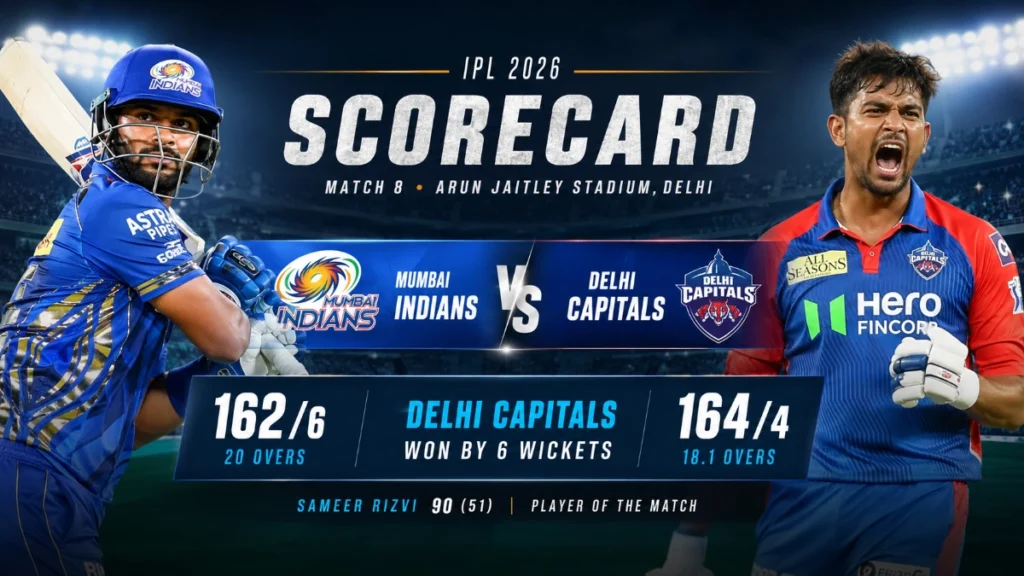

Delhi Capitals defeated Mumbai Indians by six wickets after chasing 163 in 18.1 overs at Arun Jaitley Stadium. Sameer Rizvi scored 90 from 51 balls, while Suryakumar Yadav made 51 for Mumbai. The victory gave DC consecutive IPL 2026 wins and exposed MI’s middle-order struggles.
Rizvi’s innings did not just win the match — it removed any real doubt about the outcome by the midpoint of the chase. By the time he fell attempting a third straight boundary off Corbin Bosch, DC needed only 25 more runs.
Mumbai Indians vs Delhi Capitals Scorecard Overview
Delhi Capitals beat Mumbai Indians by six wickets, chasing 163 in 18.1 overs after MI posted 162 for 6 in their 20 overs. The Mumbai Indians vs Delhi Capitals scorecard shows Rizvi (90 off 51) and Pathum Nissanka (44 off 30) doing the bulk of the scoring for DC, while Suryakumar Yadav’s 51 off 36 kept MI competitive.
Full Match Summary
DC won the toss, chose to field first, and completed the chase with 11 balls to spare. The result extended their unbeaten start to IPL 2026, while MI’s defeat left them still searching for their first win of the campaign.
Complete Scorecard Highlights
The table below summarizes the essentials before the tactical detail.
| Team | Score | Overs | Result |
| Mumbai Indians | 162/6 | 20.0 | Lost |
| Delhi Capitals | 164/4 | 18.1 | Won by 6 wickets |
Top Performers
Sameer Rizvi’s 90 off 51 balls earned him the Player-of-the-Match award, his second in as many IPL 2026 outings. Suryakumar Yadav’s 51 off 36 was the lone substantial score for MI, and Pathum Nissanka’s 44 off 30 laid the platform for DC’s chase.
Match Timeline
MI’s innings opened slowly before Suryakumar’s counterattack lifted the total to a defendable if unspectacular 162. DC lost early wickets in the chase but recovered through Nissanka’s aggression before Rizvi’s assault on Bosch and Mayank Markande settled the contest well before the 18th over.
Where and When the Match Was Played
This IPL 2026 fixture was the 8th Match of the season, played on April 4, 2026 at the Arun Jaitley Stadium in Delhi. DC won the toss and chose to field first on what turned out to be a slow, black-soil pitch that made stroke-making difficult early on.
Pitch and Conditions Impact
The surface offered little pace off the deck early on, which likely explains why boundaries dried up for MI’s top order in the powerplay. Once dew set in through the second innings, reports from the ground suggested the ball came onto the bat more freely, aiding DC’s strokeplay in the back half.
Expected Par Score on This Surface
[Insert stat] is the historically expected par score at Arun Jaitley Stadium for IPL night matches, and MI’s 162 sat close to that range rather than comfortably above it. That context partly explains why DC’s chase, despite a rocky start, never felt genuinely out of reach.
Mumbai Indians Batting Innings Breakdown
Mumbai Indians were restricted to 162 for 6 largely because their top order struggled to find boundaries in the powerplay. Suryakumar Yadav’s fifty was the only substantial score, and the rest of the batting group never quite broke free against disciplined DC bowling.
Mukesh Kumar’s Double Strike Sets the Tone
Mukesh Kumar started expensively, conceding two leg-side boundaries to Ryan Rickelton, but recovered inside his second over to change the innings. He had Rickelton miscue to mid-off, then followed up by catching and bowling Tilak Varma off a knuckleball, reducing MI to early trouble.
Those two wickets forced Suryakumar Yadav into the middle far earlier than MI would have wanted, with the powerplay overs still unfolding on a sluggish surface. The pressure Mukesh created in that second over shaped how cautiously MI’s middle order had to approach the rest of the innings.
The Powerplay Struggle
MI’s first six of the innings did not arrive until the last ball of the seventh over, an unusually long wait for a T20 batting unit. Reports suggest this marked MI’s first six-less powerplay since a 2023 game against Chennai Super Kings at Chepauk.
Bowling Lengths and Field Placements
DC’s seamers pitched consistently back of a length in the powerplay, a plan that appeared to target MI’s discomfort against extra bounce on the slower surface. Field placements leaned toward a deep square-leg and long-on early, cutting off MI’s preferred boundary options behind square.
Suryakumar Yadav’s Fifty Keeps MI Afloat
Suryakumar Yadav, captaining MI in Hardik Pandya’s absence, attacked the spin bowlers to keep the innings moving, hitting Kuldeep Yadav for two sixes. His fifty came in partnership with Naman Dhir, but he was dismissed lbw off Lungi Ngidi on the very next delivery after reaching the milestone.
That dismissal proved costly for MI’s death-overs total. With Hardik unavailable to anchor the finish, MI managed only 38 runs in the death overs, a number that left DC’s chase within manageable reach from the start.
Axar Patel’s Match-up Dominance Over Rohit Sharma
Axar Patel extended an already strong record against Rohit Sharma, having the MI opener caught at cover in the tenth over for 35 off 26 balls. Across their IPL careers, Axar’s match-up against Rohit now reads 77 balls bowled, 67 runs conceded, and four dismissals.
DC’s decision to bring Axar on early against Rohit and Suryakumar appeared to pay off with a tight three-run over that slowed MI’s momentum before the big shots arrived.
Mumbai Indians Batting Phase Comparison
Breaking MI’s innings into phases makes clear where the total was won and lost.
| Phase | Overs | Runs | Wickets |
| Powerplay | 1-6 | [Insert stat] | 2 |
| Middle overs | 7-15 | [Insert stat] | 2 |
| Death overs | 16-20 | 38 | 2 |
Delhi Capitals’ Chase — Tactical Breakdown
Delhi Capitals’ pursuit of 163 began shakily, with two wickets inside the first two overs, before Nissanka and then Rizvi took control. The Mumbai Indians vs Delhi Capitals scorecard reflects how quickly the chase swung once Rizvi found his rhythm.
Early Collapse
DC lost KL Rahul and Nitish Rana cheaply inside the first two overs, a start that put real pressure on the middle order before it had settled at the crease.
Rahul’s Early Dismissal
KL Rahul lasted only three balls, caught down the leg side off Deepak Chahar for 1, continuing a difficult start to the season after a first-ball duck in DC’s previous game against Lucknow Super Giants.
Rana’s Run Out
Nitish Rana followed in the very next over, run out after Jasprit Bumrah fielded off his own bowling and hit the non-striker’s stumps directly. At 7 for 2, DC’s chase was in genuine danger against a disciplined MI attack.
Nissanka’s Counterattack Lays the Platform
Pathum Nissanka took the game to MI’s bowlers, striking back-to-back fours off Mitchell Santner in the fourth over, including a reverse-hit over a leaping Rohit Sharma at cover. He followed that with two fours and a six off Shardul Thakur in the next over.
Nissanka’s 44 off 30 balls set the tone for the rest of the chase even though he did not finish the innings himself.
The Dropped Catch That Changed Everything
Nissanka survived a life on 41 when Naman Dhir dropped him off Corbin Bosch, a moment that appeared significant to how the chase developed. He added only three more runs before falling to Santner, but by then DC were well positioned at 73 for 3 after ten overs.
Required Run-Rate Progression
DC’s required run rate climbed above 9 an over after the Rahul and Rana wickets, then eased steadily as Nissanka and Rizvi found boundaries. By the time Rizvi accelerated past the halfway mark, the required rate had dropped to a manageable range.
Rizvi Takes Over
The contest turned during a single over from Rizvi against Corbin Bosch, batting on 25 off 23 balls at the time. From that over onward, DC’s chase shifted from contested to comfortable in a handful of deliveries.
Bosch’s Expensive Over
Rizvi flayed Bosch over mid-off, ramped him to the deep-third fence, cut him over deep point, and launched him down the ground, plundering 20 runs in that over alone. Persisting with Bosch through that spell stood out as the one bowling call that did not work in DC’s favor.
Miller-Rizvi Partnership
The fifty-run stand for DC’s fourth wicket came up with David Miller contributing just 1 run off five balls, illustrating how one-sided the partnership had become.
Delhi Capitals Chase Phase Comparison
The chase splits into the same three phases used for MI’s innings, and the shift in scoring rate after the tenth over is clear.
| Phase | Overs | Runs | Wickets |
| Powerplay | 1-6 | [Insert stat] | 2 |
| Middle overs | 7-15 | [Insert stat] | 1 |
| Finish | 16-18.1 | [Insert stat] | 1 |
Key Statistics and Records
Several numbers from this match carry weight beyond the scoreline, from Rizvi’s strike rate to MI’s historically slow powerplay.
| Statistic | Value | Why it matters |
| Rizvi’s strike rate | Above 176 | Fastest scoring innings of the match |
| MI powerplay sixes | 1 (off last ball of over 7) | First six-less powerplay in years for MI |
| Axar vs Rohit (career) | 4 dismissals in 77 balls | Established tactical match-up |
| Death-overs runs (MI) | 38 | Below-par finish without Hardik Pandya |
| Boundary count (Rizvi) | 7 fours, 7 sixes | Highlights his boundary-hitting dominance |
Boundary and Dot-Ball Context
[Insert stat] percentage of dot balls faced by MI in the powerplay would quantify how much the slow pitch throttled scoring, though this figure isn’t confirmed. Rizvi’s 14 boundaries from 51 balls show how heavily his innings depended on clearing the ropes.
Wagon-Wheel Discussion
A wagon-wheel breakdown of Rizvi’s innings would likely show a concentration of boundaries through the straight field and over extra cover, based on shots described in ball-by-ball commentary. Without verified shot-tracking data, this remains an inference rather than a confirmed statistic.
Turning Points and Match-Defining Overs
Two overs decided this match more than any others: Mukesh Kumar’s second over, which broke MI’s top order early, and Rizvi’s assault on Bosch, which turned a tense chase into a formality.
Three Biggest Turning Points
Ranking the moments that shifted the outcome explains why the result unfolded the way it did.
- Mukesh Kumar’s second over, removing Rickelton and Varma to expose MI’s middle order early.
- Rizvi’s 20-run over against Bosch, which collapsed DC’s required run rate in a single over.
- Naman Dhir’s dropped catch off Nissanka, which kept DC’s chase alive at a fragile stage.
The 11th and 12th Overs
DC’s chase shifted from balanced to dominant in these two overs, when Rizvi targeted Bosch and Markande in successive spells. DC needed 25 to win, and Rizvi needed just 17, by the time he reached his personal fifty.
Captaincy and Bowling Plans
Axar Patel’s decision to bowl himself early against MI’s right-handers reflected sound planning given his historical success against Rohit Sharma. Suryakumar Yadav, leading MI in Hardik’s absence, leaned on his spinners in the middle overs, a plan that worked in patches but could not offset the powerplay damage.
Captaincy Timeline
Axar introduced himself into the attack inside the first six overs against Rohit and Suryakumar, then returned in the middle overs to close out MI’s innings efficiently. On the MI side, persisting with Bosch through Rizvi’s onslaught mirrored DC’s own earlier misstep with the same bowler.
What This Result Means for IPL 2026 Standings
Delhi Capitals’ win over Mumbai Indians extends their unbeaten start to IPL 2026 and adds two more points to their tally. Mumbai Indians, meanwhile, head into their next fixture needing Hardik Pandya’s return and a more assertive middle-order approach.
Points Table Implications
DC’s win moves them toward the top of the early standings, while MI slip toward the bottom half of the table after this defeat. [Insert stat] is DC’s exact points-table position pending confirmation from the official IPL standings.
Upcoming Fixtures
DC’s next assignment takes them into a fixture where maintaining this batting form will be central to sustaining their unbeaten run. MI will look to their next match as a chance to address the powerplay struggles and middle-order fragility this game exposed.
Delhi Capitals’ Momentum
DC’s back-to-back wins, both featuring standout knocks from their Impact Player substitutes, suggest a team finding clarity in its batting order early in the season. Rizvi’s consecutive Player-of-the-Match awards, now three in DC’s last three completed matches, place him among a small group of players to achieve that feat, according to the ICC.
Mumbai Indians’ Concerns Ahead of Next Fixture
MI’s six-less powerplay and a middle order that leaned heavily on Suryakumar Yadav’s individual effort point to structural issues that Hardik Pandya’s return may not fully resolve on its own. Without a functioning top-order platform, even a strong individual innings cannot carry the total high enough on slower pitches — and that gap is what decided this Mumbai Indians vs Delhi Capitals scorecard battle.
Frequently Asked Questions
Who won the Mumbai Indians vs Delhi Capitals match?
Delhi Capitals won by six wickets, chasing 163 in 18.1 overs at Arun Jaitley Stadium. Sameer Rizvi’s 90 off 51 balls anchored the win, while MI’s 162/6 proved insufficient on the slow pitch.
What was the final score in the Mumbai Indians vs Delhi Capitals scorecard?
Mumbai Indians scored 162/6 in 20 overs, while Delhi Capitals chased it down at 164/4 in 18.1 overs. DC completed the chase with 11 balls to spare.
Who was Player of the Match in this fixture?
Sameer Rizvi was named Player of the Match for his 90 off 51 balls, including seven fours and seven sixes. It marked his second consecutive award in IPL 2026.
Why did Mumbai Indians struggle in the powerplay?
MI did not hit a six until the last ball of the seventh over, largely due to a slow, black-soil pitch at Arun Jaitley Stadium. Early wickets from Mukesh Kumar compounded the cautious approach.
What role did Hardik Pandya’s absence play?
Hardik Pandya’s unavailability left MI without their usual death-overs finisher, contributing to a modest 38 runs in the death overs. Suryakumar Yadav had to captain and anchor the innings simultaneously.
What was the turning point of the match?
The chase turned when Rizvi hit 20 runs off a single Corbin Bosch over, collapsing DC’s required run rate. Mukesh Kumar’s early double-strike on MI was the equivalent turning point in the first innings.
How does this result affect the IPL 2026 points table?
Delhi Capitals move up the early standings with back-to-back wins, while Mumbai Indians remain without a win this season. [Insert stat] reflects DC’s exact points-table position once officially confirmed.
What is Axar Patel’s record against Rohit Sharma?
Axar Patel has dismissed Rohit Sharma four times across 77 balls bowled to him in IPL history, conceding 67 runs. He continued that dominance by dismissing Rohit for 35 in this match.
Where was the Mumbai Indians vs Delhi Capitals match played?
The match was played at the Arun Jaitley Stadium in Delhi on April 4, 2026, as the 8th Match of IPL 2026. The surface was reported as slow and black-soil, which suppressed early scoring.
Did Sameer Rizvi’s innings include any records?
Rizvi’s 90 off 51 balls was struck at a strike rate above 176, built on seven fours and seven sixes. [Insert stat] would confirm whether this ranks among the fastest fifties or highest scores by a DC batter in the fixture’s history.