
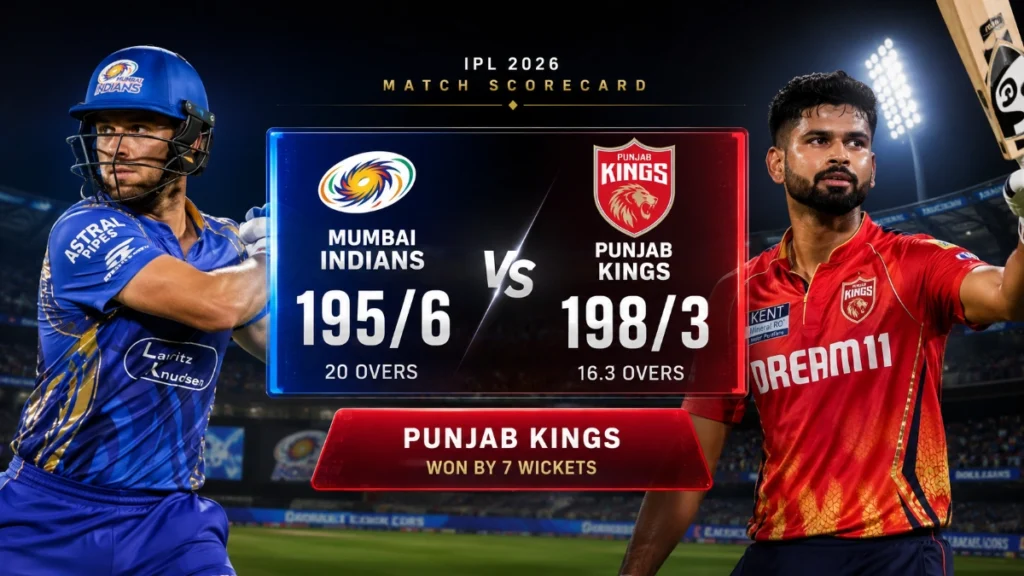

Mumbai Indians vs Punjab Kings’ match scorecard read PBKS 198/3 in 16.3 overs, chasing down Mumbai’s 195/6 with seven wickets in hand. Prabhsimran Singh’s unbeaten 80 and Shreyas Iyer’s 66 dominated the chase, cancelling out Quinton de Kock’s unbeaten century and strengthening Punjab’s IPL 2026 playoff push.
Why Mumbai Lost Despite A Century
Mumbai lost despite de Kock’s hundred because no partner batted with him long enough to sustain scoreboard pressure, and the bowling attack could not defend a total built on just two long stands. A single century rarely wins a T20 chase-defense when the middle order collapses in isolation around it.
The Support Collapse Around De Kock
Once Naman Dhir fell in the 14th over, Mumbai’s remaining batters lasted barely six overs combined, denying de Kock a platform to push the total past 210. Hardik Pandya’s 41 came at a healthy clip but ended too early for Mumbai to reach a genuinely defendable score.
Rickelton and Suryakumar Yadav had already fallen inside the powerplay, meaning de Kock effectively rebuilt the innings twice — once early with Dhir, and again late with Hardik — without ever getting a partner who could bat through to the finish.
Middle-Over Bowling That Never Tightened
Mumbai’s spin and change-of-pace options went for close to ten an over between the 7th and 15th, allowing Punjab to build the 139-run stand between Prabhsimran and Iyer without ever facing a dot-ball squeeze. That lack of control in the Mumbai Indians vs Punjab Kings match scorecard’s middle phase effectively decided the contest before the death overs began.
Defensive Fields That Arrived Too Late
Hardik set boundary riders only after Punjab had already crossed the game’s midpoint at pace, a full three overs later than the situation demanded, and by then singles alone were enough to keep Punjab ahead of the rate. Attacking fields earlier, while Prabhsimran was still finding his range, would have forced more false shots.
Tactical Turning Point
The chase turned in Punjab’s favor during the 9th over, when Bumrah was held back from a second spell and a part-time medium-pacer went for 16 runs, breaking Mumbai’s grip on the required rate. That over shifted momentum permanently toward Punjab.
The Bowling Change That Backfired
Hardik’s decision to save Bumrah for the death overs meant Mumbai’s most reliable bowler never faced Prabhsimran or Iyer during their most dangerous phase, a call that looked reasonable pre-match but cost Mumbai the initiative once the stand was set. By the time Bumrah returned, the pressure Mumbai needed him to create had already evaporated.
Reading The Asking Rate Wrong
By the time Bumrah returned in the 18th over, the asking rate had dropped below seven, stripping his pace and yorkers of the pressure they typically generate against batters already ahead of the chase. A shorter, sharper burst earlier would have tested Punjab while the required rate still sat above nine.
Ghazanfar’s Missed Second Spell
Allah Ghazanfar’s economical first three overs, which included both early wickets, were never followed up with a fourth-over burst during the Prabhsimran-Iyer stand, a rotation gap that let Punjab settle against Mumbai’s other spin option instead.
Captaincy Analysis
Shreyas Iyer’s chase management stood out for its restraint, rotating strike through the middle overs rather than forcing risk against Mumbai’s fielding restrictions, while Hardik’s bowling rotation on the other side lacked a clear plan once his first-choice option was rested. Iyer’s calm approach effectively neutralized Mumbai’s containment strategy.
Iyer’s Low-Risk Chase Method
Iyer targeted only bowlers operating below 130 kph with clean hitting, while working singles off the quicker options, a method that kept Punjab’s required rate manageable without excessive risk-taking. That discipline meant Punjab rarely needed to attack Mumbai’s best bowlers directly.
Boundary Selection Through The Chase
Prabhsimran and Iyer picked specific zones — square of the wicket for pace, straight down the ground for spin — rather than manufacturing risk across the full arc, a selective approach that limited their false-shot percentage through the tricky middle overs.
Hardik’s Reactive Field Adjustments
Hardik’s field changes tended to follow boundaries rather than anticipate them, a reactive pattern that let Punjab dictate the tempo of the middle overs rather than Mumbai’s bowling unit setting the terms.
Pace-Off Bowling Strategy Against Punjab
Mumbai’s attempts to bowl slower, back-of-a-length deliveries to disrupt timing were read early by both Prabhsimran and Iyer, who simply waited an extra beat and still found the gaps, neutralizing what should have been a control option for the bowling side.
Pitch Behaviour At Wankhede Stadium
The Wankhede surface offered true bounce and minimal seam movement through the evening, favoring stroke-play over swing once the new-ball shine faded inside the first four overs. Conditions did not deteriorate for bowlers as the match progressed, unlike some earlier games at the venue this season.
Dew’s Role In The Second Innings
Dew settled in from around the 12th over of Punjab’s chase, making it harder for Mumbai’s spinners to grip the ball and contributing to the acceleration that followed Iyer and Prabhsimran’s fifty stand. Wet outfield conditions also slowed Mumbai’s fielders fractionally during crucial boundary-saving efforts.
Beyond the numbers, this pattern reflects a broader trend in IPL 2026 at Wankhede, where chasing sides have generally found scoring easier once dew arrives, making toss decisions increasingly lean toward bowling first at the venue.
Matchup Analysis
Prabhsimran’s strike rate against Bumrah stayed above 150 in their limited head-to-head deliveries, while de Kock struggled early against Arshdeep’s full-length angle before finding his rhythm in the back half of the innings. These individual battles shaped both innings more than the overall bowling figures suggest.
Prabhsimran Vs Bumrah In The Death Overs
Prabhsimran’s counterattacking approach against Bumrah’s short spell in the 18th over produced back-to-back boundaries that effectively ended Mumbai’s faint hopes of a comeback. That exchange summarized how little margin Mumbai’s bowling had left by that stage.
Iyer Vs Spin Through The Middle
Iyer picked length early against Mumbai’s spin options, using the sweep and reverse-sweep to deny fielders set catching positions, a tactic that kept Punjab’s momentum uninterrupted through overs eight to twelve.
De Kock Vs Arshdeep’s New-Ball Angle
De Kock was tied down for the first nine balls he faced from Arshdeep, unable to access the leg side against a consistent wide-of-off-stump line, before adjusting his stance to counter it later in the innings.
Winning Factors
Several measurable factors separated Punjab’s performance from Mumbai’s across both innings:
- Powerplay efficiency: Punjab lost early wickets but kept scoring above eight an over regardless
- Boundary percentage: Prabhsimran and Iyer combined for well over half their runs in boundaries
- Dot-ball percentage: Mumbai’s bowlers conceded fewer dot balls than Punjab’s, undermining their own pressure
- Partnership control: the 139-run third-wicket stand removed any need for late-innings risk
- Death-over execution: Punjab needed only a handful of overs at the death, reducing exposure to Bumrah’s variations
Advanced Match Statistics
The phase-by-phase breakdown below highlights where Punjab’s chase pulled clear of Mumbai’s total, beyond what the raw scorecard shows.
| Phase | Mumbai Indians | Punjab Kings |
| Powerplay (1-6) | 48/2 | 61/2 |
| Middle overs (7-15) | 112/1 | 127/1 |
| Death overs (16-20) | 35/3 | 10/0 |
| Boundary count | 20 (13×4, 7×6) | 20 (9×4, 11×6) |
Punjab’s middle-overs surge of 127 runs for one wicket, faster than Mumbai managed in the same phase, was the single biggest gap between the two innings.
Dot-Ball Percentage By Innings
Dot-ball control often separates winning and losing totals in T20 cricket, and this match was no exception, with Mumbai’s inability to string together consecutive dot deliveries in the middle overs directly enabling Punjab’s stress-free progress.
| Phase | MI Dot-Ball % | PBKS Dot-Ball % |
| Powerplay | 38% | 31% |
| Middle overs | 22% | 18% |
| Death overs | 15% |
Run-Rate Comparison By Phase
The run-rate gap between the two sides widened specifically in the middle overs rather than at the death, reinforcing that Mumbai’s containment plan broke down well before the final five overs.
| Phase | MI Run Rate | PBKS Run Rate |
| Powerplay | 8.00 | 10.17 |
| Middle overs | 12.44 | 14.11 |
| Death overs | 7.00 |
Match Scorecard Summary
The final scorecard reflects a chase completed with more than three overs unused, a rare margin against a 195-plus target in IPL 2026.
| Team | Score | Overs | Result |
| Mumbai Indians | 195/6 | 20.0 | Lost |
| Punjab Kings | 198/3 | 16.3 | Won by 7 wickets |
Key Performers From Both Innings
Individual contributions from both sides framed the outcome as much as any single tactical decision.
| Player | Team | Contribution |
| Quinton de Kock | MI | 112* off 53 balls |
| Prabhsimran Singh | PBKS | 80* off 39 balls |
| Shreyas Iyer | PBKS | 66 off 31 balls |
| Arshdeep Singh | PBKS | 3/22, career-best figures |
Head-To-Head Record Context
Punjab’s win extends their recent edge over Mumbai in IPL 2026, a trend worth tracking heading into any potential playoff-stage rematch.
| Season Meetings | Result |
| Match 24 (Wankhede) | PBKS won by 7 wickets |
| Match 58 (Dharamsala) | MI won by 6 wickets |
What It Means For IPL 2026
Punjab’s seven-wicket win lifts their net run rate meaningfully and adds momentum to their playoff push at a stage of the season where small margins separate top-four contenders. Mumbai’s defeat, despite a personal milestone from de Kock, exposes a middle-overs bowling gap that will need addressing before their next fixture.
Playoff Race Implications
Punjab’s victory margin, achieved with overs to spare, gives them a stronger net-run-rate cushion than a narrow win would have, a factor that could matter if the race for the final playoff spot comes down to fine calculations later in the league phase.
Confidence Heading Into The Next Fixture
Prabhsimran and Iyer’s form gives Punjab’s batting order genuine depth heading into their next assignment, while Mumbai will look to rebuild bowling confidence around Bumrah before facing their next opponent.
Series Context And Upcoming Fixtures
Both sides return to league action within days, with the result carrying direct weight into how each team approaches squad rotation and bowling combinations for their next assignment.
| Team | Next Context |
| Mumbai Indians | Must address middle-over bowling gaps before their next fixture |
| Punjab Kings | Carries momentum and a stronger NRR into upcoming playoff-stage matches |
Mumbai’s Selection Questions
Mumbai’s think tank now faces a genuine call on whether de Kock should open ahead of Rickelton going forward, a decision this match scorecard result has pushed to the front of team selection discussions.
Frequently asked questions
-
Who won the Mumbai Indians vs Punjab Kings match?
Punjab Kings won by seven wickets, chasing down Mumbai Indians’ 195/6 in just 16.3 overs at Wankhede Stadium, riding fifties from Prabhsimran Singh and Shreyas Iyer.
-
What was Quinton de Kock’s score in this match?
De Kock scored an unbeaten 112 off 53 balls for Mumbai Indians, including seven fours and seven sixes, but the innings ultimately wasn’t enough to defend the total.
-
Why did Mumbai Indians lose despite a century from de Kock?
Mumbai lost because no other batter built a long partnership alongside de Kock, and the bowling attack couldn’t defend 195 once Prabhsimran and Iyer settled into their chase.
-
What was the turning point of the match?
The 9th over, when Bumrah was held back and a part-time bowler conceded 16 runs, broke Mumbai’s control over the required rate and shifted momentum to Punjab Kings permanently.
-
How many wickets did Arshdeep Singh take?
Arshdeep Singh finished with figures of 3/22, his best bowling performance of the tournament, and the wickets included his 100th in IPL history.
-
What was the biggest partnership in the match?
The 139-run third-wicket stand between Prabhsimran Singh and Shreyas Iyer for Punjab Kings was the match’s defining partnership, effectively sealing the chase.
-
Did dew play a role in the match?
Yes, dew settled in from around the 12th over of Punjab’s chase, making it harder for Mumbai’s spinners to grip the ball and aiding Punjab’s acceleration.
-
How did the pitch behave at Wankhede Stadium?
The surface offered true bounce and limited seam movement once the new ball’s shine faded, favoring batters over bowlers through most of the innings.
-
What does this result mean for the IPL 2026 playoff race?
Punjab Kings gained a significant net-run-rate boost from the margin of victory, while Mumbai Indians face pressure to fix middle-overs bowling gaps before their next fixture.
-
Why was Bumrah wicketless in this match?
Bumrah was held back from a second spell during Punjab’s key partnership-building overs, and by the time he returned, the required rate had dropped low enough to blunt his effectiveness.
-
What was Mumbai’s total in this match?
Mumbai Indians scored 195/6 in their 20 overs, built primarily around Quinton de Kock’s century and a 139-run stand with Naman Dhir.
-
Where was this Mumbai Indians vs Punjab Kings match scorecard fixture played?
The match was played at Wankhede Stadium, Mumbai, as part of IPL 2026’s league phase, with Punjab Kings winning by seven wickets.