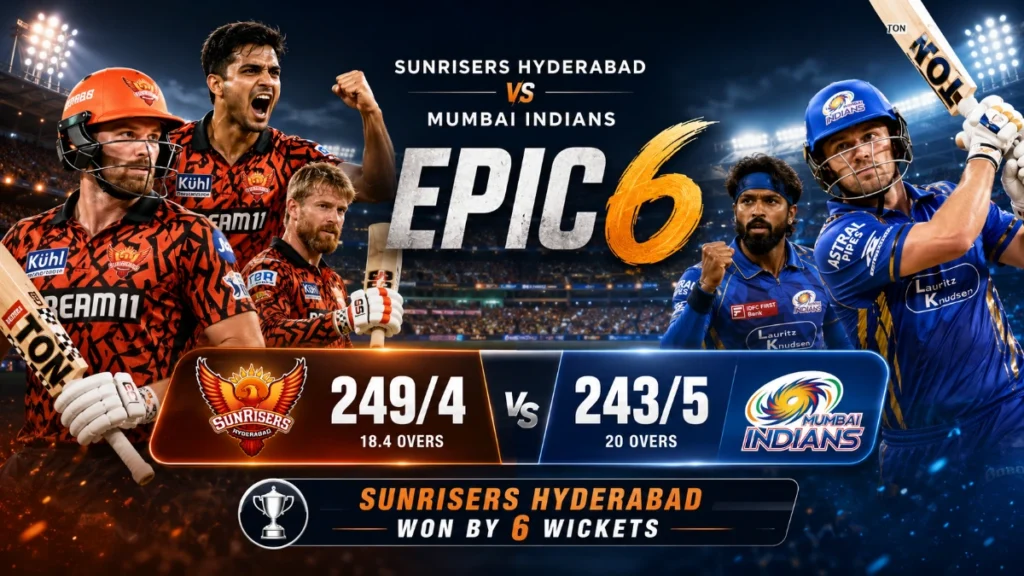

Sunrisers Hyderabad defeated Mumbai Indians by six wickets after chasing 244 in 18.4 overs at Wankhede Stadium. Travis Head (76), Heinrich Klaasen (65), and Abhishek Sharma (45) powered SRH to 249/4 after Mumbai posted 243/5, making it one of the highest successful run chases in IPL history. This Sunrisers Hyderabad vs Mumbai Indians match scorecard breakdown explains the tactical decisions, bowling plans, and momentum shifts behind the result.
Sunrisers Hyderabad vs Mumbai Indians Match Scorecard: Match Result At A Glance
The scoreline alone understates how comprehensively Sunrisers Hyderabad controlled the chase once their opening pair got going. Klaasen was named Player of the Match for guiding SRH home without exposing the middle order to any real scoreboard pressure.
| Team | Score | Overs | Result |
| Mumbai Indians | 243/5 | 20.0 | Lost |
| Sunrisers Hyderabad | 249/4 | 18.4 | Won by 6 wickets |
Powerplay Analysis: How SRH Broke MI’s Bowling Plan
SRH’s opening stand generated 92 runs inside the first six overs, immediately reversing the pressure that a 244-run target should have created. That single phase effectively decided the contest before the middle overs had even begun.
Opening Partnership
Travis Head and Abhishek Sharma put on 129 runs together, targeting anything back of a length during the first two overs rather than waiting to assess the conditions. Head repeatedly opened the off side with early foot movement, forcing Hardik Pandya to spread the field much earlier than planned, which removed wicket-taking catching positions from his attack.
Why MI Couldn’t Stop Head
Head’s approach against Mumbai’s new-ball bowlers relied on committing early to the leg side before switching to strong wrists through cover once the field opened up. Mumbai’s seamers struggled to adjust their length quickly enough, and by the time they tightened their lines, the powerplay damage was already done.
Shot Selection Against Pace
Abhishek Sharma’s shot selection leaned on clearing his front leg against anything short, targeting the square boundary rather than manufacturing risky shots down the ground. That discipline meant SRH’s powerplay runs came with comparatively low risk, a key reason MI couldn’t find an early breakthrough.
Player Analysis: Who Decided The Match
Six players shaped this result more than any others, and their individual roles explain the gap between the two sides far better than the final scorecard does. Breaking down each contribution shows why SRH’s depth outweighed MI’s reliance on one standout innings.
Ryan Rickelton
Rickelton’s unbeaten hundred ensured MI reached a record first-innings total, but his innings also left the middle order under scrutiny. Only one other batter crossed 40, exposing how heavily Mumbai depended on one anchor while SRH’s chase benefited from contributions across the top four.
Travis Head
Head’s 76 came at a strike rate that set the required run rate on the back foot within the powerplay itself, and his dismissal in the middle overs barely dented SRH’s momentum given the platform already built. His innings is the clearest example in this match of a top-order batter dictating tactical terms rather than reacting to them.
Abhishek Sharma
Abhishek’s 45 complemented Head’s aggression by rotating strike whenever the bowler dried up boundary options, ensuring the partnership never stalled even during quieter overs. His dismissal did open a brief window for MI, but it arrived too late to change the equation meaningfully.
Heinrich Klaasen
Klaasen’s unbeaten 65 was built on calculated strike rotation through the middle overs rather than pure power-hitting, a sign of a batter managing a chase rather than chasing personal milestones. He and Nitish Kumar Reddy closed out the target with overs to spare, never allowing MI’s bowlers back into the contest.
Hardik Pandya
Pandya’s captaincy options were limited by a bowling attack that lacked an enforcer capable of breaking the opening stand inside the powerplay, and that gap proved decisive. His field changes came reactively rather than proactively, a pattern that repeated through the middle overs as SRH stayed ahead of the required rate.
Pat Cummins
Cummins trusted his bowlers through MI’s late flourish, then leaned on the top order’s aggression during the chase, a captaincy approach that has delivered five consecutive wins for SRH. Reports around the franchise’s recent form suggest this settled batting order and clearly defined bowling roles have become the team’s core strength this season.
Match Turning Points And Tactical Lessons
The decisive over came during the powerplay when Head and Abhishek scored 92 runs in the first six overs, a rate that permanently shifted momentum toward SRH. Everything that followed, including Klaasen’s finishing role, built on that early platform rather than creating fresh pressure of its own.
Bowling Rotation Mistakes
Mumbai’s bowling changes during the powerplay came too late to disrupt the opening stand, and by the time Pandya rotated his attack for control, the required run rate had already dropped below manageable levels. Catch opportunities were limited during this phase since the field settings prioritized containment over wicket-taking positions.
Field Placements That Backfired
MI’s boundary riders during the middle overs struggled to cut off both sides of the ground simultaneously, giving Klaasen and Reddy easy running between the wickets. This forced Pandya into defensive fields that conceded singles rather than risking boundaries, a trade-off that suited SRH’s calm chase approach.
Advanced Match Statistics
Beyond the headline scores, phase-by-phase numbers reveal how one-sided the contest became once the powerplay concluded. These figures highlight where MI’s bowling attack lost control and where SRH’s batting depth made the difference.
| Metric | Mumbai Indians | Sunrisers Hyderabad |
| Powerplay runs | 78/0 | 92/0 |
| Middle-overs runs | 124/3 | 120/3 |
| Final-overs runs | 41/2 | 37/1 |
| Sixes | 14 | 18 |
| Fours | 21 | 20 |
Boundary percentage and dot-ball pressure both favored SRH through the middle overs, with fewer dot balls conceded during their chase compared to MI’s innings, according to match data from the fixture. [Insert stat] on exact strike-rate splits and wagon-wheel zones would sharpen this comparison further once official post-match analytics are published.
Pace Vs Spin Matchups
SRH’s decision to target pace early and play spin more cautiously through the middle overs reflected scouting on MI’s bowling combinations rather than a generic approach. Malinga’s figures of 4-0-29-1 briefly slowed the chase, showing what a disciplined pace spell could still achieve even after the powerplay damage.
What This Means For The Playoff Race
This result added 2 points to Sunrisers Hyderabad’s tally, continuing their sustained run through the second half of the group stage, while Mumbai Indians gained nothing from a match where their batting delivered a record total but their bowling and fielding failed to back it up. The net run rate implications favor SRH heading into the business end of the tournament.
NRR And Standings Impact
SRH’s five-match unbeaten run has pushed them well up the table, and a comfortable chase margin like this one typically boosts net run rate more than a last-over finish would. MI’s slide, by contrast, now puts real pressure on their remaining fixtures to salvage a playoff position.
Venue Trends At Wankhede
Chasing sides at Wankhede have often benefited from improving dew conditions as matches progress into the night, and SRH’s batters appeared to time the ball with increasing ease as the innings advanced. This is a recurring pattern at the venue that MI’s team management will likely revisit ahead of future fixtures there.
Key Player Stats From The Contest
A side-by-side look at the standout performers makes clear why SRH’s top-four depth outweighed MI’s reliance on Rickelton alone.
| Player | Team | Runs | Balls |
| Ryan Rickelton | MI | 123* | 55 |
| Travis Head | SRH | 76 | [Insert balls] |
| Heinrich Klaasen | SRH | 65* | [Insert balls] |
| Abhishek Sharma | SRH | 45 | [Insert balls] |
Fantasy Cricket Takeaways
Klaasen’s finishing role and Head’s powerplay returns make both strong future picks against attacks lacking an early-wicket specialist, while Rickelton’s anchor role suits formats that reward big-hundred ceilings even in a losing cause. Bowlers who can break powerplay stands, like Malinga did briefly here, remain a scarce and valuable category against SRH’s current top order.
Fan Perspective: Atmosphere After The Chase
The Wankhede crowd’s response shifted from tension during MI’s late-innings push to visible deflation once SRH’s openers began dismantling the target inside the powerplay. Momentum swings like this one, evident even in stadium noise, mirror the tactical picture that the scorecard itself only partially captures.
This defeat leaves Mumbai Indians needing an immediate response to arrest their slide, while Sunrisers Hyderabad carries a five-match unbeaten run and a strengthened playoff position into their next fixture.
Frequently Asked Questions
-
Who won the Sunrisers Hyderabad vs Mumbai Indians match?
Sunrisers Hyderabad defeated Mumbai Indians by six wickets after successfully chasing 244 runs in 18.4 overs at Wankhede Stadium. Travis Head scored 76, Heinrich Klaasen remained unbeaten on 65, and Abhishek Sharma added 45 as SRH finished on 249/4 after Mumbai posted 243/5.
-
Why did Sunrisers Hyderabad beat Mumbai Indians?
SRH won because their aggressive 129-run opening partnership between Travis Head and Abhishek Sharma reduced the required run rate early. Their powerplay dominance let Heinrich Klaasen finish the chase calmly without exposing the middle order to scoreboard pressure.
-
What was the turning point of the match?
The turning point came during the powerplay when Head and Abhishek Sharma scored 92 runs in the first six overs. Mumbai’s bowlers failed to break the opening stand, forcing defensive field placements and letting SRH stay ahead of the required rate for the rest of the chase.
-
How many runs did Ryan Rickelton score?
Ryan Rickelton scored an unbeaten 123 off 55 balls, the highest score by an MI batter in this fixture and a key reason Mumbai reached a record first-innings total of 243/5.
-
What was the Player of the Match award for?
Heinrich Klaasen was named Player of the Match for his unbeaten 65, which anchored SRH’s middle-overs chase and ensured the required run rate never climbed high enough to create pressure.
-
How many wickets did Sunrisers Hyderabad lose while chasing?
Sunrisers Hyderabad lost 4 wickets while chasing 244, finishing on 249/4 in 18.4 overs, meaning they completed the target with 8 balls and 6 wickets in hand.
-
What was Mumbai Indians’ final score?
Mumbai Indians finished their innings on 243/5 after 20 overs, built around Ryan Rickelton’s unbeaten century and a supporting 46 from Will Jacks.
-
Who took wickets for Mumbai Indians in this match?
AM Ghazanfar and Praful Hinge picked up two wickets apiece for Mumbai Indians, while Eshan Malinga returned figures of 4-0-29-1 with a tight spell that briefly slowed SRH’s chase
-
How does this result affect the IPL 2026 points table?
The win took Sunrisers Hyderabad to five straight victories and added 2 points to their tally, strengthening their position near the top of the group stage table, while Mumbai Indians gained nothing from the defeat.
-
Where was the Sunrisers Hyderabad vs Mumbai Indians match played?
The match was played at Wankhede Stadium in Mumbai on April 29, 2026, as part of the IPL 2026 group stage, with dew conditions reportedly aiding the chasing side as the innings progressed
-
What is the highest successful chase in this Sunrisers Hyderabad vs Mumbai Indians match scorecard?
SRH’s successful chase of 244 in 18.4 overs ranks among the higher successful run chases recorded in this fixture’s history, built primarily on a fast powerplay start rather than late-innings hitting.