
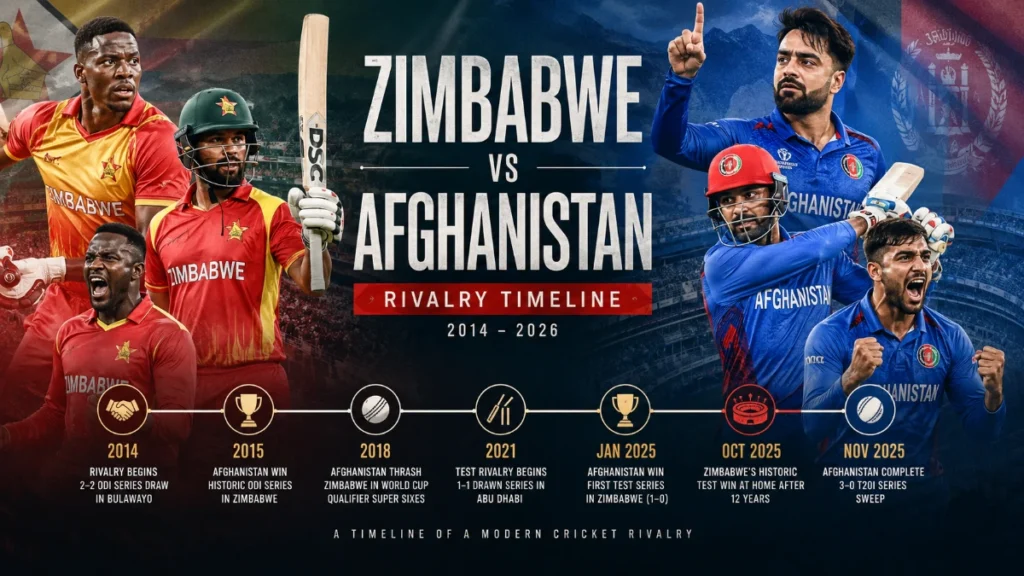

The Zimbabwe vs Afghanistan timeline began in 2014 with a drawn ODI series and has since evolved into one of Afghanistan’s most one-sided rivalries. Afghanistan dominates the head-to-head across ODIs, T20Is, and Tests overall, though Zimbabwe produced a memorable innings victory during the October 2025 Test series.
That single result — a 12-year drought-breaking Test win sandwiched by a ruthless T20I sweep in the same tour — captures exactly how lopsided and yet unpredictable this fixture has become.
How Did the Zimbabwe-Afghanistan Rivalry Begin?
The rivalry started in July 2014, when Afghanistan toured Zimbabwe for a four-match ODI series at Queens Sports Club in Bulawayo, ending in a surprising 2-2 draw. Afghanistan had not yet secured full ODI status, making the result an early signal of their competitive ceiling against a Full Member nation.
Mohammad Nabi’s Early Captaincy Imprint
Mohammad Nabi, then captain, anchored that resistance with both bat and ball, setting a template for the all-round contributions that would define Afghanistan’s rise. His decision to attack Zimbabwe’s top order with his own off-spin in the powerplay, rather than saving it for the middle overs, unsettled batters unused to early spin pressure — a tactical wrinkle Afghanistan would return to for the next decade.
Zimbabwe’s Structural Advantage Before 2014
Before the countries met in official bilateral cricket, Zimbabwe held the upper hand in earlier ICC qualifying contexts, drawing on structured domestic pathways and Full Member experience. That early edge evaporated quickly once Afghanistan began playing regular fixtures against Full Member opposition.
How Did Afghanistan Seize Control of the Rivalry?
Afghanistan took control between 2015 and 2018, winning consecutive away and home series against Zimbabwe across ODIs and T20Is behind escalating spin dominance. Their October 2015 tour of Zimbabwe produced a historic 3-2 ODI series win, the first time an Associate nation had beaten a Full Member in an away bilateral series.
Rashid Khan’s Emergence as the Fixture’s Defining Bowler
Rashid Khan and Mohammad Shahzad built on that momentum through 2016 and 2017, with Afghanistan sweeping T20I series 3-0 in Sharjah in December 2016 and winning a further ODI series 3-2 in Zimbabwe in February 2017. Rashid’s googly, bowled with almost no discernible change in action, repeatedly beat Zimbabwe batters who picked his stock leg-break but couldn’t separate it from the wrong’un — a gap in their game plan that persisted for years.
The 2018 Qualifier Turning Point
February 2018 marked a low point for Zimbabwe, as Afghanistan won 4-1 in ODIs and 2-0 in T20Is at a neutral Sharjah venue. Weeks later, at the ICC Cricket World Cup Qualifier hosted by Zimbabwe, Afghanistan avenged a narrow 2-run group-stage loss by thrashing the hosts by 10 wickets in the Super Sixes — a result that sent Afghanistan to the 2019 World Cup while Zimbabwe missed out entirely, marking one of the rivalry’s clearest turning points.
What Happened When Test Cricket Entered the Rivalry?
Afghanistan and Zimbabwe first played Test cricket against each other in March 2021 in Abu Dhabi, with the two-match series finishing 1-1. Zimbabwe won the opener by 10 wickets before Afghanistan responded with a dominant win in the second Test, even as Afghanistan completed a 3-0 sweep of the accompanying T20I series.
Hashmatullah Shahidi’s Captaincy Statement
Hashmatullah Shahidi’s unbeaten 200 in that second Test — his maiden Test double-century — set the tone for a captaincy built on batting first and grinding out long innings rather than chasing quick declarations. That patient approach, paired with Asghar Afghan’s 164 in the same match, gave Afghanistan a 307-run partnership that buried Zimbabwe’s bowling attack for the remainder of the series.
Zimbabwe’s Whitewash in June 2022
Afghanistan toured Zimbabwe in June 2022 for a full limited-overs series and won every match, sweeping both the ODI and T20I legs 3-0. It remains one of the most one-sided bilateral results either side has produced against fellow Full Member opposition, with Zimbabwe’s middle order repeatedly failing to build partnerships against Afghanistan’s spin trio in the 30-40 over period.
How Did the December 2024-January 2025 Series Unfold?
Afghanistan toured Zimbabwe across December 2024 and January 2025 for a full multi-format series and again finished the stronger side overall, winning the T20Is 2-1, the ODIs 2-0, and the Tests 1-0. Zimbabwe salvaged pride only in the T20I opener before Afghanistan’s batting depth overwhelmed them everywhere else.
Zimbabwe’s Batting Collapse in the ODIs
The ODI leg was emphatic: Afghanistan won 2-0, including a 232-run demolition in the second match after bowling Zimbabwe out for just 54. Sediqullah Atal was named player of the match in that rout, exploiting a Zimbabwe top order that kept playing across the line against seam movement rather than defending straight — the same technical flaw that had cost them repeatedly since 2022.
Rahmat Shah and Shahidi’s Record Partnership
The Test opener at Bulawayo produced the rivalry’s most extraordinary batting performance. Rahmat Shah’s 231 not out and Shahidi’s unbeaten 141 built an Afghanistan record 361-run partnership, pushing the tourists to 699 for 4 — their highest-ever Test total — in reply to Zimbabwe’s own record 586 all out. The match still ended in a draw, but Afghanistan’s response by 42 runs short of the total showed a depth of batting Zimbabwe couldn’t match ball for ball.
Afghanistan then won the second Test by 72 runs in early January 2025, with Rashid Khan picking up the player-of-the-match award to seal a 1-0 series win — Afghanistan’s first Test series victory over Zimbabwe. Why it mattered: the series confirmed Afghanistan’s batting had caught up to their bowling reputation, closing the one format where Zimbabwe had previously competed on equal terms.
What Happened in the October-November 2025 Series?
Afghanistan returned to Zimbabwe in October and November 2025 for a one-off Test and three-match T20I series, and the results split dramatically by format across the tour.
Zimbabwe Shock Afghanistan in the Test
Zimbabwe won the Test by an innings and 73 runs at Harare Sports Club — their first home Test victory in 12 years and only their third-ever innings win in Test history.
Brad Evans’ Record-Setting Spell
Brad Evans, back in the Test side after more than two years out through injury, took 5 for 22 as Afghanistan collapsed from 77 for 2 to 127 all out. Those 22 runs conceded were the fewest by a Zimbabwean bowler taking a five-wicket haul in Test cricket, bettering Heath Streak’s 5 for 27 against West Indies in 2001 — Evans targeted a fuller length than Zimbabwe’s attack had used in previous series, cutting off the width Afghanistan’s top order had previously feasted on.
Ben Curran’s Century and Ngarava’s Five-For
Ben Curran’s 121 anchored a Zimbabwe total of 359, and Richard Ngarava’s maiden Test five-wicket haul then dismantled Afghanistan’s second innings for 159. Afghanistan’s own Ziaur Rahman Sharifi still made history on debut, taking 7 for 97 to record the best Test-debut figures by an Afghan bowler, but it wasn’t enough to prevent the innings defeat.
Afghanistan Respond With a T20I Sweep
The T20I series told the opposite story entirely, as Afghanistan swept all three matches to close out the tour. Afghanistan won the opener by 53 runs on October 29 behind Ibrahim Zadran’s 52, took the second match by 7 wickets on October 31 with an unbeaten 57 from Zadran, and closed out the sweep on November 2 with Rahmanullah Gurbaz’s 92 off 48 balls anchoring a 210-run total.
Zadran’s Consistency Across the Series
Zadran’s back-to-back innings of 52 and 57 not out reflected a deliberate shift to targeting Zimbabwe’s new-ball bowlers before their spinners could settle, a tactic Afghanistan had used sparingly in 2022 but leaned on fully here. Why it mattered: the sweep reasserted the format gap immediately after the Test defeat, signaling Afghanistan treated the two results as entirely separate tactical problems rather than a momentum swing.
Sikandar Raza’s Lone Resistance
Sikandar Raza remained Zimbabwe’s most consistent threat throughout the T20I series, top-scoring in two of the three matches and taking wickets with his off-spin, yet his all-round efforts weren’t enough to prevent the clean sweep.
Tactical Evolution of the Rivalry
Afghanistan’s long-term edge traces to a deliberate strategy: pairing Rashid Khan’s wrist spin with Mohammad Nabi’s off-spin to control the middle overs, forcing Zimbabwe batters into high-risk shots rather than allowing them to rotate strike. Zimbabwe’s repeated inability to read Rashid’s variations out of the hand — rather than off the pitch — turned manageable targets into collapses in white-ball cricket throughout 2016-2022.
Pace has told a different story. In Test cricket at home, Zimbabwe’s seamers — Evans, Ngarava, and Blessing Muzarabani — have found more lateral movement at Harare and Bulawayo than Afghanistan’s top order, built primarily on subcontinent and UAE surfaces, has been comfortable countering. That gap explains why Zimbabwe’s best rivalry results cluster in the Test format specifically, even as the white-ball gap keeps widening.
Memorable Partnerships That Defined the Rivalry
Rahmat Shah and Hashmatullah Shahidi’s unbeaten 361-run stand at Bulawayo in December 2024 remains Afghanistan’s record partnership for any wicket, built by refusing to take risks against second-new-ball spells and simply batting Zimbabwe into exhaustion. Asghar Afghan and Shahidi’s 307-run partnership in Abu Dhabi in 2021 set the precedent for that approach three years earlier.
For Zimbabwe, Ben Curran’s first-innings century in October 2025, supported by a 97-run stand with Nick Welch, gave the hosts first-day control they never relinquished — the platform for their innings victory. Each of these partnerships shares a pattern: the team that built one unbroken stand past 90 runs went on to dominate that particular match.
Captaincy Decisions That Shaped Results
Mohammad Nabi’s early captaincy set an aggressive, spin-first template that Afghanistan’s later captains largely preserved. Hashmatullah Shahidi, leading the Test side since 2021, has favored patient, runs-first batting over quick declarations, a choice that produced Afghanistan’s record 699 in December 2024 but arguably cost them time to bowl Zimbabwe out twice in that same drawn match.
Sikandar Raza’s captaincy stints for Zimbabwe have leaned on his own all-round form to paper over batting fragility elsewhere in the order, a reliance that worked in isolated wins like the October 2025 Test but broke down whenever he was the only recognized batter succeeding, as in the 2022 whitewash.
Head-to-Head by Venue
| Venue | Matches | Afghanistan Wins | Zimbabwe Wins |
| Harare Sports Club | 14+ | 10 | 4 |
| Queens Sports Club, Bulawayo | 9+ | 5 | 3 (1 drawn) |
| Sharjah Cricket Stadium | 10+ | 9 | 1 |
| Sheikh Zayed Stadium, Abu Dhabi | 5 | 4 | 1 |
Afghanistan’s Sharjah dominance reflects home-away conditions closer to their training base during their early years without a settled home ground, while Zimbabwe’s better return at Bulawayo lines up with their strongest Test-format showings, including the December 2024 draw and January 2025 defeat that still produced competitive totals.
Biggest Turning Points in the Rivalry
Three moments best explain the rivalry’s shifting balance. October 2015 — Afghanistan’s 3-2 ODI series win in Zimbabwe was the first away bilateral series win by an Associate nation over a Full Member, proving their competitiveness was not confined to neutral venues. March 2018 — the World Cup Qualifier Super Sixes thrashing sent Afghanistan to the 2019 World Cup and Zimbabwe home empty-handed, a result with consequences well beyond the fixture itself. October 2025 — Zimbabwe’s innings-and-73-run Test win ended a 12-year home Test drought and proved the gap could close dramatically in the right format and conditions, even as the T20Is that followed showed how quickly it could reopen.
Records Broken in the Rivalry
Highest individual score: Hashmatullah Shahidi’s 246 for Afghanistan at Bulawayo in December 2024, a record he broke twice in the same rivalry after his own 200 not out in 2021. Most runs overall: Rahmat Shah leads Afghanistan’s tally with 1,850 runs across formats against Zimbabwe, while Sikandar Raza tops Zimbabwe’s list. Best bowling figures: Ziaur Rahman Sharifi’s 7 for 97 on Test debut in October 2025 is the best figures by an Afghan bowler on debut in any Test. Largest victory: Zimbabwe’s innings-and-73-run win in October 2025 stands as their biggest margin in the fixture, while Afghanistan’s 232-run ODI win in December 2024 is their largest. Highest team total: Zimbabwe’s 586 all out at Bulawayo in December 2024, surpassed days later by Afghanistan’s own 699 in reply.
Where Does the Overall Head-to-Head Record Stand?
Afghanistan leads the rivalry decisively in white-ball cricket: roughly 20 wins from 31 ODIs and 19 wins from 21 T20Is against Zimbabwe. In Tests, the two sides have now met five times, with Afghanistan and Zimbabwe level at two wins apiece and one match drawn following Zimbabwe’s October 2025 innings victory.
Rashid Khan remains the fixture’s leading wicket-taker with more than 40 wickets across formats, while Mohammad Nabi leads Afghanistan’s ODI run-scoring against Zimbabwe with 733 runs from 28 matches. For Zimbabwe, Sikandar Raza holds the equivalent ODI record with 765 runs from 24 matches, including a century and four fifties.
What Comes Next in the Rivalry?
Zimbabwe are scheduled to tour Afghanistan for a multi-format series between December 2026 and January 2027, comprising two Tests, three ODIs, and three T20Is, according to the ICC future tours program. The tour will mark the first time Zimbabwe have traveled to Afghanistan for a bilateral series, shifting home advantage for the first time in the fixture’s history.
That venue change carries real weight given how thoroughly conditions have shaped recent results. If Zimbabwe’s October 2025 Test performance reflects genuine progress rather than a one-off, a series played away from Harare and Bulawayo will test whether that improvement travels — or whether Afghanistan’s white-ball dominance simply extends into unfamiliar territory too.
Frequently Asked question
-
Who has the better head-to-head record between Zimbabwe and Afghanistan?
Afghanistan holds a commanding lead across white-ball formats, winning roughly 19 of 21 T20Is and around 20 of 31 ODIs against Zimbabwe. In Tests, the two sides are now level at two wins apiece with one draw across five matches
-
When did Zimbabwe and Afghanistan first play each other?
The rivalry began in July 2014, when Afghanistan toured Zimbabwe for a four-match ODI series at Queens Sports Club in Bulawayo, which ended in a 2-2 draw before Afghanistan had even secured full ODI status.
-
What was Zimbabwe’s biggest win over Afghanistan?
Zimbabwe’s biggest win came in October 2025, defeating Afghanistan by an innings and 73 runs in a one-off Test at Harare Sports Club — only the third innings victory in Zimbabwe’s Test history and their first home Test win in 12 years.
-
Who is the leading run-scorer in the Zimbabwe vs Afghanistan rivalry?
Rahmat Shah leads all players with 1,850 runs across formats for Afghanistan, while Mohammad Nabi holds Afghanistan’s ODI-specific record with 733 runs. Sikandar Raza tops Zimbabwe’s list with 765 ODI runs against Afghanistan.
-
Who has taken the most wickets in this fixture?Rashid Khan has taken more than 40 wickets across all formats against Zimbabwe, making him the leading wicket-taker in the rivalry by a significant margin.
-
What is the highest individual score in the Zimbabwe vs Afghanistan rivalry?
Hashmatullah Shahidi’s 246 at Bulawayo in December 2024 is the highest individual score in the fixture, a record he set after previously holding it with an unbeaten 200 in 2021.
-
Did Zimbabwe and Afghanistan play at the 2026 T20 World Cup?No. Afghanistan were eliminated in the group stage of the 2026 ICC Men’s T20 World Cup after losses to New Zealand and South Africa, while Zimbabwe advanced to the Super Eight in a different group, meaning the two sides never met at the tournament.
-
What happened in the December 2024 Test series?
Afghanistan won the two-match Test series 1-0. The first Test in Bulawayo ended in a draw despite Afghanistan’s record 699, built on a 361-run stand between Rahmat Shah and Hashmatullah Shahidi, and Afghanistan won the second Test by 72 runs in early January 2025.
-
How did the October 2025 T20I series between Zimbabwe and Afghanistan finish?
Afghanistan swept the three-match T20I series 3-0, winning by 53 runs, 7 wickets, and 9 runs respectively, with Ibrahim Zadran and Rahmanullah Gurbaz both producing standout batting performances.
-
Where will Zimbabwe and Afghanistan play next?
Zimbabwe are scheduled to tour Afghanistan between December 2026 and January 2027 for a multi-format series featuring two Tests, three ODIs, and three T20Is, marking their first bilateral series played on Afghan soil.
-
Why did Afghanistan struggle in the October 2025 Test but dominate the T20Is that followed?
The longer format exposed Afghanistan’s batting against a fuller-length Zimbabwe seam attack led by Brad Evans, while the compressed nature of T20 cricket favored Afghanistan’s power-hitting depth and Rashid Khan-led bowling attack once the series shifted formats.
-
Has Zimbabwe ever whitewashed Afghanistan in a bilateral series?
No bilateral series sweep by Zimbabwe over Afghanistan has occurred across Tests, ODIs, or T20Is; Zimbabwe’s strongest results have come as individual match or single-Test wins rather than full series sweeps