
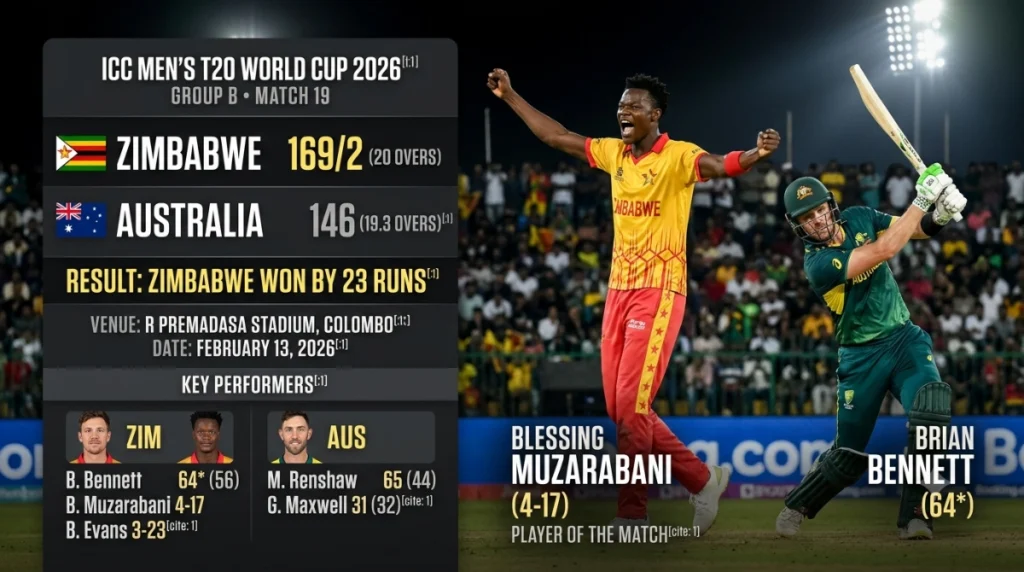

Zimbabwe Stun Australia by 23 Runs: T20 World Cup 2026 before, and on February 13, 2026, at the R Premadasa Stadium in Colombo, history brutally repeated itself. Blessing Muzarabani’s career-best spell and a poised half-century from Brian Bennett powered Zimbabwe to a 23-run win over the world’s No. 2-ranked T20I side, throwing Group B of the ICC Men’s T20 World Cup 2026 into disarray.
Zimbabwe posted 169 for 2 off their 20 overs after being sent in to bat by stand-in Australian captain Travis Head, then bowled Australia out for 146 in 19.3 overs to complete their second win from two games — and their second-ever T20 World Cup victory over Australia, following the famous 2007 upset in Cape Town.
Match Result: Zimbabwe Beat Australia by 23 Runs
Zimbabwe won by 23 runs after restricting Australia to 146 all out in 19.3 overs while chasing a target of 170. Blessing Muzarabani took 4 for 17 and was named Player of the Match, with Brad Evans adding 3 for 23 to complete the demolition of Australia’s batting order.
The result lifted Zimbabwe level with co-hosts Sri Lanka at the top of Group B, both unbeaten from two matches, while Australia’s campaign now hangs on victories over Sri Lanka and Oman to reach the Super 8s.
Full Scorecard: AUS vs ZIM, 19th Match, Group B
Venue: R Premadasa Stadium, Colombo
Date: February 13, 2026
Toss: Australia won the toss and chose to field first
Zimbabwe innings — 169/2 (20 overs)
| Batter | Dismissal | Runs | Balls |
| Tadiwanashe Marumani | c | 35 | 21 |
| Brian Bennett | not out | 64 | 56 |
| Ryan Burl | not out/out | 35 | — |
| Extras | 10 (7 wides, 3 leg byes) | ||
| Total | 169/2 | 20 overs |
Fall of wickets: 1-61 (Marumani, 7.3 ov), 2-131 (Burl, 15.6 ov)
Australia bowling
| Bowler | O | M | R | W | Econ |
| Ben Dwarshuis | 4 | 0 | 40 | 0 | 10.00 |
| Marcus Stoinis | 2.5 | 0 | 17 | 1 | 6.00 |
| Glenn Maxwell | 1 | 0 | 14 | 0 | 14.00 |
| Matthew Kuhnemann | 3 | 0 | 24 | 0 | 8.00 |
| Nathan Ellis | 4 | 0 | 34 | 0 | 8.50 |
| Adam Zampa | 4 | 0 | 31 | 0 | 7.75 |
| Cameron Green | 1.1 | 0 | 6 | 1 | 5.14 |
Australia innings — 146 all out (19.3 overs)
| Batter | Dismissal | Runs | Balls |
| Josh Inglis | c | 8 | 4 |
| Travis Head | b | 17 | 15 |
| Cameron Green | c (wk) | 0 | 2 |
| Tim David | c | 0 | 2 |
| Glenn Maxwell | b | 31 | 32 |
| Matt Renshaw | c | 65 | 44 |
| Marcus Stoinis | c | 6 | 4 |
| Ben Dwarshuis | c | 6 | 7 |
| Nathan Ellis | not out | 7 | 4 |
| Adam Zampa | b | 2 | 2 |
| Matthew Kuhnemann | run out | 0 | 1 |
| Extras | 4 (2 lb, 2 w) | ||
| Total | 146 all out | 19.3 overs |
Fall of wickets: 1-13 (Inglis, 1.1), 2-24 (Green, 2.5), 3-25 (David, 3.2), 4-29 (Head, 4.3), 5-106 (Maxwell, 14.2), 6-117 (Stoinis, 15.4), 7-131 (Dwarshuis, 17.4), 8-139 (Renshaw, 18.4), 9-141 (Zampa, 18.6), 10-146 (Kuhnemann, 19.3)
Zimbabwe bowling
| Bowler | O | M | R | W | Econ |
| Sikandar Raza | 2 | 0 | 17 | 0 | 8.50 |
| Blessing Muzarabani | 4 | 0 | 17 | 4 | 4.25 |
| Brad Evans | 3.3 | 0 | 23 | 3 | 6.57 |
| Dion Myers | 1 | 0 | 9 | 0 | 9.00 |
| A.G. Cremer | 4 | 0 | 33 | 0 | 8.25 |
| Wellington Masakadza | 4 | 0 | 36 | 1 | 9.00 |
| Ryan Burl | 1 | 0 | 9 | 1 | 9.00 |
Player of the Match: Blessing Muzarabani
How Zimbabwe Built a Defendable 169
Put in to bat after Head won the toss and opted to field, Zimbabwe made a deliberate choice: run hard between the wickets rather than chase boundaries on a pitch that was gripping and slower than expected in Colombo’s evening conditions. Tadiwanashe Marumani gave the innings early tempo with 35 off 21 balls before falling in the eighth over, but the platform he built let Brian Bennett play the anchor’s role that ultimately decided the match.
Bennett’s unbeaten 64 off 56 balls wasn’t a highlight-reel innings, but it was the difference between a par score and a winning one. He absorbed pressure through the middle overs, found the boundary when Australia’s bowlers erred in length, and accelerated late alongside Ryan Burl, whose 35 gave the innings its final flourish. Zimbabwe’s approach — prioritising strike rotation over risk — meant Australia’s attack, missing the control of a fully fit Marcus Stoinis, never found sustained pressure points.
Australia’s bowling figures tell their own story of a plan that didn’t fire: no Australian bowler took more than a single wicket, and both Ben Dwarshuis and Glenn Maxwell went for double-figure economy rates. Only Cameron Green, with a tidy 1 for 6 in a solitary over, offered control befitting a title-contending attack.
Australia’s Powerplay Collapse Set Up the Chase
If Zimbabwe’s total looked competitive rather than commanding, Australia turned it into a mountain within the first five overs. Josh Inglis, Cameron Green, and Tim David were all back in the shed for single-figure scores, with Green and David both dismissed without scoring — a horror start against the new-ball combination of Blessing Muzarabani and Brad Evans. By the time Travis Head fell in the fifth over, Australia were reeling at 29 for 4, already needing something close to a miracle partnership against a required rate climbing past nine an over.
That’s exactly what Glenn Maxwell and Matt Renshaw briefly produced. Their fifth-wicket stand of 77 runs — Renshaw’s first T20I half-century contribution and Maxwell’s characteristic counter-attacking 31 — dragged Australia from the wreckage back into calculation range. But Muzarabani returned to end the recovery, deceiving Renshaw with a slower ball that ballooned to mid-off in the 19th over, and the required equation of 29 from 6 balls was simply too much. Australia’s last five wickets fell for 40 runs inside five overs, with Matthew Kuhnemann’s run-out in the final over sealing a defeat that was as clinical as it was unexpected.
Why the Zimbabwe Bowling Attack Was Decisive
Blessing Muzarabani’s 4 for 17 was the single biggest factor in Australia’s collapse, combining early wicket-taking with a crucial late strike to remove Renshaw just as Australia threatened to complete the chase. Brad Evans complemented him perfectly, taking 3 for 23 and finishing the innings with a sharp run-out. Together, the new-ball pair reduced Australia to two wickets down for 24 runs inside three overs — pressure the middle order never fully escaped.
Muzarabani’s spell also carried personal significance: it took him past 100 career T20I wickets for Zimbabwe, joining an elite list that includes Richard Ngarava and Sikandar Raza. Post-match, he credited adapting to a slower-than-expected pitch and specifically targeting Travis Head, calling the win over Australia and the resulting Super 8s qualification “fantastic.
Group B Standings and What It Means Going Forward
Zimbabwe’s win moved them level with Sri Lanka at the top of Group B, both unbeaten after two matches, while Australia dropped to third with two points from one win and one loss. The result leaves Australia needing victories over Sri Lanka and Oman in their remaining group games to guarantee progression to the Super 8s stage.
For Zimbabwe, ranked far below Australia in the ICC T20I standings, the win extends their unbeaten head-to-head record against Australia at T20 World Cups to two from two — the first coming in 2007 at Cape Town. Captain Sikandar Raza, playing with a squad stretched to just 13 fully fit players, said the group would stick with its processes rather than change approach, with the next fixture already being treated as Zimbabwe’s most important of the tournament.
Australia coach and Head, standing in as captain, pointed to the powerplay collapse as the difference-maker, noting the middle-overs partnership had briefly repaired the innings but left too much to chase in the end. With two group games remaining, Australia’s title defence now depends on turning that same top-order fragility around before it costs them a place in the knockouts.
Frequently Asked Questions
-
Who won the Australia vs Zimbabwe T20 World Cup match?
Zimbabwe won the 19th match of the ICC Men’s T20 World Cup 2026 by 23 runs, defeating Australia after posting 169 for 2 and restricting the Australians to 146 all out in 19.3 overs at the R Premadasa Stadium, Colombo, on February 13, 2026.
-
What was the final score in Australia vs Zimbabwe?
Zimbabwe scored 169 for 2 in 20 overs, and Australia were bowled out for 146 in 19.3 overs while chasing, resulting in a 23-run win for Zimbabwe
-
Who was the Player of the Match in Australia vs Zimbabwe?
Blessing Muzarabani was named Player of the Match after taking 4 for 17, the best figures by a Zimbabwe bowler in the innings and a spell that dismantled Australia’s top and middle order.
-
Who top-scored for Zimbabwe against Australia?
Brian Bennett top-scored for Zimbabwe with an unbeaten 64 off 56 balls, anchoring the innings alongside contributions of 35 each from Tadiwanashe Marumani and Ryan Burl.
-
Who top-scored for Australia in the chase?
Matt Renshaw top-scored for Australia with 65 off 44 balls, forming a 77-run fifth-wicket partnership with Glenn Maxwell (31) before falling to a Blessing Muzarabani slower ball in the 19th over.
-
Why did Australia lose to Zimbabwe?
Australia lost primarily due to a powerplay collapse, slipping to 29 for 4 inside five overs against the new-ball pace of Blessing Muzarabani and Brad Evans, a hole too deep for the middle order to fully climb out of despite a 77-run recovery stand.
-
What does this result mean for Australia’s T20 World Cup 2026 campaign?
The loss dropped Australia to third in Group B with two points from two matches, meaning they now need to beat both Sri Lanka and Oman in their remaining fixtures to secure a place in the Super 8s.
-
Has Zimbabwe beaten Australia at a T20 World Cup before?
Yes. Zimbabwe’s win in Colombo in 2026 was their second T20 World Cup victory over Australia, following a similar upset by 5 wickets in Cape Town during the 2007 T20 World Cup
-
Where was the Australia vs Zimbabwe 19th match played?
The match was played at the R Premadasa Stadium in Colombo, Sri Lanka, as part of Group B fixtures in the ICC Men’s T20 World Cup 2026.
-
What is Zimbabwe’s position in Group B after beating Australia?
Zimbabwe moved level with co-hosts Sri Lanka at the top of Group B, both remaining unbeaten after two matches, while Australia sat third with one win and one loss.
.