

Two nations. One urn. A rivalry running for nearly 150 years and it still doesn’t get old. When England fly to Australia for The Ashes, or Australia land in England, something shifts in world cricket. Players who have already cemented their legacies suddenly look nervous. Captains lose sleep. Fans on both sides of the world set alarms for 3 AM to watch a single session unfold. Just as the england cricket team vs australian men’s cricket team carries its own weight of Caribbean flair and subcontinental grit, the England-Australia rivalry operates on an entirely different axis one of identity, empire, and pride.
This is not just cricket. This is the England cricket team vs Australian men’s cricket team the defining contest of the sport.
The Ashes: What Most People Get Wrong About This Rivalry
The Ashes is not just a cricket series. It is a proxy war between two national identities played out on 22 yards of turf.
Most articles describe The Ashes as “cricket’s greatest rivalry” and stop there. What they miss is the reason it cuts so deep. England invented the game. Australia perfected the art of beating England at it. That inversion of power, repeated for over a century, is what makes this rivalry psychologically unique in global sport.
The trophy itself a tiny terracotta urn allegedly containing the ashes of a burnt cricket bail never leaves Lord’s. Teams compete for a replica. The symbolism is deliberately absurd, and that’s exactly the point: the actual prize is pride, not silverware.
Why Losing the Ashes Feels Different
What people think: The Ashes is intense because of tradition.
Reality: It is intense because losing feels like a national humiliation on both sides, amplified by media, history, and a rivalry that predates most modern sports.
Unlike bilateral series in other formats much like the contrasting but equally compelling england cricket team vs australian men’s cricket team the Ashes carries the weight of colonial history and sporting identity combined. No other bilateral cricket series does that.
A Timeline That Tells the Real Story
The England vs Australia cricket rivalry spans 149 years, beginning with the very first Test match ever played.
The rivalry began on March 15, 1877 the very first Test match at the Melbourne Cricket Ground. Australia won by 45 runs. The “Ashes” name was born after Australia’s shock win at The Oval in 1882, their first Test victory on English soil. A satirical obituary in The Sporting Times declared English cricket “dead” and the body would be “cremated and the ashes taken to Australia.” An era-defining name was born from a single newspaper joke.
Dominant Eras: Who Led When
| Era | Dominant Team | Reason |
| 1930s–40s | Australia | Bradman’s genius, depth in batting |
| 1950s–60s | Contested | Both nations evenly matched |
| 1970s–80s | Australia (mostly) | Pace battery, Lillee-Thomson era |
| 2005 | England | Flintoff, Harmison, Vaughan’s captaincy |
| 2010–13 | England | Anderson-Broad swing combination |
| 2021–2026 | Australia | Starc, Cummins, Head era |
Turning Points That Shaped the Rivalry
- 1932-33 Bodyline Series: England’s Douglas Jardine instructed Harold Larwood to bowl short-pitched deliveries directly at batters’ bodies intimidation legalised as tactics. It nearly caused a diplomatic incident between the two governments.
- 1948 The Invincibles: Don Bradman’s Australian side completed an unbeaten England tour, winning 4-0. Bradman averaged 99.94. England had no answer.
- 2005 Ashes: England’s 2-1 victory after 18 years of hurt remains the most celebrated Ashes in living memory ending with Flintoff consoling a tearful Brett Lee at Edgbaston.
- 2021-22: Australia won 4-0. England were tactically outclassed at every venue.
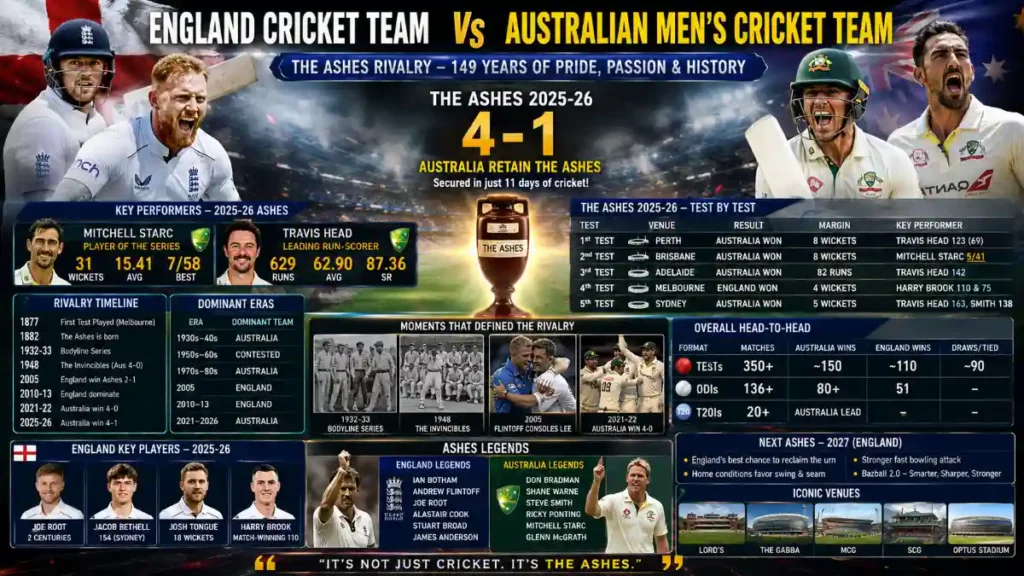
- 2025-26: Australia retained the Ashes 4-1 their third consecutive series win with the urn secured inside 11 days of cricket.
Much like how historians map the england cricket team vs australian men’s cricket team through distinct eras of dominance and decline, the Ashes story is best understood through its shifting power dynamics.
The 2025-26 Ashes: Australia’s Dominance Decoded
Australia won the 2025-26 Ashes 4-1, securing the urn in the fastest time in modern Ashes history across just three Tests.
The scoreline doesn’t reveal how comprehensively England were beaten, nor how close some individual moments came to flipping the narrative entirely. This was not just superior talent it was superior planning, pitch awareness, and in-series adaptability.
Test-by-Test Breakdown
| Test | Venue | Result | Margin | Key Performer |
| 1st Test | Perth | Australia won | 8 wickets | Travis Head (123 off 69 balls) |
| 2nd Test | Brisbane | Australia won | 8 wickets | Mitchell Starc (5-wicket haul) |
| 3rd Test | Adelaide | Australia won | 82 runs | Travis Head (142) |
| 4th Test | Melbourne | England won | 4 wickets | Harry Brook |
| 5th Test | Sydney | Australia won | 5 wickets | Travis Head (163), Steven Smith (138) |
The Real Turning Point: Perth, Day 1
Here is where most analysis goes shallow. The 2025-26 Ashes was effectively decided not in Adelaide but in the first 10 overs in Perth. Mitchell Starc dismissed Zak Crawley first ball, then removed Joe Root for 0 and Ben Stokes for 6, ultimately taking a 7-wicket haul as England were bowled out for 172.
What made it psychologically devastating was not the wickets themselves it was the order. England’s four most experienced batters departed inside 10 overs. The innings never recovered emotionally, not just technically.
England did fight back. Jofra Archer and Brydon Carse reduced Australia to 31/4. But here is the counterintuitive insight most coverage missed: that collapse actually helped Australia it brought Travis Head to the crease earlier in the chase, and he made 123 off 69 balls to seal the match before day two was done.
Australia did not just beat England. They out-Bazball’d Bazball.
Mitchell Starc: The Series Architect
Mitchell Starc took 31 wickets in the 2025-26 Ashes the most by any bowler in an Ashes series in over 12 years, matching Ian Botham’s 1981 record.
His method was not mystery. It was relentless targeting of left-handers with in-swing at 140+ km/h, backed by a bouncer that England’s lower-middle order consistently miscued. Crucially, England could not rotate their batting lineup to avoid him. You cannot hide from the new ball.
Why Starc Was Unplayable
- Four dismissals in the first over across multiple innings a feat matched only by Ray Lindwall and Bill Voce in Ashes history
- England’s left-handers Duckett, Root (when repositioned), and Bethell could not find a consistent answer to his inswinger at pace
- His variety: not just the swinging delivery, but the disguised yorker and the back-of-length bouncer made him a three-dimensional threat
Common mistake analysts make: They describe Starc as a “rhythm bowler” who needs conditions. In 2025-26, he was far more than that; he was a tactical weapon used in planned bursts, not a bowler relying on cloud cover.
Travis Head: The Man England Cannot Solve
Travis Head finished the 2025-26 Ashes with 629 runs at an average of 62.90 and a strike rate of 87.36 the first batter to score 600+ in an Ashes series since Steve Smith’s 774 in 2019.
His unexpected promotion to opener in the first Test after Usman Khawaja suffered back spasms turned out to be the most impactful tactical decision of the entire series.
Head’s Tactical Blueprint Against England
Head’s Ashes philosophy is deliberately provocative: attack from ball one. When England set defensive fields, he hit over them. When they crowded him with short balls, he pulled. There was no off switch and England’s bowlers had no second plan.
The common analyst mistake: They keep calling Head a “matchwinner.” That is incomplete. Head is a series disruptor he breaks opposition bowling plans before they are fully set. That is a different, more dangerous skill set entirely. Much like how a dominant fast bowling unit reshapes the england cricket team vs australian men’s cricket team, Head’s batting fundamentally reshapes how England plan across a five-match series.
England’s Perspective: What Went Wrong and What Worked
England’s Bazball philosophy transformed Test cricket after 2022, but Australia’s conditions in 2025-26 exposed its tactical boundaries.
Bazball works on English pitches with variable bounce and lateral movement. In Perth and Brisbane, the pitches were quicker, bouncier, and unforgiving of the loose lengths that aggressive batting demands. England’s top order kept attacking when discretion was the required weapon.
What England Got Right
- Joe Root: Two centuries across the series in Brisbane and Sydney, confirming his status as one of Test cricket’s all-time greats.
- Jacob Bethell: A remarkable debut series temperament. His 154 in the 5th Test at Sydney was the brightest English subplot of the entire tour.
- Josh Tongue: 18 wickets in the series, joint-highest for England, proving he belongs at this level.
- Melbourne victory: England’s first Ashes Test win in Australia in 14 years, driven by Harry Brook’s calculated aggression across both innings. This was genuine quality, not Australian generosity.
What England Got Wrong
The real problem was the bowling depth. Outside Jofra Archer (when fit) and Tongue, England lacked a bowler who could consistently threaten in Australian conditions at 140+ km/h.
- Mark Wood’s fitness was never resolved ahead of the tour
- Gus Atkinson struggled with the extra bounce on Australian surfaces
- The second-change bowling options lacked the pace to complement Archer which is exactly the problem that manifests on all Australian tours
This is where things go wrong for most touring nations in Australia: they arrive with bowlers who won them games at home, only to find home form is irrelevant once you cross the equator.
England vs Australia Across All Formats
The England-Australia rivalry extends far beyond Tests their white-ball battles carry equal intensity, particularly in World Cup campaigns.
Head-to-Head: The Complete Numbers
| Format | Matches Played | Australia Wins | England Wins | Draws/Tied |
| Tests | 350+ | 150 | 110 | 90 |
| ODIs | 136+ | 80+ | 51 | |
| T20Is | 20+ | Australia lead | – | – |
ODI Rivalry: Australia’s Consistent Edge
In ODIs, Australia have won over 80 matches against England’s 51 from 136 contests a commanding head-to-head advantage that reflects Australian dominance in 50-over cricket globally. Australia’s ODI record against England includes wins in three World Cups, including their defining 2003 and 2015 World Cup campaigns.
T20I Rivalry: Tighter Than You Think
England lead Australia in T20I cricket more narrowly reflecting England’s emergence as a white-ball superpower since 2016, particularly following their 2019 and 2022 T20 World Cup campaigns. This format balance is worth watching as both nations evolve their short-format rosters.
Unlike the england cricket team vs australian men’s cricket team, which traces a Caribbean T20 revival against Pakistan’s spin-heavy bowling, the England-Australia T20 contests are decided primarily by power hitting and death bowling precision.
The Tactical Battlefield: Key Match Factors
Three tactical elements consistently decide the England vs Australia cricket contest conditions, new-ball strategy, and captaincy adaptability.
Pitch and Conditions
Australian pitches at Perth (WACA/Optus Stadium) and Brisbane demand pace handling above all else. English conditions reward swing and seam. These are almost opposite skill requirements, which is why touring sides struggle: they prepare for home conditions, then arrive somewhere fundamentally different.
The Toss and the Morning Session
In Australia, winning the toss matters more in the first 90 minutes than at almost any other Test venue globally. The Perth morning session is genuinely unplayable for a top order not calibrated for extreme pace and carry. Australia’s batters grow up facing this England’s do not.
Captaincy and In-Series Adaptability
Pat Cummins’ 2025-26 captaincy was defined by granular in-play adjustments, not just pre-match plans. When England found a counter to a bowling plan, Cummins adjusted mid-over switching ends for Neser, varying field settings within deliveries, and rotating Starc’s burst lengths.
That in-over adaptability was something England’s captains consistently failed to match. Ben Stokes is an outstanding tactical thinker in English conditions; in Australia, he needed more reactive tools and they were not available.
What This Means for the Next Ashes (2027, England)
The 2027 Ashes in England represents England’s strongest opportunity to reclaim the urn in six years and the conditions shift dramatically in their favour.
Three factors will define that series:
- England’s bowling depth: If Mark Wood, Jofra Archer, Brydon Carse, and Josh Tongue are all fit, England possess match-winning firepower on pitches that reward swing and seam movement.
- Australia’s batting without Khawaja: Usman Khawaja retired during the 2025-26 series. Finding a reliable, left-handed opener is now Australia’s single largest planning challenge for 2027.
- The Bazball evolution: Stokes and McCullum will have two full years to adapt. The best coaches learn from their heaviest defeats. England’s 2027 approach will not be a repeat of 2025-26.
Just as observers of the england cricket team vs australian men’s cricket team watch for generational shifts and tactical reinventions, England’s rebuild toward 2027 will hinge on whether their bowling depth can match their batting ambition.
Ashes Legends: Players Who Defined the Rivalry
The England vs Australia rivalry has produced some of cricket’s most iconic individual careers across both nations.
| England Legends | Australia Legends |
| Ian Botham | Don Bradman |
| Andrew Flintoff | Shane Warne |
| Joe Root | Steve Smith |
| Alastair Cook | Ricky Ponting |
| Stuart Broad | Mitchell Starc |
| James Anderson | Glenn McGrath |
Shane Warne’s 708 wickets and Steve Smith’s 7,700+ Test runs are the two individual statistical landmarks that most define Australia’s modern Ashes superiority. On England’s side, James Anderson’s 700+ Test wickets most of them in helpful English conditions remain the gold standard of bowling in this rivalry.
Venue-by-Venue: Ashes Records That Matter
Venue performance is one of the most underanalysed factors in the England vs Australia rivalry and it shapes selection decisions more than most fans realise.
| Venue | Advantage | Reason |
| Lord’s (London) | England | Slope, swing, emotional home advantage |
| Headingley (Leeds) | Contested | Variable pitch, seam movement |
| Edgbaston (Birmingham) | England | Noisy crowd, attacking pitch |
| The Gabba (Brisbane) | Australia | Pace and bounce, extreme heat |
| MCG (Melbourne) | Australia | Large outfield, bouncy pitch |
| SCG (Sydney) | Contested | Historically helps spinners late |
| Optus Stadium (Perth) | Australia | Fastest pitch in Ashes cricket |
Frequently Asked Questions
Q1: What is the England cricket team vs Australian men’s cricket team rivalry called?
Ans. It is called The Ashes a Test cricket series played since 1882 between England and Australia, contested for an urn symbolically containing the ashes of a burnt cricket bail. It is the oldest bilateral Test rivalry in cricket.
Q2: Who won the 2025-26 Ashes series?
Ans. Australia won the 2025-26 Ashes series 4-1, retaining the urn and claiming their third consecutive Ashes series victory. The urn was secured inside 11 days of cricket across the first three Tests only.
Q3: Who was Player of the Series in the 2025-26 Ashes?
Ans. Mitchell Starc was named Player of the Series after taking 31 wickets the most in an Ashes series since Mitchell Johnson’s 37 in 2013-14, and matching Ian Botham’s 1981 record.
Q4: Who has won more Ashes series England or Australia?
Ans. Australia have won significantly more Ashes series in the historical head-to-head. England’s most recent Ashes win came in 2023 at home. Australia have dominated since 2021-22.
Q5: When did The Ashes begin?
Ans. The Ashes rivalry formally began in 1882 following Australia’s first Test winon English soil. The first Test between the two nations was played in March 1877 in Melbourne.
Q6: How does Bazball work, and did it fail in Australia?
Ans. Bazball is England’s ultra-aggressive Test philosophy attacking batting intent, proactive captaincy, and full-length bowling regardless of conditions. In Australia 2025-26, it partially failed because Perth and Brisbane pitches demanded defensive solidity and pace management that Bazball was not designed to provide.
Q7: Who was the highest run-scorer in the 2025-26 Ashes?
Ans. Travis Head finished as the leading scorer with 629 runs at an average of 62.90 and a strike rate of 87.36 the first batter to cross 600 in an Ashes series since Steve Smith in 2019.
Q8: Did England win any Test in the 2025-26 Ashes?
Ans. Yes. England won the 4th Test at Melbourne by 4 wickets their first Ashes Test win in Australia in 14 years. Harry Brook was the key performer with the bat across both innings.
Q9: When is the next Ashes series?
Ans. The next Ashes series is scheduled for England in 2027, where home conditions offering swing, seam movement, and England’s largest fast bowling arsenal in a decade strongly favour the hosts.
Q10: What about England vs Australia in white-ball cricket?
Ans. England and Australia compete in all three formats. Australia lead the ODI head-to-head with 80+ wins from 136 matches, while the T20I series is more closely contested, reflecting England’s emergence as a white-ball superpower from 2016 onward. Just as the pakistan national cricket team vs west indies cricket team timeline shows distinct format-based rivalry shifts, England and Australia’s white-ball contests have their own competitive identity beyond the Ashes.