
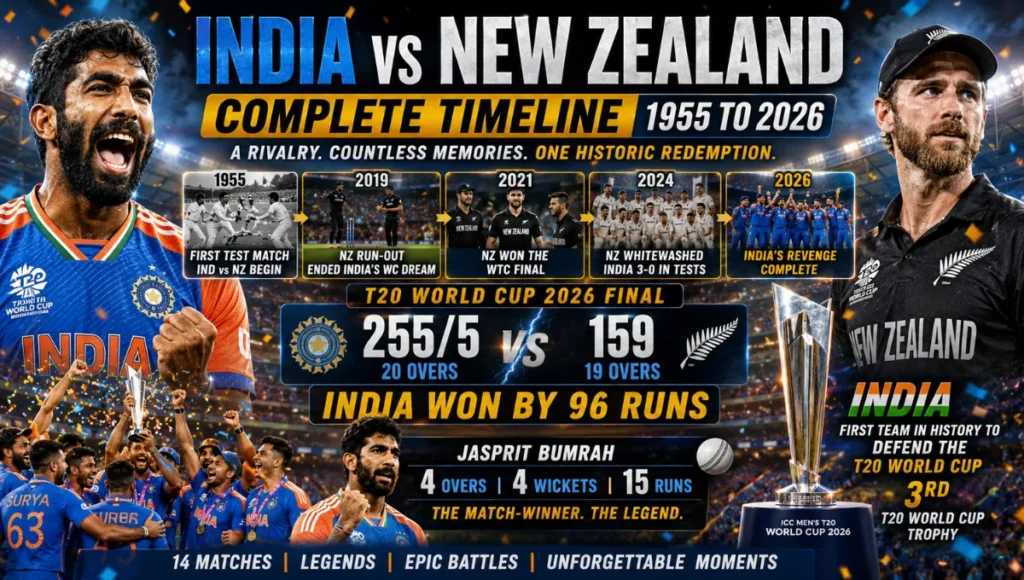

March 7, 2026. Narendra Modi Stadium, Ahmedabad. T20 World Cup Final.
New Zealand needed 256 to win. The highest T20 World Cup Final total ever against the hosts, in their own stadium, in front of 132,000 people. Jasprit Bumrah bowled 4 overs. He took 4 wickets. He conceded 15 runs.
New Zealand were bowled out for 159. India won by 96 runs.India became the first team in cricket history to defend the T20 World Cup title. Their third T20 World Cup trophy.
The India vs New Zealand rivalry had come full circle. In 2019, a New Zealand run-out ended India’s World Cup campaign. In 2021, New Zealand beat India in the World Test Championship Final. In 2024, New Zealand whitewashed India 3-0 in Tests on Indian soil for the first time in history. And in 2026, India answered every single one of those defeats with a 96-run Final demolition.
This is the complete timeline from the 1955 first Test to the 2026 T20 World Cup trophy.
Head-to-Head at a Glance: All Formats (2026 Updated)
Format-by-Format Records
The Dual Identity of This Rivalry
India dominate bilaterally but New Zealand have won the decisive ICC moments.
Before 2026:
- India led Tests 21–12
- India led ODIs and T20Is comprehensively
- Yet New Zealand had beaten India in the 2019 ODI World Cup semi-final, the 2021 World Test Championship Final, and the 2024 Test series in India (3-0)
After 2026, the picture changes. India’s T20 WC Final win by 96 runs and Bumrah’s 4/15 represents the first time India answered a series of ICC knockout losses against New Zealand with a definitive championship-level performance.
The India vs New Zealand rivalry through 2024 was uniquely imbalanced India were the better team bilaterally, New Zealand were the better team when it mattered most. The 2026 Final changed that calculus. It is the first time India have beaten New Zealand to win an ICC trophy outright. The 96-run margin was not close it was a statement.
1955–1990: India Dominate Early Test Meetings
First Series and Vinoo Mankad 231: India’s Commanding Early Batting
India and New Zealand first met in Tests in the 1955–56 New Zealand tour of India.
India won the series. The rivalry began on India’s terms at home, in conditions that suited India’s spinners, and with batting lineups that New Zealand’s early pace bowling could not contain. the highest score by any Indian batter against NZ in Test cricket.
The 21–12 Test lead India has built reflects these early decades of dominance at home: India’s spinning pitches, their batting depth, and New Zealand’s relative inexperience in subcontinental conditions gave India wins in bulk during the 1960s–1980s home series.
India’s Test dominance in this rivalry is almost entirely home-based. India’s away Test record against New Zealand is considerably closer to parity than the 21–12 headline suggests. When both teams play in New Zealand on NZ’s bouncy, seaming tracks the results consistently go New Zealand’s way. The 21–12 ledger describes two very different rivalries: India dominant at home, competitive (but not dominant) away.
2014: Brendon McCullum’s 302. The Rivalry’s Most Extraordinary Individual Score
February 14–18, 2014. Basin Reserve, Wellington. New Zealand vs India, 1st Test.
Brendon McCullum was 32. India’s bowling attack Zaheer Khan, Shami, Jadeja, Ashwin had 400+ combined Test wickets.
McCullum scored 302: the highest individual score ever made against India in Test cricket. He batted for 560 minutes. Hit 32 fours and 4 sixes. Built New Zealand’s total to 680/8 declared the highest total New Zealand have ever posted against India.
McCullum’s 302 at Wellington is the individual performance that most directly signals New Zealand’s batting evolution from “spirited competitor” to “genuine Test force” against India. Before 2014, NZ’s biggest Test innings against India rarely crossed 400. McCullum’s 680/8 declaration set a standard that New Zealand’s batting lineup from Taylor through Williamson aspired to replicate.
McCullum’s 302 came in a drawn Test. New Zealand scored 680/8 declared and could not bowl India out twice to win. The most extraordinary batting performance in this rivalry’s Test history and it produced a draw. That paradox tells you everything about how matched these teams are in red-ball cricket at neutral and away conditions: even an individual masterclass of 302 is not enough to guarantee a result.
2019: World Cup Semi-Final. The Dhoni Run-Out and India’s Heartbreak
Old Trafford, July 9–10, 2019: NZ Set 240, India Collapsed to 5/3
ICC Cricket World Cup 2019. 1st Semi-Final. Old Trafford, Manchester. India vs New Zealand.
The match was played over two days due to rain. New Zealand batted first and posted 239/8.India needed 240 to win a gettable target.
Then Matt Henry and Trent Boult bowled the first six overs.
Rohit Sharma, Shikhar Dhawan, Virat Kohli, and KL Rahul were out in the first 24 runs. India’s batting order the strongest in ODI cricket that year had effectively ended.
Jadeja 77 + Dhoni 50: India Nearly Made It
Ravindra Jadeja came in at No. 8 and scored 77 off 59 balls. MS Dhoni, at No. 7, scored 50. Together, they put on a 116-run partnership and brought India to 221/6 needing 19 off 24 balls with Dhoni still in.
The match had turned. India were going to make it.
Guptill’s Run-Out: The Exact Moment India’s 2019 World Cup Ended
Martin Guptill had been India’s tormentor throughout the fielding phase. Dhoni played a ball to the off side and ran. Guptill gathered. His throw was direct. Dhoni was short of his crease.
India needed 9 off the remaining overs with Jadeja suddenly without his partner. India lost 2 more wickets and finished on 221.
The 2019 WC Semi-Final is routinely described as India’s heartbreak match. But the actual cricket narrative is this New Zealand’s top order and bowling outclassed India’s batting order in the first 10 overs. Henry and Boult’s swing at Manchester was not lucky. It was premeditated. NZ had studied India’s opening combination in English overhead conditions and built a specific plan for it. Henry took 3/37. Boult took 2/42. The run-out was dramatic but the match had been set up by New Zealand’s tactical preparation, not just Guptill’s arm.
2021: ICC World Test Championship Final. NZ Beat India by 8 Wickets
June 18–23, 2021. Ageas Bowl, Southampton. India vs New Zealand ICC World Test Championship Final.
India were bowled out for 170 in their first innings. Kyle Jamieson took 5/31 — his best Test figures.
New Zealand replied with 249. India’s second innings was 170 again. New Zealand chased the remaining target and won by 8 wickets.
NZ’s first ICC World Test Championship trophy. India’s first ICC knockout loss in a red-ball competition.
Kyle Jamieson’s 5/31 in the 2021 WTC Final against India is the bowling performance that most changed the India vs New Zealand competitive narrative. Before Southampton, NZ had never beaten India in an ICC Final of any format. After Southampton, New Zealand were the WTC champions and they had beaten India to get there. Jamieson’s performance exploited India’s vulnerability against high pace with gentle movement a vulnerability that Matt Henry would exploit even more brutally in India’s own conditions in 2024.
2024: The Historic Shock. New Zealand’s 3-0 Test Whitewash in India
October–November 2024. India vs New Zealand, 3-Test Home Series.
India had not lost a Test series at home in 12 years.
New Zealand won all three Tests.
| Test | Venue | Result |
|---|---|---|
| 1st Test | Bengaluru (Oct 16) | NZ won by 8 wickets |
| 2nd Test | Pune (Oct 24) | NZ won by 113 runs |
| 3rd Test | Mumbai (Nov 1) | NZ won by 25 runs |
New Zealand won 3-0. India’s 12-year unbeaten home Test record — ended in 18 days.
Matt Henry’s Swing + Santner + Ajaz Patel The Bowling Combination India Could Not Read
New Zealand’s bowling plan was specific and devastating:
- Matt Henry: Swing bowling at high pace on Indian soil exploiting the new Kookaburra ball’s reverse swing in the first 20 overs in ways India’s batters weren’t prepared for
- Mitchell Santner: Slow left-arm orthodox perfectly calibrated for the turn in Bengaluru and Pune
- Ajaz Patel: Off-break bowling Ajaz had previously taken 10/119 in a single Test innings against India at Mumbai in 2021 (all 10 wickets in one innings only the third bowler ever to achieve that feat)
This is where things go wrong for India at home against NZ: India’s batting in 2024 prepared for the spin combination they faced domestically. New Zealand came with three different threat types simultaneously Henry’s seam swing, Santner’s left-arm angle, and Ajaz’s off-breaks and India’s top order had no consistent answer for all three within the same match.
New Zealand’s 3-0 whitewash in India in 2024 is the single most significant result in this rivalry’s 70-year history. It is more significant than the 2019 WC semi-final, more significant than the 2021 WTC Final. Those were ICC knockouts where tournament pressure and specific conditions played a role. A 3-0 Test series win in India on Indian soil, against an India Test lineup that had beaten everyone else there for 12 years is a different level of achievement. New Zealand did not get lucky three times. They executed a tactical bowling plan against India’s home conditions that India had no response to across three Test matches.
January 2026: New Zealand Tour of India. The Format Split Explained
New Zealand toured India for 3 ODIs and 5 T20Is in January 2026.
ODI Series (Jan 8–18, 2026): NZ Won 2-1
| Match | Venue | Scores | Result |
|---|---|---|---|
| 1st ODI | Hyderabad | NZ won | NZ by 7 wickets |
| 2nd ODI | Rajkot | NZ won | NZ by 7 wickets |
| 3rd ODI | Indore | NZ 337/8 vs IND 296 | NZ by 41 runs |
3rd ODI (Indore): Daryl Mitchell scored 137 off 131 balls. Glenn Phillips added 106 off 88 balls. Mitchell’s 137 is the highest individual ODI score by a New Zealander in India. New Zealand posted 337/8.
Virat Kohli scored 124 (108 balls) in India’s chase of 338 — but India fell short at 296.
New Zealand’s ODI series win — their first bilateral ODI series win in India in years — came primarily through Mitchell and Phillips. Both batters have IPL experience (both have played in the league), meaning they understand Indian pitch conditions and crowd pressure environments better than previous NZ touring batters. Mitchell’s 137 is the result of a specific conditioning system NZ has built around players who have subcontinental IPL experience.
T20I Series (Jan 21–30, 2026): India Won 5-0
India won the T20I series 5-0.
5th T20I: Ishan Kishan 103 off 43 balls + Suryakumar Yadav 63 off 30 India 271/5.
India’s 271/5 in the 5th T20I was their highest T20I total against New Zealand. Kishan’s 103 was only the 4th T20I century scored by an Indian player against NZ.
New Zealand’s 2-1 ODI win and India’s 5-0 T20I win in the same bilateral series illustrates the clearest format-specific split in this rivalry. New Zealand’s test-match-mentality ODI batters (Mitchell, Williamson, Phillips) build innings that compound pressure across 50 overs. India’s T20I batters (Samson, Kishan, Suryakumar) exploit powerplay and death-over windows that India’s home pitches amplify. New Zealand’s relative weakness in T20I cricket in India comes from the same place as their ODI strength they play longer, not faster. In the era of powerplay-dominant T20 cricket, India’s approach wins.
T20 World Cup 2026 Final: India 255/5, NZ 159, India Won by 96 Runs
March 7–8, 2026. Narendra Modi Stadium, Ahmedabad. ICC Men’s T20 World Cup 2026 Final.
New Zealand won the toss and chose to field.
Sanju Samson 89 off 46. India’s 255/5: Highest T20 WC Final Score Ever
India: 255/5 in 20 overs the highest score in any T20 World Cup Final, ever.
James Neesham took 3/46 for New Zealand but 255 was a total New Zealand could not chase under any conditions, against any attack.
Turning point: Samson’s 89 off 46 balls set the foundation. After his dismissal in the 16th over, Abhishek and Kishan accelerated to push India from approximately 185 to 255 an additional 70 runs off the last 4 overs. India’s death-batting precision in the final took a formidable total and made it insurmountable.
Bumrah 4/15 + Axar 3/27: NZ 159 All Out in 19 Overs
Jasprit Bumrah: 4 overs, 4 wickets, 15 runs. Economy rate: 3.75.
This is the best bowling performance in a T20 World Cup Final by any bowler, in any edition.
New Zealand’s chase never had a platform. Tim Seifert scored 52 (26 balls) a fighting knock but with NZ needing 117 off the last few overs with 4 wickets down, the match was over.
NZ: 159 all out in 19 overs. India won by 96 runs.
India: First Team to Defend the T20 World Cup: 3rd T20 WC Trophy
India became:
- The first team ever to defend the T20 World Cup title
- The first team to win three T20 World Cup titles (surpassing West Indies and England on 2 titles each)
- The first host country to win a T20 World Cup
All three records were set in a match against New Zealand.
The T20 WC 2026 Final against New Zealand at the Narendra Modi Stadium carries a specific resonance in this rivalry that no statistics capture. India had lost to New Zealand in the 2019 ODI WC semi-final, the 2021 WTC Final, and the 2024 home Test series. Each loss was a different format, a different competition, a different context. The 2026 Final answered all three of those defeats simultaneously with India winning an ICC championship match against New Zealand by 96 runs. That is not coincidence. That is a team that remembered every single one of those losses and built a playing group capable of eliminating New Zealand when the stakes were highest.
Sanju Samson: The Player Who Defined India’s 2026 T20 WC Chapter vs NZ
Player of the Tournament: Sanju Samson 321 runs across the 2026 T20 World Cup.
Samson scored 89 against England in the semi-final at Wankhede. Samson scored 89 in the Final against New Zealand at Ahmedabad.
Two consecutive knockout matches. Two 89-run anchoring innings. Both against opposition that had beaten India in previous ICC tournaments. Both matches won comfortably by India.
Samson’s 321 runs in the 2026 T20 WC is the highest tournament total by an Indian player in T20 WC history.
5 Moments That Define India vs New Zealand
Complete Format Timeline Table
FAQs
Q1: What is the overall head-to-head record between India and New Zealand in Tests?
Ans. India leads New Zealand 21–12 in Tests from 59 matches (26 draws). India holds the advantage primarily through home dominance. India’s most notable Test record holder is Rahul Dravid (1,659 runs). Ravi Ashwin has taken 75 wickets against NZ — more than any other Indian bowler.
Q2: What was the result of the India vs New Zealand T20 World Cup 2026 Final?
Ans. India beat New Zealand by 96 runs in the T20 World Cup 2026 Final on March 7–8, 2026 at Narendra Modi Stadium, Ahmedabad. India posted 255/5 (Sanju Samson 89 off 46, Ishan Kishan 54, Abhishek Sharma 52). New Zealand were bowled out for 159 (Tim Seifert 52, Jasprit Bumrah 4/15, Axar Patel 3/27). India became the first team to defend the T20 World Cup title and won their third T20 WC trophy,
Q3: Did New Zealand ever beat India in a Test series in India?
Ans. Yes — in October-November 2024, New Zealand beat India 3-0 in a 3-match Test series in India — India’s first home Test series defeat in 12 years. Results: 1st Test Bengaluru (NZ by 8 wickets), 2nd Test Pune (NZ by 113 runs), 3rd Test Mumbai (NZ by 25 runs).
Q4: What happened in the India vs New Zealand 2019 World Cup semi-final?
Ans. New Zealand beat India by 18 runs in the 2019 ODI World Cup semi-final at Old Trafford on July 9–10. NZ posted 239/8. India collapsed to 5/3 (24/4) before Ravindra Jadeja (77) and MS Dhoni (50) fought back. Dhoni was run out by Martin Guptill in the 49th over. India finished on 221.
Q5: What was the result of the New Zealand tour of India 2026 (bilateral series)?
Ans. New Zealand won the ODI series 2-1 (January 2026) — Daryl Mitchell scored 137 and Glenn Phillips scored 106 in the 3rd ODI at Indore (NZ 337/8, India 296). India won the T20I series 5-0 — Ishan Kishan scored 103 off 43 balls in the 5th T20I (India 271/5, NZ 225).
Q6: Who has the highest individual Test score against India in cricket history?
Q7: What were Jasprit Bumrah’s figures in the T20 World Cup 2026 Final?
Ans. Jasprit Bumrah took 4 wickets for 15 runs in 4 overs in the T20 World Cup 2026 Final against New Zealand — the best bowling figures in any T20 World Cup Final in history. He was named Player of the Final. India won by 96 runs.