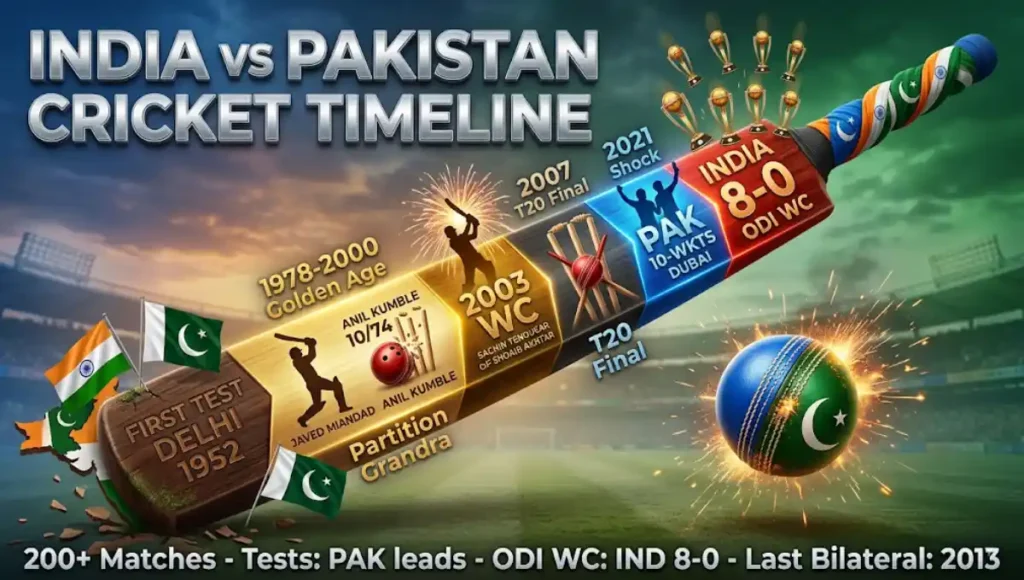

When Pakistan and India first played a Test match in October 1952 at Feroz Shah Kotla in Delhi, the players on both sides had been born in the same undivided country. The crowd was enormous. The tension was already national. And cricket became the only arena where both nations could meet without declaring war. That is the real origin of the Pakistan national cricket team vs India national cricket team timeline.
The Beginning: First Test Series, 1952
India hosted Pakistan for a five-match Test series in 1952. India won the first Test by an innings and 70 runs, Pakistan won the second by an innings and 43 runs, and India clinched the series.
What most people miss is this: Pakistan entered international cricket only in 1948, just one year after partition. They were a brand-new cricket nation, barely formed, playing against a more established India on Indian soil. Yet they pushed back hard. The competitive DNA was there from Day One.
The real insight here is format loyalty. The early rivalry was entirely Test cricket, slow, long, fought over five days. Neither side could afford to lose face. Every session had geopolitical weight.
The Political Hiatus: Wars and Silence (1962–1977)
If we talk about the Pakistan national cricket team vs India national cricket team timeline, between 1962 and 1978, India and Pakistan played virtually no cricket. The 1965 war, the 1971 war that created Bangladesh, and sustained political hostility made bilateral sport impossible. Fifteen years of silence.
What people think: cricket was paused because of mutual disinterest.
Reality: the cricket boards wanted to play. Governments said no. This is a pattern that would repeat itself decades later, and it reveals something critical: India Pakistan cricket has never truly been controlled by cricketers or boards alone.
1978-2000: The Golden Age of Bilateral Cricket
When the two sides finally resumed in 1978 with an ODI in Indore, the Pakistan national cricket team vs India national cricket team timeline started. The 1980s and 1990s produced the rivalry’s richest bilateral cricket, including full home-and-away Test and ODI series. The era’s defining moments:
- Javed Miandad’s last-ball six (1986): Off Chetan Sharma in the Australasia Cup Final in Sharjah. Pakistan needed 4 to win off the final ball. Miandad hit it over the boundary. The image of his raised bat is still used in Pakistani cricket broadcasts nearly 40 years later.
- Anil Kumble’s 10-wicket haul (1999): In the second Test at Delhi, Kumble became only the second bowler in Test history, after Jim Laker, to take all 10 wickets in a single innings, helping India win by 212 runs. The performance stands as one of the greatest individual bowling feats in all of cricket, not just this rivalry.
This era matters because bilateral series create legends. When you play multi-match series across formats, you generate narratives, personal rivalries between players, and a rhythm of contests. Neutral-venue tournament cricket, which is all fans get now, compresses that into single-match explosions.
Individual Moments That Changed Everything
Some moments in the Pakistan national cricket team vs India national cricket team timeline did not just decide a match. They changed what both teams believed about themselves.
2003 ODI World Cup: Sachin vs Shoaib
India faced Pakistan at Centurion. Shoaib Akhtar, the fastest bowler alive at the time, was bowling at over 150 km/h. Sachin Tendulkar smashed him for an upper-cut six over third man, a shot that did not exist in the coaching manual. He finished with 98 from 75 balls. India won comfortably.
The moment mattered not because India won, they were expected to win, but because Sachin chose to attack the fastest bowler in the world at the start of a World Cup knockout match. That was a psychological statement directed not just at Pakistan but at every other team in the tournament.
2007 T20 World Cup Final: The Bowl-Out
The match ended in a tie at the India vs Pakistan T20 World Cup Final. In the bowl-out that followed, Virender Sehwag, Robin Uthappa, and Harbhajan Singh hit the stumps. Shahid Afridi, Umar Gul, and Yasir Arafat all missed. India won the first-ever T20 World Cup.
The counterintuitive insight here is that this match is remembered as a thriller, but India’s actual victory came from a nerve drill, not batting or bowling skill. MS Dhoni, in his first major tournament as captain, had prepared his team for exactly this kind of pressure moment.
India’s World Cup Record: 8-0 and the Mental Fortress
Here is the stat that defines the Pakistan national cricket team vs India national cricket team timeline in the modern era: India has never lost to Pakistan in an ICC Men’s ODI World Cup. Eight matches. Eight wins. This is not a coincidence. And it is not pure talent.
Consider the structural reality: India’s World Cup record against Pakistan began in 1992 and has survived format changes, different captains, different eras of players, and shifts in Pakistan’s strength. From Sachin Tendulkar to Virat Kohli to Rohit Sharma, three different golden generations, the result stayed the same.
The psychological mechanism is straightforward but underappreciated: Pakistan’s preparation for India’s World Cup matches has, for decades, been contaminated by the weight of expectation. Pakistani fans, media, and players treat a World Cup India fixture as a must-win existential event. The pressure creates technical errors. India, having won consistently, approaches the same match with belief already banked.
The one moment that suggested this could change: the 2021 T20 World Cup in Dubai.
The 10-Wicket Shock That Rewrote the Script (2021)
October 24, 2021. Dubai. Pakistan beat India by 10 wickets in the T20 World Cup group stage. Babar Azam made an unbeaten 68. Mohammad Rizwan made 79 not out. India was bowled out for 151. This was not just a match result. It was a psychological rupture.
For the first time in a major ICC knockout or group-stage match, Pakistan had dominated India completely, not squeezed a win, not chased down a target nervously, but crushed them. Babar and Rizwan did not even need a third batter.
What this revealed about India: their dependence on top-order stability. When Rohit, KL Rahul, and Kohli failed collectively, there was no floor. The middle order had no experience absorbing a T20 World Cup collapse under that specific pressure.
What this meant for the rivalry: it was now genuinely two-sided again. That matters more than the single result.
The Invisible Wall: Why Bilateral Series Stopped After 2013
The last bilateral series between India and Pakistan took place in January 2013, when Pakistan toured India for ODIs and T20Is. Since then, for over 12 years, not a single bilateral match has been played. This is the biggest fact most cricket fans casually overlook.
Every India-Pakistan clash since 2013 has been in a neutral-venue ICC event. The Asia Cup in the UAE, the World Cup in Australia, the Champions Trophy in Pakistan, always a third country, always tournament cricket.
Why did the bilateral series stop? The answer is not cricketers or administrators. The answer is government-level political clearance that neither country has been willing to grant consistently, particularly after tensions over cross-border issues escalated sharply from 2016 onward. The BCCI and PCB cannot schedule a bilateral series without government approval. Neither government has provided it.
The losers are the fans. The financial losers are Pakistan cricket, which relies heavily on India’s matchday revenues for ICC events.
2022–2025: Only ICC Events, Maximum Drama
Since 2022, every India-Pakistan match has been a compressed, maximum-pressure, single-game event. The results:
- T20 World Cup 2022 (Melbourne): India won by 4 wickets in a dramatic chase, Virat Kohli scoring an unbeaten 82 off 53 balls
- Asia Cup 2023 (Super 4): India won by 228 runs, the largest margin of victory in ODI history between these two sides
- ODI World Cup 2023 (Ahmedabad): India won by 7 wickets, Pakistan bundled out for 191
- Champions Trophy 2025 (Dubai, Feb 23): India defeated Pakistan, restricting them to 241, then chasing it down
- T20 World Cup 2024 (New York): India won by 6 runs in a low-scoring thriller
- Asia Cup 2025 (Dubai, Sep 14): T20I match
The pattern in this period is stark: India has won every marquee ICC encounter since the 2021 T20 World Cup shock. Pakistan won that one, India recalibrated and won the next seven in a row.
What the Numbers Actually Tell You
People often cite head-to-head numbers without context. Here is what the actual data structure reveals:
| Format | India Wins | Pakistan Wins | Key Context |
| Tests (all-time) | 9 | 12 | Most played in 1950s-2000s bilateral era |
| ODIs (all-time) | 58 | 73 | Dominated by 1980s-2000s bilateral series era |
| T20Is (all-time) | 9 | 3 | Post-2007 era, mostly neutral venues |
| ODI World Cup | 8 | 0 | India is unbeaten in 8 matches |
Pakistan leads in Tests and ODIs overall because those numbers are built on decades of bilateral series cricket. India leads in ICC tournament cricket because that is all they play now, and India’s infrastructure for tournament pressure is currently superior.
The rivalry has effectively split into two different contests: the historical record, which Pakistan leads, and the modern reality, where India dominates every ICC event they share.
Frequently Asked Questions
How many times have India and Pakistan played cricket?
Over 200 combined matches across Tests, ODIs, and T20Is since 1952.
Has India ever lost to Pakistan in the ODI World Cup?
No. India’s record against Pakistan in the ICC Men’s ODI World Cup is 8-0, with wins dating back to 1992.
When did India and Pakistan last play a bilateral series?
In January 2013, when Pakistan toured India for ODIs and T20Is. No bilateral series has been held since.
When did Pakistan first beat India in a World Cup?
Pakistan beat India by 10 wickets in the T20 World Cup group stage on October 24, 2021, in Dubai, their first World Cup win over India in any format.
Why do India and Pakistan only play in ICC events now?
Bilateral series require government-level clearance from both countries, which has not been granted since 2013 due to sustained political tensions.
What is the most famous individual performance in India-Pakistan cricket?
Multiple contenders, Javed Miandad’s last-ball six in 1986, Sachin Tendulkar’s 98 against Shoaib in 2003, and Anil Kumble’s 10-wicket haul in 1999, are the three most cited.